Every team is already using AI.
The product owner. The designer. The developer.
And yet the work still breaks down at exactly the same places it always did.
https://t.co/FrdfHRwII6 is live. 🎉
A 3D asset library built specifically for @threejs: every model web-optimized, drop-in ready, cleanly licensed for commercial work.
Shipping 3 things at once today: the library, our first pack, and a free browser Studio (beta). 🧵
China has open-sourced a sandbox that:
→ boots in 60ms (docker takes 200ms)
→ uses 5MB of RAM per instance
→ runs thousands of AI agents on one machine
→ isolates every agent at the hardware level
→ drops into your E2B code by swapping one URL
It’s called CubeSandbox, a hardware-isolated sandbox for AI agents that cold-starts in under 60ms with just 5MB of memory overhead.
It's a drop-in E2B replacement. Swap one URL. Keep your code. Kill the bill.
no Docker. no shared kernel. no cold start tax.
100% open source.
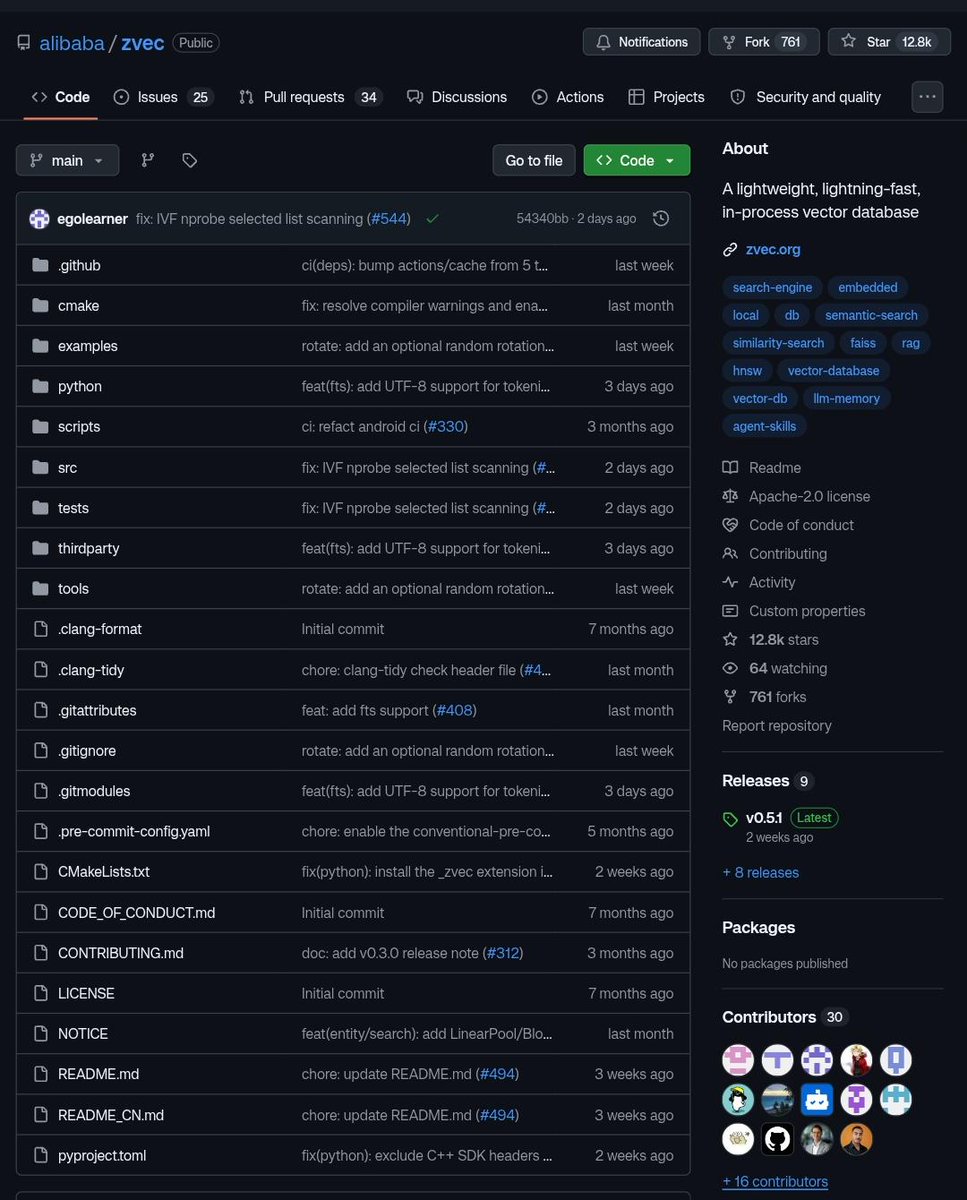
🚨 BREAKING: Alibaba just dropped a vector database that could change RAG forever.
Meet Zvec
✅ No server. No Docker. No cloud bills.
✅ pip install zvec and you're ready in under a minute.
✅ Dense + sparse + hybrid search in one API.
✅ Searches billions of vectors in milliseconds.
✅ 100% Open Source (Apache 2.0).
If you're building AI apps, this is worth checking out.
GIVEAWAY: I'm giving 10 people access to my favorite AI resources & tools.
To enter: Like & Repost + Comment "ZVEC"
Winners will be announced in 48 hours.
🔗 Link in the first comment.
Fable 5 was able to create 4 maps, 3 game modes, a tutorial, a multiplayer mode, several bots, and account-based saved progress in a single ordinary late-night session.
For a fast hobby project, the game turned out shockingly good. The audio was produced in ElevenLabs.
Cc: @wescld
One of my personal favorite features announced at WWDC will I suspect be a sleeper hit: container machines, allowing your Mac to run a lightweight, persistent Linux environment with your home directory and repos automatically mounted: https://t.co/dOBdfOOVxC
Be aware and:
- Never npm install / run unknown repos on your real machine
- Read code first: grep atob|eval|Function|child_process, check pre/post/prepare scripts
- Always use a VM or container to run something you are not sure about
Stay safe. RT to warn a dev.
Got targeted by a "coding assessment" that was actually MALWARE by a Job I've applied. If you're job-hunting as a dev, read this:
They send a repo, ask you to clone + run it. That's the whole attack — the "task" is getting YOU to run THEIR code.
The tells:
- They give you a finished repo to RUN (not build)
- Fake commits like "Fix bug in villa10.jpg" / "Add tests in a .ttf font"
- Random leftover crypto files in an unrelated app
- Generic template README
If you want to become good at AI engineering (in 3 weeks), then learn these 15 concepts:
1 AI Agents: Memory, State & Consistency
→ https://t.co/v8H7O00jub
2 Machine Learning System Design 101
→ https://t.co/9MkHcLb5e0
3 Design Personal AI Chat Assistant
→ https://t.co/nNWq3onTnW
4 How RAG Works
→ https://t.co/cGmunPTUlb
5 LLM Concepts - A Deep Dive
→ https://t.co/5lCKxq2g4N
6 How to Design an AI Agent
→ https://t.co/JvnPd9773A
7 What is Reinforcement Learning
→ https://t.co/AVpl9j1oit
8 How Vector Databases Work
→ https://t.co/FVxan8xHH3
9 Context Engineering 101
→ https://t.co/OMkiZhkODL
10 AI Coding Workflow 101
→ https://t.co/paIf9ksIU9
11 LLM Evals Explained
→ https://t.co/nv3Ol8W53p
12 How AI Agents Work
→ https://t.co/tk3zkCjRvg
13 How MCP Works
→ https://t.co/wgf8gHnnkn
14 Agentic Patterns Explained
→ https://t.co/8YdBBWvTj1
15 Multi-Agent Architecture Explained
→ https://t.co/rS5QQS7Jln
What else should make this list?
===
👋 PS - Want my System Design Playbook for FREE?
Join my newsletter with 210K+ software engineers right now:
→ https://t.co/ByOFTtOihX
===
💾 Save & RT to help others ace AI engineering.
👤 Follow @systemdesignone + turn on notifications.
One of my favorite superpowers of agents is building classifiers. It’s insanely high leverage.
Before AI, you needed a year-round team:
- 3 ML engineers to build the models
- 3 ML infra engineers to scale them up
- 2 software engineers to integrate the parts
- 1 data scientist to analyze it
- 1 PM to manage the product
- 0.5 EM to hold it together
Now, in minutes, you can have an agent generate a markdown file that classifies inputs, then let agents run continuously against it.
Below is a Sentry error classifier I generated at @FactoryAI. But you can build this for almost anything: customer-reported bugs, backend traffic analysis, fraudulent payment activity.
Personal use cases too: categorizing credit card transactions, labeling emails, or organizing documents.
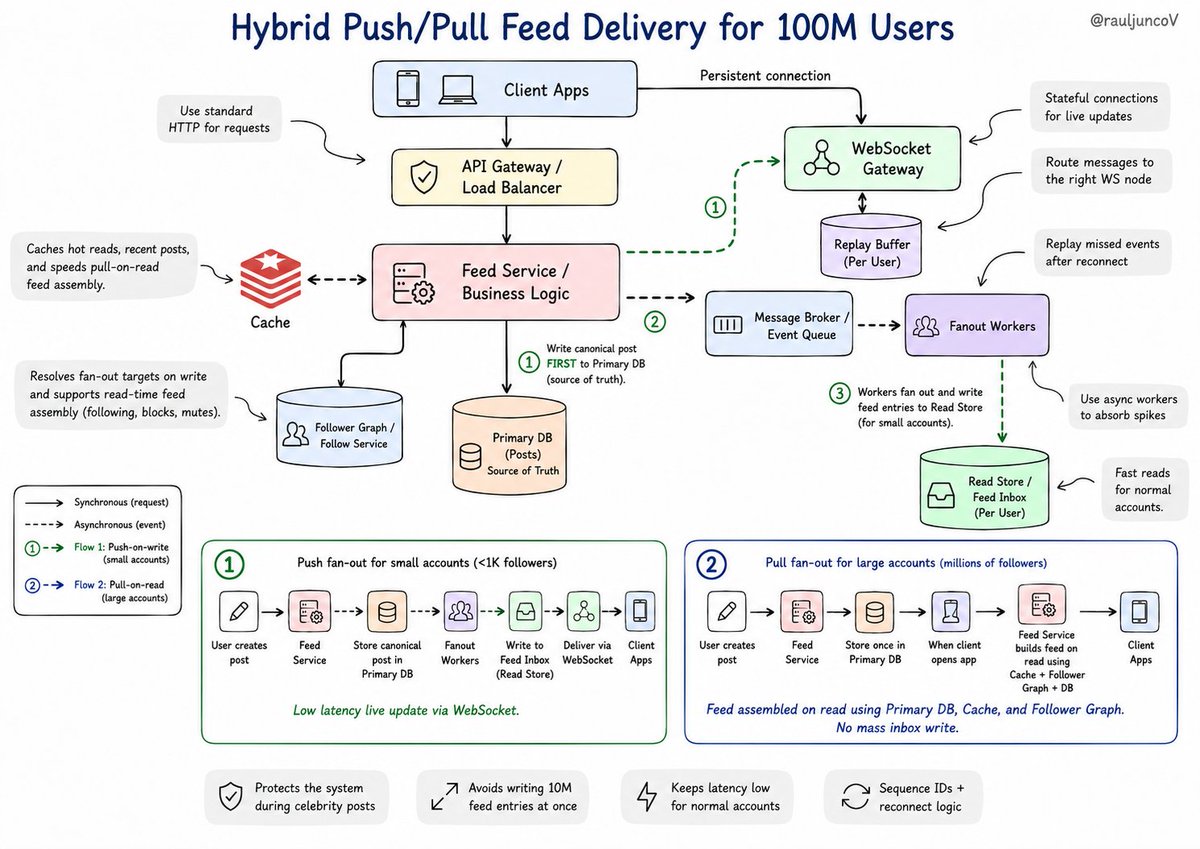
Push-based systems come up in 90% of system design interviews.
Here's the exercise you should be able to solve:
Design a notification system for 100M users. Some have 50 followers. Some have 10M.
The instinct is to hold a WebSocket connection open to every active user and push updates as they arrive. Clean mental model. It collapses the moment a celebrity posts.
When someone with 10M followers posts, you push to 10M open connections simultaneously. Your message broker saturates. Your WebSocket servers fall over. The system fails at the exact moment it needs to work.
That's the fan-out problem. And it kills more interview answers than any other mistake.
The production answer: push and pull aren't binary. You pick based on follower count. Users with fewer than 1,000 followers get push fan-out. Each follower gets notified immediately.
Users with millions of followers get pull fan-out. Their feed assembles on read. Nobody gets a push. Followers see the post when they open the app.
Twitter built exactly this: push-on-write for small accounts, pull-on-read for large ones.
But fan-out is only half the problem.
Push means stateful connections. Your servers now need to know which connection lives on which machine. You can't route blindly. Most teams reach for Redis pub/sub here; the WebSocket server subscribes, the backend publishes, the message finds the right node.
Add a 3-second network drop and you have another layer: what did the client miss? Now you need sequence IDs, a message buffer, and reconnect logic that replays missed events.
"Push-based" became push with a pull fallback, a message broker, sticky routing, and a replay buffer.
Most engineers stop at the first diagram.
The ones who get the offer keep pulling the thread until the system breaks.
Ask Claude to map your entire app's architecture into a single HTML page and JSON file.
The HTML is for you. The JSON is for the next agent working on a new feature.
Your codebase now explains itself.