🧵 In the forthcoming issue of @ForeignAffairs, I argue that the time has come to build a collective defense alliance in Asia—the Pacific Defense Pact—initially comprising Australia, Japan, the Philippines, and the United States.
New from @MiraRappHooper and me in @nytopinion: President Trump has gambled that accommodating China’s ambitions in Asia would bring restraint from Beijing. It’s backfiring, and the new Congress has a chance to change course. https://t.co/vtUkLi2TBH
American policymakers have “too often failed to press on China’s pain points or even develop options for doing so.” Read @elyratner and Nick Danby on why Washington must “be ready to go on offense.”
https://t.co/IRtfP2qV8e
American policymakers have “too often failed to press on China’s pain points or even develop options for doing so.” Read @elyratner and Nick Danby on why Washington must “be ready to go on offense.”
https://t.co/IRtfP2qV8e
“China’s success in cornering the Trump administration was not simply a result of the United States’ failure to secure its supply chains,” write @elyratner and Nick Danby. “It reflected a profound failure of U.S. strategy.”
https://t.co/IRtfP2qV8e
China “has been a clever practitioner of finding the gaps and seams in American power,” write @elyratner and Nick Danby. By contrast, American policymakers have “too often failed to press on China’s pain points or even develop options for doing so.
https://t.co/IRtfP2qV8e
The Indo-Pacific is now, more than ever, a vital theater of competition—one in which U.S. allies could play a decisive role in deterring regional adversaries.
@elyratner, @DavidFeith, @AmbVMKwatra, and @LisaCurtisDC will join @AsiaLens at the CNAS 2026 National Security Conference for a panel on burden sharing and cooperation in the region.
American policymakers have “too often failed to press on China’s pain points or even develop options for doing so.” Read @elyratner and Nick Danby on why Washington must “be ready to go on offense.”
https://t.co/IRtfP2qV8e
NEW in the July/August issue of @ForeignAffairs: For decades, U.S. strategy has failed to build competitive leverage over China. Nick Danby and I lay out how to change that, from chips and trade to the dollar and energy. https://t.co/A4f13Vd9HW
On Hegseth’s soft-pedaling of China, in @nytimes:
“Trump’s accommodation of China may yield more military engagement in the near term, but it will also invite greater PLA coercion against U.S. allies. That’s not a recipe for strategic stability.”
https://t.co/AalEt2Z21G
My contribution:
— China is a lower priority in Trump’s 2nd term; views inside more mixed.
— “All of this comes together to create this softer policy we see now, philosophically this group appears geared toward a more accommodationist approach to China.”https://t.co/uPmxJgRK5a
President Trump is in Beijing for a state visit to America’s chief global competitor, and increasingly, its chief geopolitical rival.
Trump has long targeted China as an economic foe of the U.S. while cultivating a relationship with President Xi Jinping.
@nickschifrin reports.
Really enjoyed this discussion with Mark Wu during a recent visit to the @FairbankCenter on U.S. defense strategy in the Indo-Pacific. https://t.co/4vf5XKtjEJ
The Trump administration is pursuing a policy of accommodation toward China that will leave the U.S. with “less leverage, fewer partners and wider gaps to close.”
My latest in @FT: https://t.co/eH6l6dTbI8
Thank you @elyratner for the vote of confidence in #Taiwan. We’ll do all we can to acquire the right arms & transform our military for effective deterrence. Still more to be done. Timely passage of the special budget by the LY is crucial.
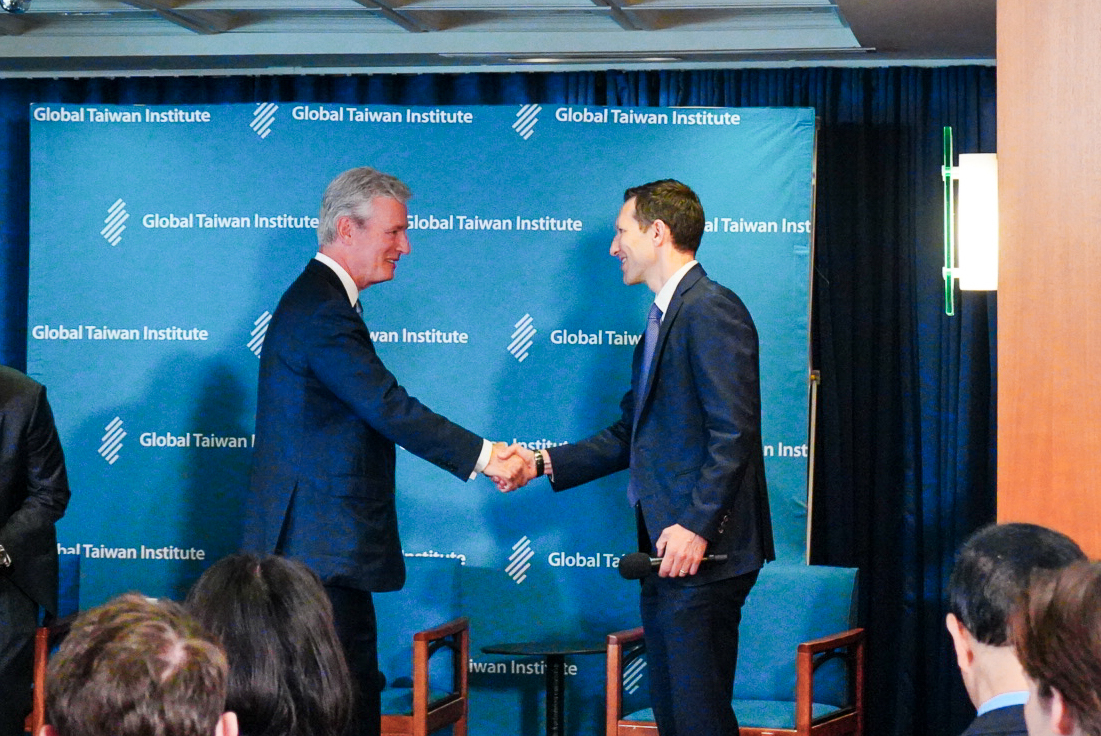
@elyratner, Vice-Chair of #GTI's US-Taiwan Task Force, argues that after serious reform, #Taiwan is able to play a critical role in #deterrence against future crises.
Watch the entire US-Taiwan Task Force Launch event: https://t.co/8MaatHfU6R
#USTaiwan
Enjoyed this conversation on how U.S. businesses should be thinking about the geopolitics of Asia. It capped a great day of discussions with faculty and students @HarvardRajawali and @Kennedy_School.
@elyratner joins the Rajawali Foundation to examine U.S. strategy in the Indo-Pacific, highlighting key geopolitical risks, private sector implications, and the region’s strategic and economic importance.
https://t.co/f8qUcKk8ZM
Honored to lead this bipartisan U.S.-Taiwan Task Force with Ambassador @robertcobrien — an exceptional group of former officials and experts committed to strengthening U.S.-Taiwan relations. Full details: https://t.co/hExCzzo7k6
#GTI today announced the members of its #US#Taiwan Task Force, a #bipartisan coalition of national security experts from #Washington and #Taipei, chaired by Amb. O'Brien, and vice-chaired by Dr. Ratner. @elyratner@joshrogin
Press release: https://t.co/jax7qW54o3
@Mike_Cherney@Heritage@elyratner “While this may not lead to major contributions to a regional conflict, Wellington still has huge contributions to make in curbing China’s malign influence in the Pacific islands,” Ratner said.
https://t.co/1zwBOaBXl3
Washington can't let this period of geopolitical flux put cross-Strait deterrence at risk.
In a new piece for @NikkeiAsia, my former Pentagon colleague Lauren Dickey and I lay out concrete steps Congress can take to help strengthen Taiwan's self-defense capabilities.