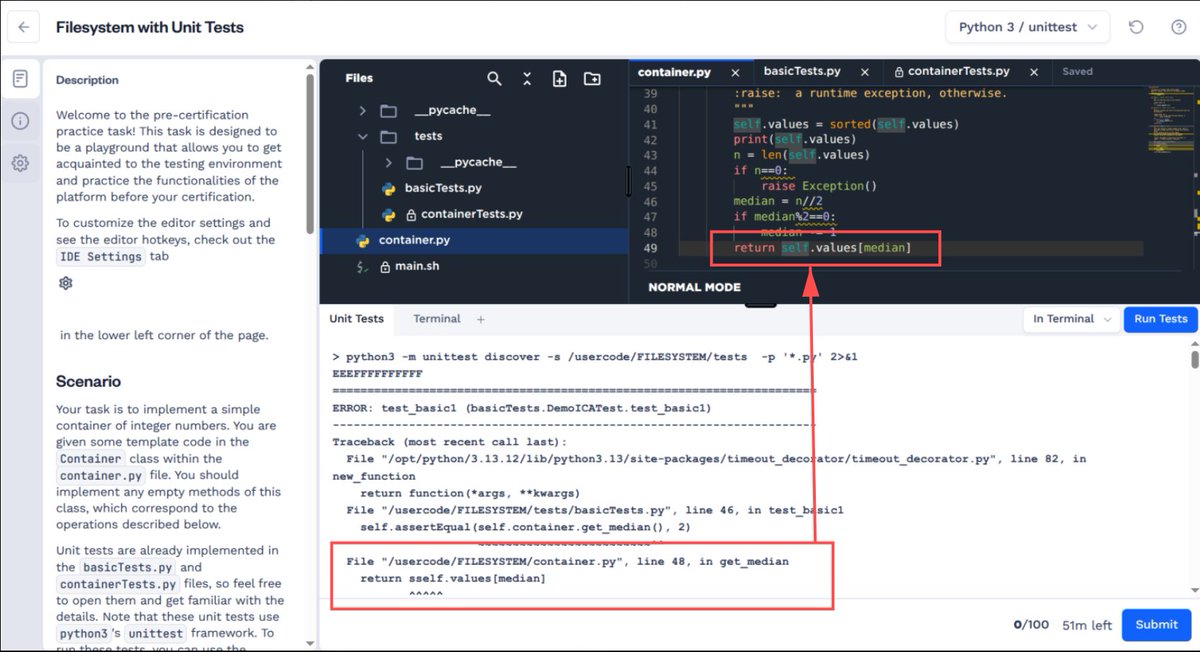
@CodeSignalCom It's not only VIM mode. I encountered again a similar problem, where the source code displayed in the editor is not in-sync with that being run in the tests, and the only way to solve the issue is to reload the page (which resets the timer!)
@rizbicki I've been working on something similar but using open models:
https://t.co/RKWvGzFkU4
Several authors confirmed the finding, while others flagged a false positive (stats in the readme). We will probably prepare a detailed report. This can obviously be scaled with better models.
Sadly, French research institutes do not allow us to use research funding to pay for US-based AI services. I have desperately tried to explain that much of CS research does not involve sensitive data, without success... 😔
Nowadays, doing a PhD only makes sense if your advisor is happy to support at least one 20x plan (and maybe a 100x one someday).
Luckily, that’s actually true in our lab. It’s basically a requirement now lol.
Really, really grateful to both @zicokolter and Kaiming for pushing for this ages ago — and especially to Zico for actually footing the bill. ❤️
Always stunning to see how much the quality of NeurIPS reviews depends on the subcommunity a paper is sent to. But the worst fate is for papers that do not clearly belong to any community: they end up torn apart in a no-man’s-land of confident misunderstanding and bitterness.
I wrote an agent skill for using Grid'5000 with LLM coding assistants.
Grid'5000 uses the OAR scheduler, which these tools rarely know well. The skill is a single Markdown document capturing the correct commands and conventions.
https://t.co/iSZTp76khX
The first Jean Zay (IDRIS) skill to use France's national supercomputer with AI coding agents, packaged so your agent knows everything it needs 👇
https://t.co/DaG9kfDC3c
cc @Genci_fr
An open-source AI that reads published mathematics for mistakes.
We ran it over 300+ graph-theory papers and had it adversarially double-check its own findings. Several authors have already told us the feedback was
genuinely useful!
🔗 https://t.co/EGOfIofU1g
My institute uses @Zimbra, for which none of the major LLM providers offer a connector. So I built zmail: a zero-dependency CLI + skill.md that lets any AI agent read, search &
draft email in a Zimbra mailbox over IMAP. 👇
https://t.co/f0BSjOw2md
I wanted a dead-simple way to spin up a throwaway Linux VM to run untrusted code in.
mkvm: one command → a booted Ubuntu 24.04 VM, SSH key already in it. One Bash script, no config, runs from curl. MIT.
https://t.co/L3wYQVrkz3
I have my own theory here: many mathematicians have started using top-tier models and agentic systems. The effect is that they are finishing up very old projects that were left untouched for years. They realized that they had all the required ideas and tools but did not have a person to wrap things up. I think this "vacuum cleaner effect" will last for the next few years and will end up with a complete stall in most areas of mathematics. What will remain are very hard questions, and possibly some new ones. But once a question is within reach of the agent, it will get published almost automatically. People will remember this period of civilization as the "great purge of ideas". The outcome will be a vast intellectual startup where everyone is at ground zero, and the occasional genius will pop up to scale their ideas and drain it again until the thread dies.
We believe every mathematical breakthrough should be automatically verified in Lean.
That means formalizing all of mathematics—and this will require us to run agents at an extremely large scale, perhaps burning through billions of tokens. We hope that Leanstral can be the foundation to get there.
Congrats to @nowathom for his https://t.co/MPcXBbsaHi. I was thinking about something similar, a "Lean coverage" badge analogous to the concept of code coverage in software engineering.
I always had an engineer’s soul. As a kid I’d tear open electrical toys to rebuild them. I became a scientist, but hated theorists joking about engineers.
Engineering built the AIs now outperforming most of us at short-horizon theory. Victory for the builders.⚙️
@arcprize@GregKamradt@GregKamradt thanks for the private clarification. The paper associated with the submission (https://t.co/SQZIlknnFv) claimed a 30% score, which misled me. There should then be no environment leak.
@arcprize@GregKamradt I think ARC-AGI-3 has an environment leak: https://t.co/ntEGcLEQfi imports /environment_files/.../<game>.py, runs a BFS on a private copy of the game, then replays the winning actions. That isn't action-efficient game understanding.