instead of watching 2 hours of Netflix tonight, watch this 40-minute masterclass from the founder of a $20B China AI company
it's the clearest explanation I've seen of how Agent Swarms and AI systems actually work at scale
useful whether you've never built an agent in your life or have been using Claude every day for the past year
I took the key ideas and turned them into a practical guide on how to actually build with Kimi
find it below
In 2000, Palm was worth more than Apple, Amazon, Google, and Nvidia. Combined!!
Their story is one of the wildest stories in the history of tech.
Palm, Inc. was an American company that pioneered the personal digital assistant (PDA) market with the iconic PalmPilot in the 1990s.
This groundbreaking PDA was compact, easy to use, and offered features like a calendar, address book, and memo pad, instantly becoming a must-have for professionals and tech enthusiasts.
The company also developed its own operating system, Palm OS, known for its intuitive interface and efficient use of memory. This attracted numerous device manufacturers who licensed Palm OS for their own PDAs, further expanding Palm's reach.
And the reach was massive.
By 2000, Palm was at the peak of its success. The PalmPilot series had sold over 30 million units, and the company's market capitalization soared to $58 billion, surpassing Apple, Amazon, Google, and Nvidia combined. Palm seemed poised to lead the mobile revolution.
Yet, it failed miserably.
As smartphones with touchscreens and internet access began to emerge, Palm struggled to keep up. The company's reliance on physical buttons and its slowness to embrace new technologies led to a decline in market share.
By the mid-2000s, Palm's revenue and stock price plummeted. Despite attempts to regain market share with devices like the Treo and Centro smartphones, the company was unable to compete with the likes of Apple and Blackberry.
In 2009, Palm was acquired by Hewlett-Packard for $1.2 billion. HP's efforts to revive the Palm brand were unsuccessful, and the company was eventually discontinued in 2010.
The crazy part? Palm co-founder Donna Dubinsky famously said this in 2000: "Five years from now, Apple will be selling fruit."
This proved to be wildly inaccurate, as after 7 years, Apple introduced the iPhone which revolutionized the mobile industry forever.
Palm teaches us all a valuable lesson: today's tech titan could be tomorrow's trivia answer.
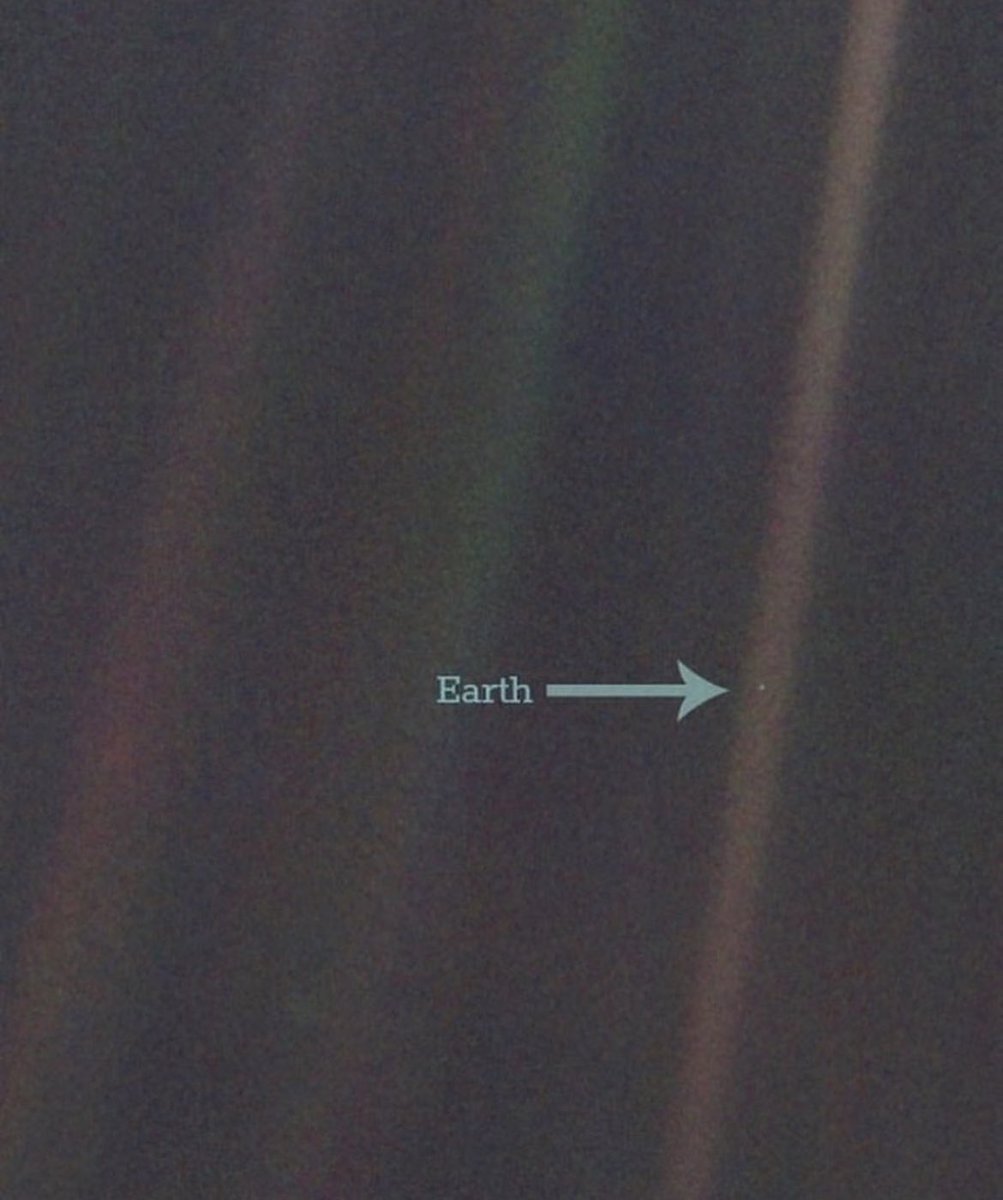
Pale Blue Dot is a photo of Earth that was taken by the Voyager 1 space probe in 1990 from a distance of about 6 billion kilometers (3.7 billion miles) as it was leaving our solar system. This is what Carl Sagan said about the photo:
"Look again at that dot. That's here. That's home. That's us. On it, everyone you love, everyone you know, everyone you ever heard of, every human being who ever was, lived out their lives. The aggregate of our joy and suffering, thousands of confident religions, ideologies, and economic doctrines, every hunter and forager, every hero and coward, every creator and destroyer of civilization, every king and peasant, every young couple in love, every mother and father, hopeful child, inventor, and explorer, every teacher of morals, every corrupt politician, every 'superstar,' every 'supreme leader,' every saint and sinner in the history of our species lived there — on a mote of dust suspended in a sunbeam.
The Earth is the only world known so far to harbor life. There is nowhere else, at least in the near future, to which our species could migrate. Visit, yes. Settle, not yet. Like it or not, for the moment the Earth is where we make our stand. It has been said that astronomy is a humbling and character-building experience. There is perhaps no better demonstration of the folly of human conceits than this distant image of our tiny world. To me, it underscores our responsibility to deal more kindly with one another, and to preserve and cherish the pale blue dot, the only home we've ever known.”
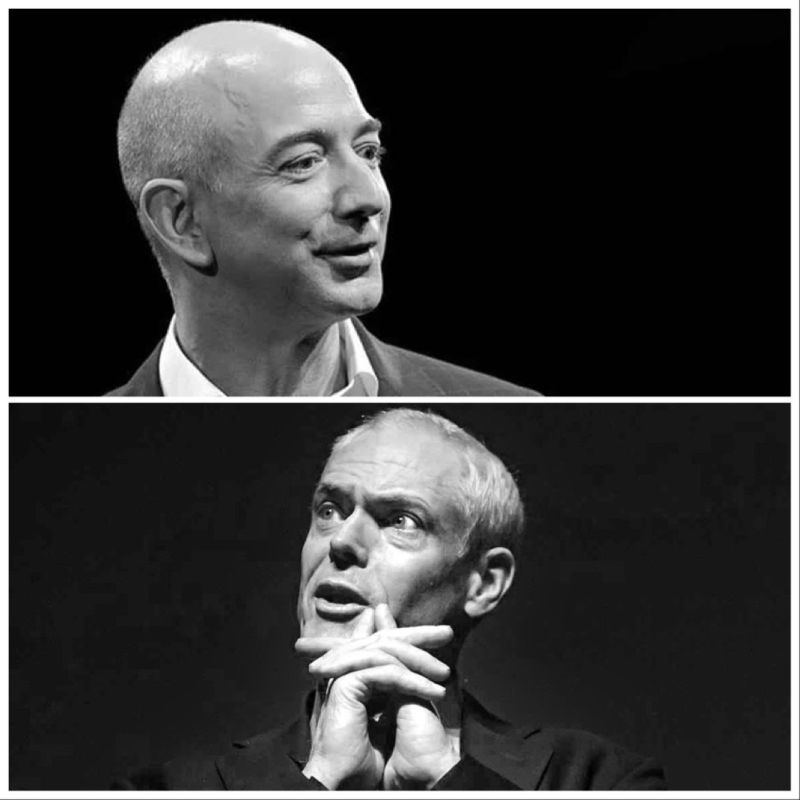
In 2001, Amazon’s stock fell 90%. In a hail-mary attempt, Bezos invited a book author to Amazon. Together, they created the foundation for trillions in market cap:
The author was Jim Collins, who published Built to Last in 1994. By 2001, Bezos had already adapted several of its concepts into Amazon’s principles:
· Tyranny Of Or → Avoid 1-Way Doors
· Homegrown Leadership → Hire & Develop the Best
· Good Enough Never Is → Insist on the Highest Standards
So, Bezos was intrigued when Jim said, in front of the whole executive team:
"In times like this you want to respond not by reacting to bad news, but by building a flywheel."
Collins had in mind the 5,000 lb old-style flywheels. They took hours to turn at first. But at some point, WHOOSH! Their own momentum kept them going.
Collins had quite a bit of reason to believe in his statement. He had commissioned a large team of Harvard MBA researchers for his new book, Good to Great. They compared companies that had delivered sustainable, S&P 500-beating results to mediocre companies that had flailed.
What the team found is the great companies were spinning flywheels. It wasn’t the first, fifth, or one-hundredth rotation that got them spinning. It was their concentrated effort that led to the breakthrough momentum.
On the other hand, mediocre companies were constantly launching new initiatives. Instead of achieving breakthrough momentum on one flywheel, they tried to create many. But each never achieved breakthrough velocity. They had to keep manually cranking them.
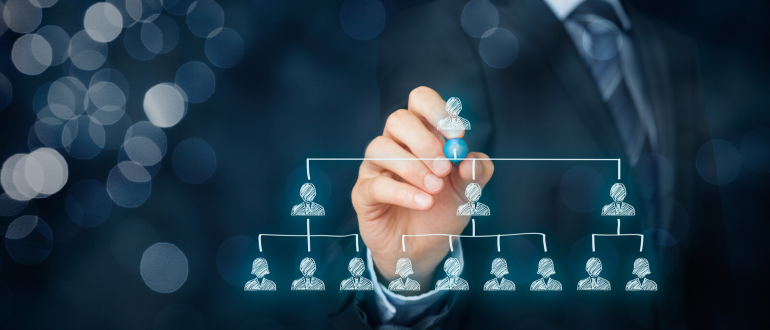
Given the insight, Bezos and Collins began sketching out Amazon’s e-commerce flywheel. They identified that Amazon could generate self-reinforcing momentum in 2 ways:
1. Lower cost structure leading to lower prices leading to more scale and back to lower costs.
2. Greater selection leading to customer experience leading to traffic leading to more sellers and back to greater selection.
These two elements have been the backbone of Amazon’s e-commerce business for the 20+ years since the pair initially founded them.
To this date, the flywheel continues to extract market share for Amazon. Last year, Amazon reached a tremendous 57% of total US e-commerce sales. At $514B in revenue, it has left the competition - like Walmart - in the dust.
So, what can we learn from Amazon’s e-commerce flywheel? As product and business people, we are tempted to start new flywheels constantly. But, it usually pays to focus on spinning our main one with self-reinforcing momentum faster.
Sketch out your flywheel, and go get it.
The 10 Biggest things that happened in AI in March:
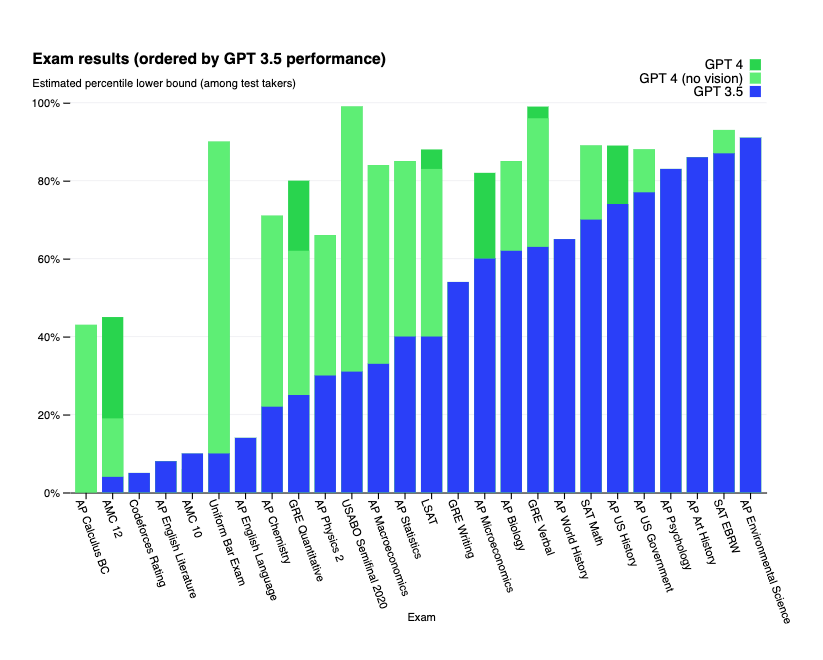
1. GPT-4 was released ― and it shook the world.
It can:
• Understand images
• Handle 25,000 words in one go
• Ace the bar exam with a top 10% score
• Shows advanced reasoning capabilities
Weekly Recap
1) 🇸🇦 Saudi Arabia enters trade alliance with China, Russia, India, Pakistan, and four Central Asian nations to step further away from reliance on the US dollar.
2) 🇨🇳 China and France complete first LNG gas trade using Chinese Yuan, ending reliance on the US dollar for energy trades.
3) 🇨🇳 China and Brazil to settle trades in their own currencies, ditching the US dollar.
4) Brazil, Russia, India, China, and South Africa (BRICS) are developing a new currency, State Duma Deputy Chairman says.
5) 🇸🇦 Saudi Arabia partners with China to build a Chinese oil refinery for 83.7 billion yuan ($12.2 billion).
6) 🇰🇪 Kenya signs deal with Saudi Arabia and UAE to buy oil with Kenyan shillings instead of US dollars.
7) 🇰🇪 President of Kenya tells citizens to get rid of US dollars.
8) Association of Southeast Asian Nations considers dropping the US dollar, euro, yen, and British pound for local currency financial settlements.
9) 🇸�� El Salvador President officially signs bill eliminating all taxes on income, property, and capital gains for technology innovations.
10) 🇺🇸 US Senator Elizabeth Warren launches "anti-crypto" re-election campaign.
11) 🇮🇳 India to settle trade in Indian rupees with certain countries instead of US dollars, Commerce Secretary says.
12) 🇨🇳 Chinese yuan surpasses the euro to become Brazil's second-largest currency in foreign reserves.
13) 🇺🇸 US government to sell 41,500 #Bitcoin ($1.18 billion) connected to Silk Road, in four batches this year.
14) 🇭🇰 Hong Kong regulators to assist #crypto firms with banking in effort to become a digital asset hub.
15) #Binance and CEO sued by US CFTC over alleged regulatory violations
16) 🇺🇸 US Social Security funds are projected to run out by 2033, Reuters reports.
17) 🇫🇷 5 major banks raided by French authorities in €100 billion fraud investigation
18) 🇺🇸 Former President Trump says President Biden is directly responsible for the bank failures and creating an economic catastrophe that will only get worse.
19) MicroStrategy purchases an additional 6,455 #Bitcoin ($150 million).
20) 🇺🇸 President Biden says the banking crisis is "not over yet."







![heyshrutimishra's tweet photo. 50 AI Tools to Finish Hours of Work in Minutes:
1. Ideas
• Claude AI
• ChatGPT 4
• Bing Chat
• Perplexity
• Better research
2. Images
• Midjourney
• Bing Create
• Leap AI
• Astira AI
• Stable Diffusion
3. Notes
• Fireflies
• Laxis
• Otter
• Notion AI
• Evernote
4. Video
• Runway
• Pika Labs
• Eightify
• InVideo
• Morphstudio xyz
5. Transcript
• Podium AI
• Auris AI
• Rev
• Otter
• Sonix
6. Speech-to-text
• Trint AI
• Audiopen
• Descript
• Otter
• Rev
7. Shorts
• Opusclip
• 2Short AI
• CapCut
• Vidoomy
• Lumen5
8. Design
• Canva
• Microsoft Designer
• Flair AI
• Clipdrop
• Fotor
9. Writer
• ChatGPT 4
• Writesonic
• Jasper
• Copy ai
• Longshot AI
10. Avatar
• Synthesia
• Fotor
• Ready Player Me
• Zepeto
• Vroid Studio
[Bookmark for later]](https://pbs.twimg.com/media/GY8gZhGawAAo6GP.jpg)