Easy SEO hack.
Go to Google Search Console.
Go to Performance, Search results.
Add filter.
Click Query.
Change to Custom (regex).
Take this: ^(?:\S+\s+){7,}\S+$
Paste it in.
Click Apply.
“These are long, specific questions people Google before they find you. It’s the same kind of questions they ask ChatGPT.
Pick ones with high impressions and low clicks.
Answer them at the top of your page that already ranks.”
From @askOkara
So if you click on one of these keywords, it shows you the pages that are ranking for the keyword. All you do is you go to your page and add in your desired keyword at the top.
Then you rank for more high volume keywords.
And you can get more amazing Google Search Console filters by clicking on the blue button within GSC. It’s an AI chat that makes your filters with natural language.
open your competitor's homepage. right click. view page source. ctrl+f "GTM-"
that's their google tag manager ID. copy it
now paste this into your browser: googletagmanager. com/gtm.js?id= and add their ID on the end
a wall of code opens. it's public. it has to be, every visitor's browser downloads it. it's the file that runs their entire tracking setup
now ctrl+f "AW-"
every google ads conversion they track. if tere are 6 of them, they're optimising for 6 different things. most teams can't even tell you which one matters
now ctrl+f "event"
their conversion names, typed by their own marketers. "demo_booked." "trial_started." "sql_qualified." you're reading their funnel in the order they built it
now ctrl+f "value"
sometimes a number sits right next to the conversion. 250. 800. 1500. that's what a demo is worth to them. they typed their unit economics into a public file
now combine all four:
-the GTM ID gets you into the container
-AW- tells you how many things google is chasing for them
-the event names give you their funnel
-the values give you what each step is worth
their tracking, their funnel and their numbers. from one file they can't hide. every head of growth reading this just opened their own container
now take their demo value. if they pay $800 for a demo and you know yours is worth $2,000, you can outbid them on every keyword you both want and still win
(9 years inside google. tracking is the first thing we open on every audit → link in bio)
LINKEDIN MAXXING with Grokbot
50 tactics behind 3.24M impressions in the last 90 days
Ranked:
S TIER
1. Build a voice guide that makes every draft more specific to you.
2. Feed it your strongest posts, interviews and transcripts to capture how you actually explain things.
3. Extract your opinions, recurring phrases and examples to give drafts a recognizable perspective.
4. Add rejected phrases and approved edits to stop correcting the same mistakes.
5. Build a separate guide for each executive so your CEO and CRO don’t become the same writer.
6. Turn sales conversations into your content strategy.
7. Review call transcripts to find questions prospects ask before they understand your offer.
8. Group objections by frequency and deal stage to identify which explanations are missing.
9. Preserve buyers’ exact wording to write about the problem as they experience it.
10. Match each topic with a real example or result to give the post supporting evidence.
11. Build an outreach research desk.
12. Supply your target-account list and qualification criteria to give the bot a defined research job.
13. Review company websites, announcements and supplied profile information to check account fit.
14. Find relevant triggers such as a product launch or leadership change to establish why now.
15. Match verified account details with a relevant case study to prepare a specific outreach draft.
16. Use content to support deals already in your pipeline.
17. Review stalled-deal notes to identify concerns prospects explicitly raised.
18. Draft posts addressing recurring objections without exposing confidential deal details.
19. Match approved resources with the questions they answer to help sales prepare useful follow-ups.
20. Draft a follow-up connecting the resource to the actual conversation for the account owner to review.
A TIER
21. Find content patterns worth testing.
22. Supply a swipe file of relevant posts with dates and available performance data.
23. Compare each post with its author’s typical results to find meaningful outliers.
24. Break winners into topic, opening, argument, evidence and format to understand their construction.
25. Rebuild useful structures with your own experience instead of borrowing someone else’s story.
26. Turn market conversations into LinkedIn commentary.
27. Track relevant X discussions and original announcements to find developments your buyers should understand.
28. Check competing interpretations to avoid repeating the loudest take as established fact.
29. Add your own experience or customer evidence to explain where you agree or disagree.
30. Draft the LinkedIn version around a practical business implication rather than a recycled summary.
B TIER
31. Prepare better conversations with people showing interest.
32. Supply relevant comments and inbound messages to identify the question behind each interaction.
33. Distinguish explicit interest from casual engagement to avoid treating every like as buying intent.
34. Check CRM notes to avoid duplicate outreach and draft a useful response for human review.
35. Prepare a meeting brief from the conversation history when someone actually wants to talk.
36. Extract more value from expertise you have already recorded.
37. Review podcasts, webinars and interviews to find moments that support a standalone argument.
38. Pull exact quotations and timestamps to keep every source easy to check.
39. Ask focused follow-up questions when an example needs more detail or supporting evidence.
40. Turn approved material into a text post, visual brief or short video outline.
C TIER
41. Build resources that give outreach a useful purpose.
42. Find a repeated buyer task to choose a checklist, worksheet or calculator worth creating.
43. Ask Grok Bot to prepare the resource from your approved process and test it against realistic examples.
44. Write a demonstration post showing the resource solving a specific problem.
45. Draft a relevant reply offering the resource when someone asks about that problem.
D TIER
46. Build the review and reporting loop.
47. Check drafts against your voice guide and sources to catch unsupported claims and repetitive writing.
48. Combine analytics, inquiry records and CRM notes to identify relevant business conversations.
49. Separate tracked conversions from possible influence to keep attribution honest.
50. Turn recurring edits into better instructions and choose one experiment for the next month.
The article below has the 12 copy-and-paste prompts behind the core system, the business context to load first, and the order to build it in.
As someone who has personally spent $500k / mo+ on Google Ads for years, I can tell you with certainty:
This revenue growth in Search is artificial & extremely unhealthy for Google’s business long term
Search volumes are declining as legacy search is being increasingly cannibalized by non-monetized LLM queries
Google’s response?
Manufacture revenue growth via short-sighted, highly extractive, customer-hostile tactics. I.e. charge advertisers more for lower quality clicks, including clicks they do not want and explicitly did not approve Google to charge them for
A few examples to illustrate:
For all of its history until recently, Google operated on a 2nd price auction model
I.e. if you bid $5 CPC and the next highest bidder bids $1 CPC, Google charged you $1.01 for the click (one penny more than the 2nd highest bidder) rather than the $5 you bid
This was a genius move by Google early on as it incentivizes advertisers to input their true maximum willingness to pay rather than trying to play the game of bidding low and constantly adjusting to try to stay just ahead of the next highest bidder while still not paying too much
However recently, Google silently deprecated the 2nd price auction and began charging advertisers as much as their bid and budget caps allow, regardless of what anyone else is bidding
It’s a short-sighted cash grab at the expense of the long term health of the advertiser ecosystem
Making thing worse, Google also recently nerfed keyword targeting precision
Google previously had precise keyword targeting settings that allowed advertisers pick individual search phrases to bid on, defined down to the character w/ exact match or phrase match targeting
This was one of the core features that made search advertising magic, enabling advertisers to run extremely precise campaigns based on exactly what their target customer typed
But now, even if you bid on a specific term or phrase using the strictest exact
-match targeting settings, Google will show your ad across 1000’s of unrelated keywords, labeling them as as “exact match (close variant)”
The definition of “close variant” means whatever they want it to and changes constantly. The result is advertisers get billed for clicks that are totally irrelevant to their business and that their targeting settings explicitly forbid Google from targeting. Google does it anyway and there’s no ability to turn this off
So now exact match is broad match, and broad match is just meaningless spam
This is all very bad for advertisers, but for Google, it allows them to show your ad and bill you for clicks across 1000x more searches that were previously going unmonetized (mainly because they’re garbage queries no one wants)
This is how you grow revenue atop declining search volumes
Lastly, and perhaps most egregiously, Google quietly stopped respecting budget caps by a factor of 2x. For example campaigns we’ve been running for years with $1000 daily budget caps suddenly began spending $2000+ per day
And the extra spend is entirely on the garbage keywords Google arbitrarily throws in as “exact match (close variants)” which have no value to our business, but can’t be turned off
Google offers no refunds nor any recourse for overspend or spend on keywords you explicitly did not target
These are not the actions of a healthy business. These are the actions of company whose core business is in decline but desperately needs to pump quarterly earnings so Wall Street will continue to fund insane capex while hopefully looking through their rapidly deteriorating negative free cash flow
Google operated a benevolent monopoly for the better part of 25 yrs
Meaning the value Google captured from Search was but a small fraction of the value it created, and that spread produced a potential energy that justified expectations of high earnings growth far, far into the future
This is now no longer the case
At the alter of AI capex, Google is sacrificing the golden goose
Hey @VirginAustralia, flying Business BNE-DOH (VA15, Qatar operated) and DOH-ARN (QR167) on separate tickets. Can bags be checked through to ARN at BNE, or must I collect and recheck in DOH? Getting conflicting advice. Can you confirm?
If you use Grok Bot every day, I’d run this audit once a month.
It finds all the places where YOU are still the bottleneck.
Copy this prompt into your Chief of Staff to find where Grok Bot could be doing more without you:
HUMAN-DEPENDENCY AUDIT
Review how we’ve worked together over the last 30 days.
Find every place where work unnecessarily stopped, slowed down or came back to me before it could continue.
Look specifically for:
1 - Jobs you could have started without me prompting you
2 - Decisions you repeatedly waited for me to make
3 - Information you repeatedly asked me for that could have been stored
4 - Approvals I keep giving the same answer to
5 - Work I manually transfer between agents
6 - Repetitive checks that could become routines or triggers
7 - Outputs I manually distribute that you could deliver yourself
8 - Work where I review everything but could potentially review exceptions only
For every dependency you find, classify it:
KEEP ME IN - My judgment genuinely matters.
TEACH - You need more knowledge or clearer instructions.
SYSTEMISE - The information or process needs to live somewhere permanent.
AUTOMATE - You could probably handle this without me.
ESCALATE ONLY - Handle normal cases yourself and bring me the exceptions.
Don’t change anything yet.
Show me the biggest dependencies first and explain what would need to change to safely remove each one.
Then we’ll go through them one at a time.
The goal isn’t to remove yourself from everything your Grok Bot does.
It’s to make sure you’re only involved where you actually add value.
9 cool GPT 6 Astra prompts worth trying:
1. The bill renegotiator.
"Go through my internet, phone, and software bills, jump into each provider's chat support, and negotiate them down or cancel what I'm not using."
2. Turn an agency into software.
“Pick one service business in [niche] and reverse-engineer the exact workflow they sell to clients. Break it into steps, tools used, inputs, outputs, human judgment points, and places where the work gets slow or expensive. Then design the simplest AI product that could replace the first version of that service and charge $500-$5,000/month.”
3. Garage sale flipper.
"Watch Facebook Marketplace and Craigslist in my city for [cameras / furniture / bikes] listed way under market, and text me the second one's mispriced with the link."
4. Create my 1 person company dashboard.
“Look at my docs, notes, Stripe exports, analytics, customer calls, and project list, then build a weekly operator dashboard. I want to know what is making money, what is wasting time, what customers are asking for, what I should stop doing, and the three highest-leverage actions for next week. Be blunt and show your work.”
5. Audit my company for agent opportunities.
“Look at how this business works and find the tasks we should give to agents before hiring another person. For each task, estimate the current human time, the cost of mistakes, the tools involved, the difficulty of automating it, and the first safe version we could deploy. Prioritize things that save money or create revenue within 30 days.”
6. Be my browser operator.
“Use the browser to complete this workflow: [workflow]. As you go, click through the actual sites, collect the data, fill the forms where appropriate, and keep notes on what broke or slowed you down. When you’re done, give me the output, the repeatable SOP, and the automation plan so this can become an agent.”
7. The whole QA team.
"Every night, open my app on a real phone, go through signup, checkout, and the main flows, and screenshot anything that's broken or confusing."
8. The competitor spy.
"Sign up for my top 3 competitors, sit inside their product and their emails, and send me a monthly report on every new feature, price change, and thing they do better than us."
9. Make a game people would actually play for 5 minutes as a lead magnet
“Build a browser game around this mechanic: [mechanic]. Don’t just make a cute demo; add progression, tension, scoring, failure, polish, and one reason someone would send it to a friend. Then add lead capture (email/sms), it needs to tie into my core product which sells XYZ.”
After 2 years using Claude, I can say it’s the technology that has revolutionized my life.
Here are 15 prompts I use daily that have transformed my day to day; they could do the same for you:
(Save this 🔖)
keep calling me crazy...but I will keep repeating this..
1. open Grok Bot
2. paste these 20 prompts
3. dominate Google like a $10k/month SEO agency
4. make your first million dollars
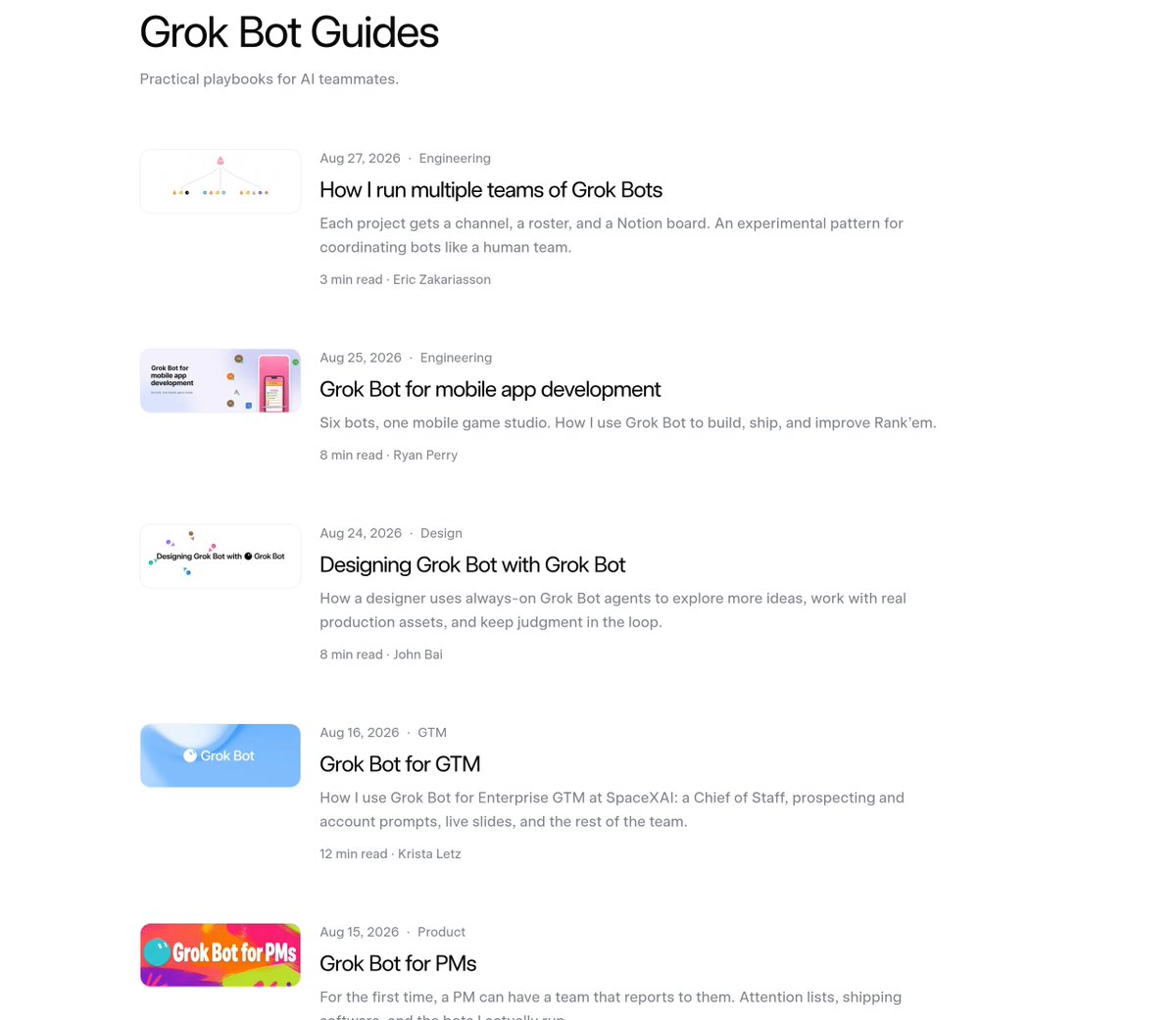
SpaceXAI has built an entire Grok Bot Guides library showing how people are actually using AI agents as real teammates
These are practical playbooks from people already running Grok Bot for:
• Mobile app development
• Product management
• Design
• Enterprise GTM
• Managing multiple teams of agents
And these are not just chatbot workflows
Each Grok Bot can have its own role, memory, cloud computer, connected tools, recurring routines and learned skills, then hand work directly to other specialized bots
One example runs a six-bot mobile game studio across analytics, creative, engineering, infrastructure and bug fixing
Another has a PM running a Chief of Staff, engineering manager, five engineering agents, data analyst, product agent and recruiter
There are even setups where entire projects get their own channel, roster of bots and Notion board, basically organizing AI agents like a human team
This is probably one of the most useful resources SpaceXAI has published for understanding what working with a real team of AI agents actually looks like
You can check out the entire library here:
https://t.co/RAaw7VwijP
SpaceXAI engineer just dropped 1-hour Grok Bot workshop: 1 prompt → CEO bot → agent teams → 100% of daily and business tasks from 0% to 100%:
0% → 3:30 - build your first Grok Bot
25% → 6:52 - give every Bot a role
50% → 16:51 - give bots tools and context
75% → 31:50 - run agent teams in parallel
100% → 52:18 - full system that automate business and life
most courses just tell you what Grok Bot is - but this is a real case study from an engineer on the SpaceXAI team who automated her life - and you can do the same
watch it, build your first CEO Bot, turn it into a team - then read the full Grok Bot workflow below ↓
STOP STARTING YOUR EMAILS WITH:
“I HOPE YOU’RE DOING WELL.”
IT’S CORRECT. IT’S POLITE. AND IT’S ALSO ONE OF THE MOST FORGETTABLE OPENINGS THERE IS.
IF YOU WANT SOMEONE TO REPLY, DON’T START LIKE EVERYONE ELSE.
START WITH INTENTION.
HERE ARE 10 ALTERNATIVES: 👇