In 2007 Messi bathed a baby for a Barça charity calendar. That baby was Lamine Yamal.
Messi is the best football player of all time and Lamine Yamal the best of his age group.
"What was the probability of this?" is not the right question as any event is near impossible if described in enough detail.
better is: how likely is it that pure chance produces ANY story this short and this rare from this event?
Surprise = rarity bits minus description bits, with the guarantee P(any statement nets s bits) <= 2^-s (Kolmogorov).
Choosing the story after the fact can't cheat it.
Context: The raffles ran in ordinary working-class neighborhoods; in Lamine's, about 2/3 of all babies were entered. It is the only setting that ever paired a football star with essentially random babies for a photoshoot.
The story: "the child paired with the group's best player becomes the best of his birth cohort."
Description: ~5 bits (small but debatable menus of alternatives; "the best" needs no name)
Rarity:
5 calendar editions, ~13 raffle kids each, one per player
P(Spanish boy = best of his birth year) = 0.14/253,000 (Spain's share of generational no.1s / boys born 2007)
loading x3: kids from dense working-class areas reach the elite at 3x the per-capita rate. The families were barely self-selected: ~2/3 of the neighborhood's babies were in the raffle.
P = 5 x 3 x 0.14/253,000 = 8 in a million = 17 bits
Surprise = 17 - 5 = 12 bits = about 1 in 4,000
(range: 1 in 700 to 1 in 20,000)
Meaning: in a world with no special connection, just chance plus the selection effects above, you would need to run about 4,000 calendar programs like this one before any of them produced a story this strong.
In 2007 Messi bathed a baby for a Barça charity calendar. That baby was Lamine Yamal.
Messi is the best football player of all time and Lamine Yamal the best of his age group.
"What was the probability of this?" is not the right question as any event is near impossible if described in enough detail.
better is: how likely is it that pure chance produces ANY story this short and this rare from this event?
Surprise = rarity bits minus description bits, with the guarantee P(any statement nets s bits) <= 2^-s (Kolmogorov).
Choosing the story after the fact can't cheat it.
Context: The raffles ran in ordinary working-class neighborhoods; in Lamine's, about 2/3 of all babies were entered. It is the only setting that ever paired a football star with essentially random babies for a photoshoot.
The story: "the child paired with the group's best player becomes the best of his birth cohort."
Description: ~5 bits (small but debatable menus of alternatives; "the best" needs no name)
Rarity:
5 calendar editions, ~13 raffle kids each, one per player
P(Spanish boy = best of his birth year) = 0.14/253,000 (Spain's share of generational no.1s / boys born 2007)
loading x3: kids from dense working-class areas reach the elite at 3x the per-capita rate. The families were barely self-selected: ~2/3 of the neighborhood's babies were in the raffle.
P = 5 x 3 x 0.14/253,000 = 8 in a million = 17 bits
Surprise = 17 - 5 = 12 bits = about 1 in 4,000
(range: 1 in 700 to 1 in 20,000)
Meaning: in a world with no special connection, just chance plus the selection effects above, you would need to run about 4,000 calendar programs like this one before any of them produced a story this strong.
@dvassallo Probably selection bias, but still crazy how the only publicly known photograph of a professional football player with a random baby that later went pro is of arguably the best football player of all time and the biggest young star right now.
@jukan05@RJCcapital I checked all your tweets and the implied stock calls and did some data analysis on it. also have the data for Serenity.
if you are curious heres the link: https://t.co/eOubhXpd4z
@RJCcapital I've analyzed his tweets and the returns people would have gotten if they invested into every call. Performance really is crazy but only the last few months.
link:
https://t.co/sPmGjyOKBC
@RonCyr9 Sure. Keep in mind that the tool can't reproduce your portfolio performance as we can't know how much you invested with each trade.
Here's your analysis, let me know about any inaccuracies:
https://t.co/slW4zGJdIC
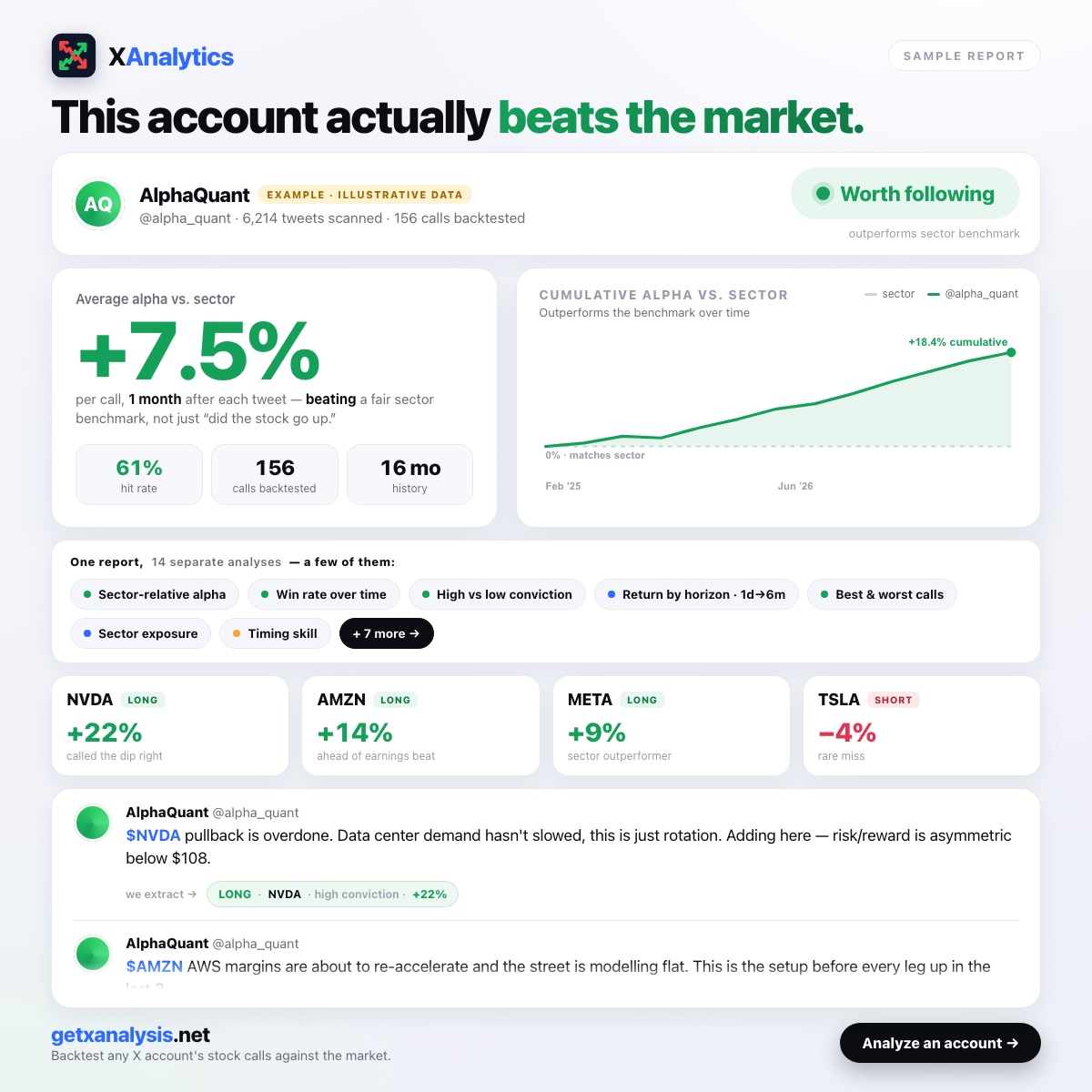
Ever wondered if the accounts you follow for stock picks actually beat the market? I built a tool that checks: an AI reads every post, pulls the calls, scores them against the market. Past analyses free to browse, new ones $5-20. Non-profit, runs at a loss.
Ever wondered if the accounts you follow for stock picks actually beat the market? I built a tool that checks: an AI reads every post, pulls the calls, scores them against the market. Past analyses free to browse, new ones $5-20. Non-profit, runs at a loss.
@DawnDeL82031880 No that's not at all what it is. It's a tool that lets you hold X accounts who claim that they give good investment advice to account.
"By their fruits ye shall know them." — Matthew 7:16
Nobody keeps score on FinTwit, so I built something that does. An AI grades any account's stock calls against the market and ranks them by real alpha. Past analyses free to browse, new ones $5–20. Runs at a loss (for research).
“Trust me bro” is not a track record. So I built one: an AI reads every post an account ever made, pulls the calls and then backtests them against the market. Free to browse, $5–20 for a new account, community project that runs at a loss.