@jxnlco Things that would make me more interested in auto:
- the ability to configure which models are in the auto range (ie - set the range from medium-xhigh / switch off low).
- transparency over which model fulfilled which request in a session
the avg person probably doesn’t care about ads in chatgpt
but what is gonna make these ads resonate is how they’ve captured the chipper, clipped, empty-eyed cadence of the gpt 5 models
The tech/investor class needs a stronger understanding of impartiality vs neutrality or we’re doomed.
If and when ground truth is verifiable, a party or political perspective that better engages with that truth is preferable to one that doesn’t.
Otherwise you’re just inserting bias as a prior, because the judgment that “technology shouldn’t be political” is itself, political.
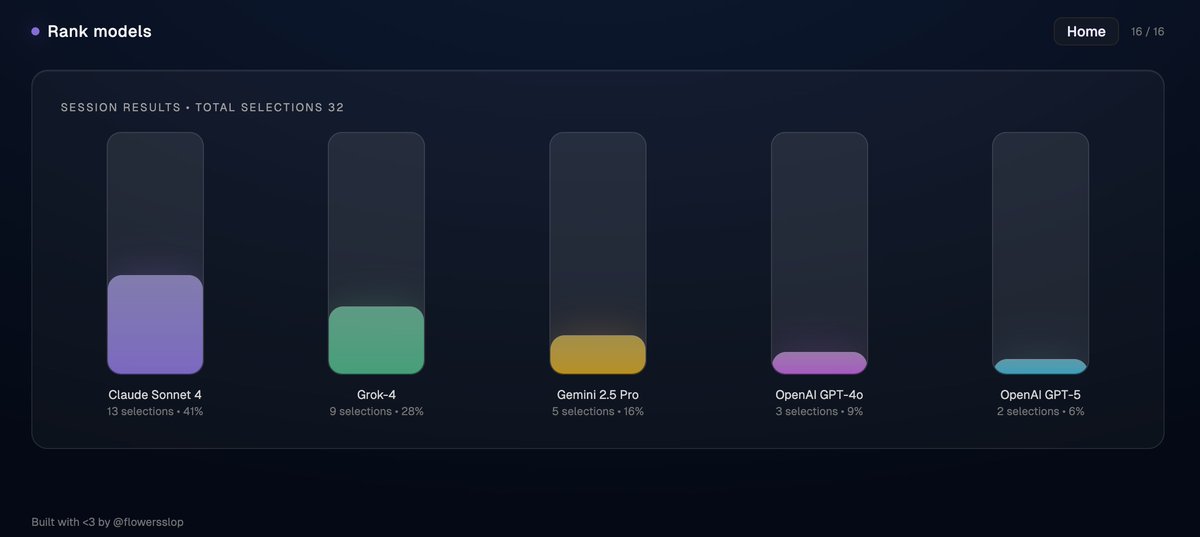
@flowersslop Super surprised by this.
When I compared 5 to 4o, 5 came out ahead by 15% or so - but when put alongside all the models it was clearly my least favourite 😕
This seems like a good faith question so a good faith reply:
As an Australian, @GothamChess was my introduction to chess back in 2020. Levy made chess interesting and dramatic. The only comparable experience I had early on were watching @ginger_gm’s grainy old videos where he talked about the romance of the King’s gambit as he walked through famous games 😂
But because Levy was so accessible, he was also the first chess lesson I ever spent money on. Which taught me how to study chess - ie. how to use pgn’s - how to think about ideas and plans rather than just memorise moves. A lot of the Caro-Kann ideas, even though they were only 8-9 moves of opening theory were simple enough to remember and apply and see the uptick in ELO.
I think it’s easy to forget, and then underestimate, how inaccessible chess can feel when you’re just starting out - especially as an adult. Tournaments and classes are packed with tiny kids who are better than you.
When you hear commentators talking about “losing a crucial tempo being disastrous” while you’re trying your best not to hang your queen against an 800 ELO player who’s just learned the England Gambit - it’s impossible to relate.
I now follow chess closely - and for major games I might now prefer someone like Naroditsky or Hess - but I would never have discovered either of them if it hadn’t been for @GothamChess and @amanhambleton who were among the few chess players at the time who made an effort to be relatable and instructional rather than just constantly flexing their skill on stream.
And now that I’m more of an intermediate player - I would say I actually learn the most from some of the videos in which Levy gets coaching or talks through his mistakes because I recognise his thought pattern in the lead up (ie. mostly getting excited by or over attached to a plan and then not being able to robotically pivot in the way someone like Hikaru can when he plays bullet).
Is clickbait insufferable? Yes. Do I need the same level of hype and drama in videos to find them engaging these days? No.
But I’m glad that Levy and other popular creators have the energy to continue producing that content alongside more instructional stuff because it IS needed when you’re just starting out and the only experience you’ve had of chess is losing to 7 year olds on repeat until you’re in double digit ELO territory.
In other words - it would be a mistake to think of the chess creator ecosystem as a trade off or zero sum game between creators.
Levy is at the top of a funnel. How wide that funnel stays, how quickly it narrows, and how many people flow through it to in person events etc is sort of up to the quality of other creators and people like yourself!
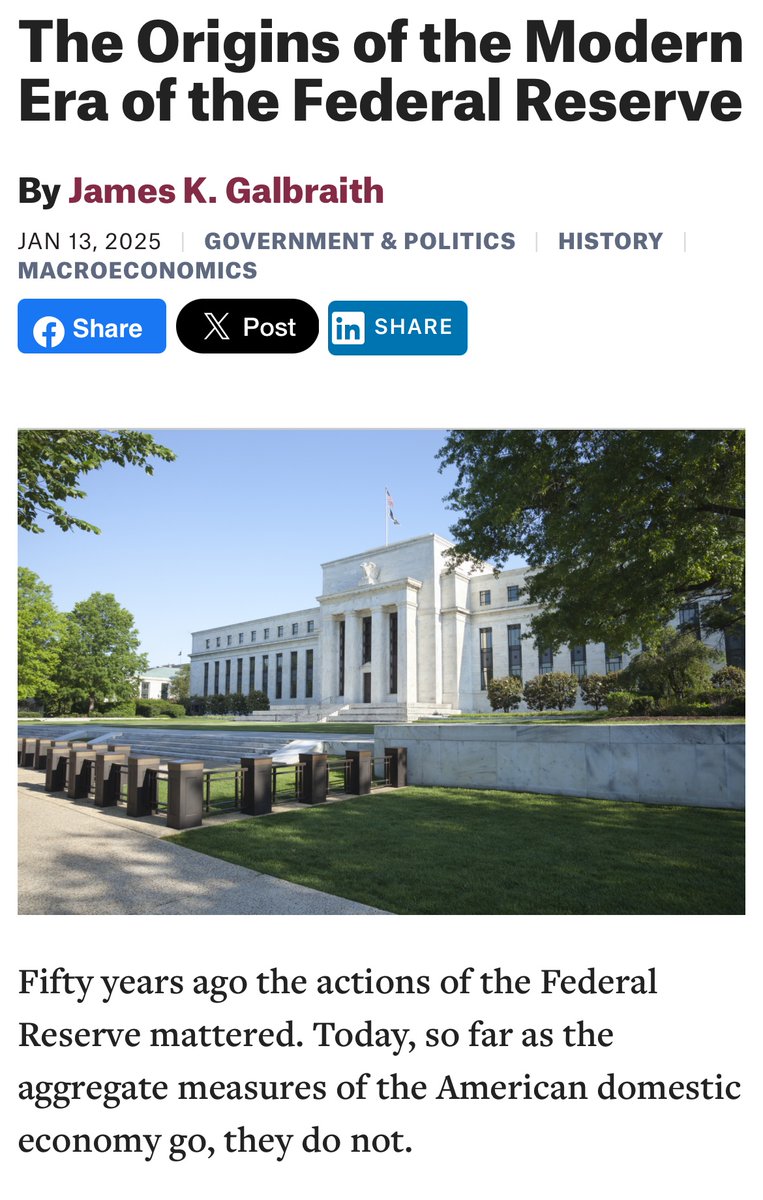
“Powell’s interest rate hikes, launched in March 2022, had no perceptible effect on growth or employment, hence no plausible role in bringing the inflation rate down. Monetary policy has become an empty set of rituals. When interest rates rise, the press reflexively reports that inflation is being fought; when they fall, the Fed is supporting growth and the labor market. But the gears are disconnected from the engine; the supposed causes no longer bear on the supposed effects.” ~James Galbraith
I’d also try to bracket non-work stuff separately as much as you can. Ie - twitter, personal email, WhatsApp group chats don’t really count. Use an email client that allows you to hide accounts. Leave Doug on read etc.
Maybe your use case is different because you’re pretty active across platforms / you get work relevant requests everywhere. I’ve never been in a situation where I feel overloaded on multiple channels like that - but I imagine it’s a situation in which some kind of cheap virtual PA would be helpful and high accuracy in triaging things to a single platform for you.
Otherwise same principle - quick response or action (archive, delegate immediately), or if important put it somewhere you track.
I’m big on this - partly because I have to be, I’m not naturally super organised and get overwhelmed if I don’t have a system. I think the goals for me are:
1. Unblock things where quick responses from me are preventing something from moving forward. Ie. quick feedback on work, approvals, forwarding things to the right person for review etc. - stuff that takes 1-2 minutes. This is usually no more than 20-30 minutes - and it helps to do it in a block/get into a flow.
2. Visibility and organisation over inbound demands on my time. There’s lots of nonsense that doesn’t really need tracking - the goal is to clear/archive/forward that stuff, and pull the stuff you do want to track into a place you track (like asana). Maybe you feel like this is double handling, but this is actually pretty quick to achieve and it allows you to organise/prioritise everything with full vis. If step 1 has been pretty light on, you can maybe knock out a few responses here - depends on the day.
Not sure how you typically organise your days/weeks etc. but whatever that process is for you, I’d try and chunk inbox review ahead of that process as much as you can - because then you can decide when/where you’ll fit the bigger responses in as a matter of priority. If you track your work in Asana, a bunch of stuff will end up in there for scheduling.
I do the clearing/organising at the book ends of my day - usually no more than 20 mins. But I also know other people like to think about their prioritisation first, and then review.
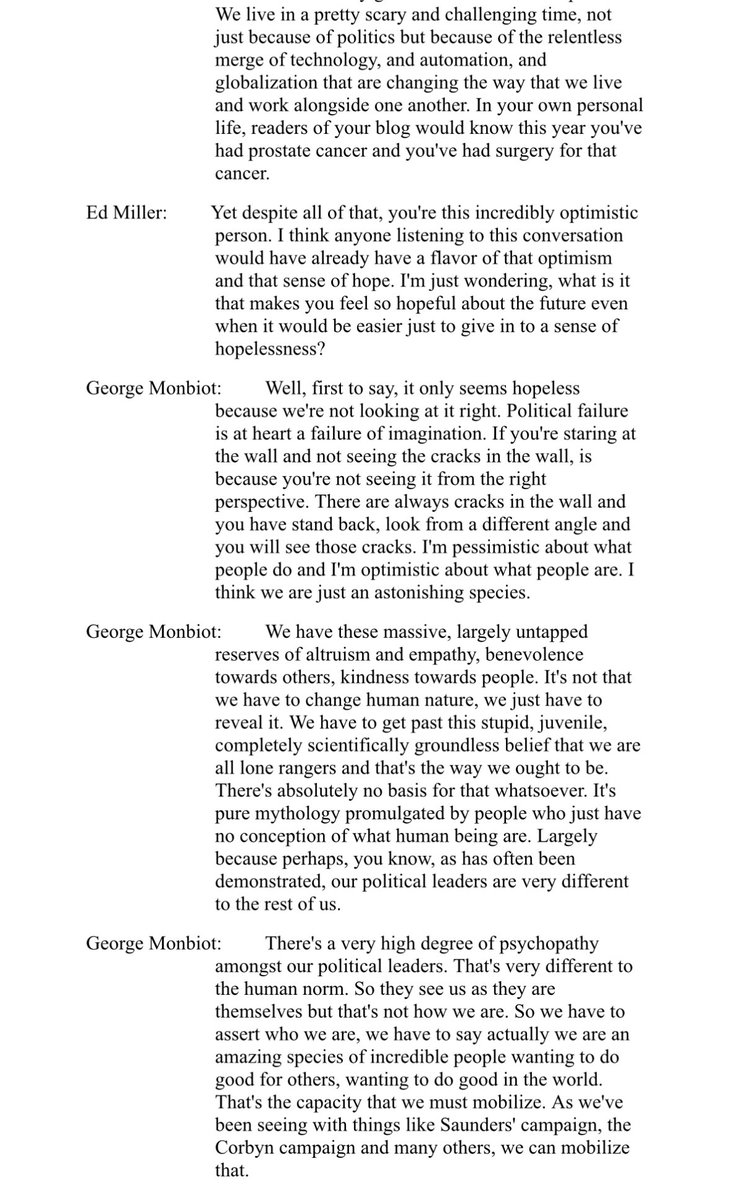
@GeorgeMonbiot This morning I dusted off a transcript of a conversation we had in 2017 - after Trump’s first win - as a way of reminding myself to seek a different perspective.
Things are going to get extremely bad, but it’s not the end of the story.
Respectfully, most of this analysis just doesn’t seem to take into account the way the CAPS evaluation works.
I’m 1400 and will often get mid-high 80’s in my games against players at my level - sometimes 90+. I’ll also frequently get mid 60’s.
The reason it’s possible for this level of variation (as I understand it) is that your CAPS score is hugely dependent on the quality of your opponents play.
If you spend 15 moves in theory, to enter a middle game position/line you’re familiar with repeatedly (as often happens during a match with the same player) against a good opponent - your CAPS evaluation will be consistently great. If you are playing a much weaker opponent where the tactical response is *obvious* your CAPS eval will still be great.
But what happens if you’re playing against a weaker opponent, which creates tactical opportunities that aren’t obvious - you start losing CAPS for every move you miss a line the computer sees. Importantly when this happens - both players lose CAPS rating because one player is making non-obvious mistakes, and the other is missing non-obvious responses. So if they’re playing fairly you would expect their rating to move in tandem.
That variation can be huge, especially at the lower levels - I miss lots and make lots of mistakes. It’s possible for me to score 90+ even at my level against opponents who are my level (because they also make mistakes where the response is obvious in the middle game which allows me to have a high accuracy). But when I miss things, or make mistakes - I miss big, and my eval can end up in the 50’s.
But this analysis seems to just say “Danya experiences variation between low 80’s and low 90’s which is fairly typical of high level play, although isn’t explicable based on the ELO of his opponent. In some matches he is unusually consistently high, in others surprisingly low”. But there’s SO many other obvious explanations for that variation - based on the kinds of openings that are being played, and the consistency with which positions are reached in the same match.
On the face of it it feels like you’ve spent an enormous amount of time to gather data on a CAPS evaluation that isn’t actually a measure of player strength - but a measure of RELATIVE performance based largely on an opponents level of play.
Does anyone know the story behind the product lines at AusPost offices? Like who makes the stock decisions?It makes me vaguely patriotic that you can walk into any branch and find the most insane crossover of officeworks, Bunnings, toysRus and supercheap auto for no reason
@VBkramnik Have you read this? It goes through the methodology in detail. Hikaru oversimplifies his analysis when it comes to consecutive randomized probability, but so do you. https://t.co/gNnf2k73qR