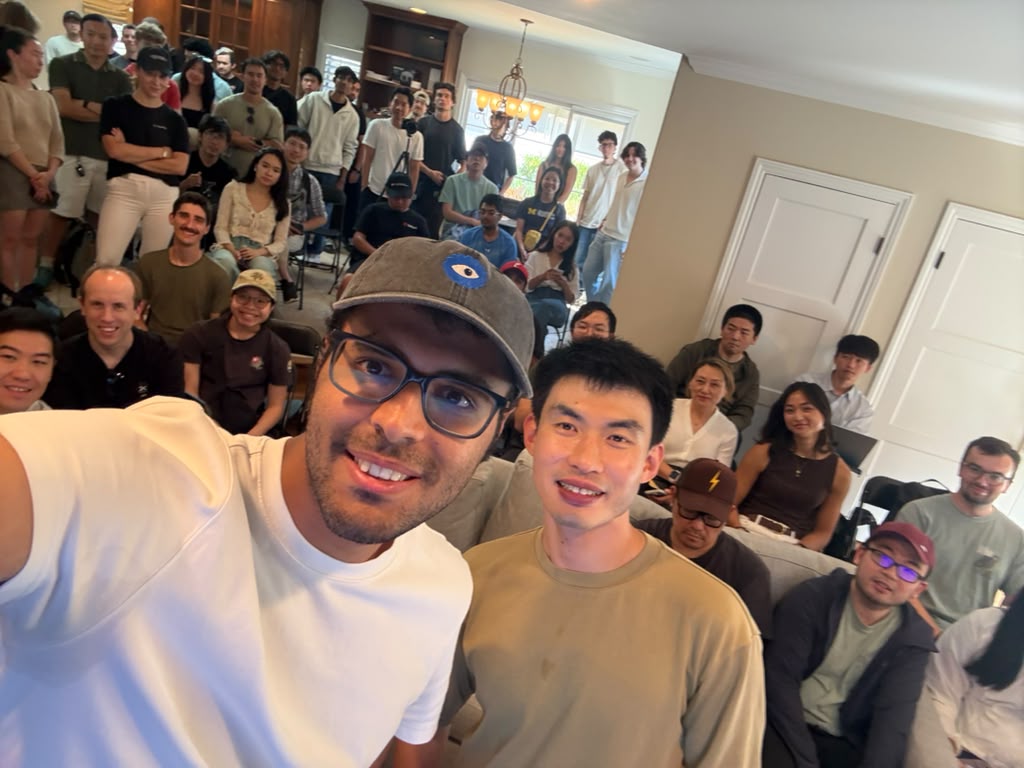
A huge thank you to everyone who joined
@SundaeRobotics 03! 🤖🍨 Special thanks to @binghao_huang for an outstanding talk on the future of flexible tactile skin for dexterous manipulation.
🤖🍨 Next Sundae (https://t.co/WqKLdxQag1), we're excited to host @kaiwynd, a Ph.D. student at Columbia University advised by Prof. Yunzhu Li, for a talk on engineering robotic simulators for evaluation, data generation, and sim-to-real robot learning.
Thanks to @angelajiazhang@thejonohart@menemazarakis@drjingxi@litian_liang@Joshuabrowder
A huge thank you to everyone who joined @SundaeRobotics 02. 🤖🍨
Special thanks to @ChanghaoWang78 for an outstanding talk on the future of human demonstration, DexterityGen & SPIDER.
🤖🍨 Next Sundae (https://t.co/3dnAYWMHiO), we're excited to host @binghao_huang, a Ph.D. student at Columbia University advised by Yunzhu Li, for a talk on scaling tactile intelligence for robot learning and flexible tactile skin.
Thanks to @menemazarakis@angelajiazhang@thejonohart@drjingxi@Joshuabrowder!
@JinjingLiang Ethel’s fancy, zola, tamarine, nutrition restaurant, kanji, shang’s cafe, Mikiya, Madera, darda’s seafood, village pub, yakiniku ginza are some of my faves!!
Every company will become a portfolio of AI brains.
Almost none know how to build one.
@latentius and I joined @a16z@speedrun to build @ThirdbrainLabs -- the post-training layer that turns your data and expertise into models you actually own.
Data in. Your model out. Continuously improved.
No heavy consultancy or bundling different data and training solutions - it's about time we had a scalable, technical platform delivering specialized intelligence for all.
in college one of my favorite courses CS280r was on “collaboration between AI and humans”, and it’s so thrilling to see so many of those concepts unfold into a reality. Excited to embrace all the ways we will adapt and become more empowered by leveraging AI tools to expedite productivity and generate more creative ideas
Graphite is joining Cursor!
@TomasReimers, @MerrillLutsky, and I started Graphite in 2020. Back then it was the three of us, an apartment that doubled as an office, and a fold-out plastic table where I interviewed candidates between debugging sessions.
Five years later, Graphite is a team of 75+ people, and we’re joining Cursor to build the future of software collaboration faster than we ever could alone.
I co-founded Graphite for two reasons: good people and a love for dev tools.
First: I wanted to work with wonderful people. Tomas was my CS partner in college and one of my closest friends. Merrill was years ahead of us at Harvard and had already taken the leap into startups. From day one, we wanted to build with people we genuinely admired, and that started with each other.
Second: I’ve been obsessed with how software gets built since I was 15. It started with hacking together iOS apps as a teenager in Reno, then turned into devtools work at Airbnb, and eventually became Graphite. Software engineering itself is high leverage, but creating better tools for software engineers is exponentially impactful.
Graphite began with a simple insight: the best ways to ship code were trapped inside private tools at the biggest companies. Stacked diffs, PR inboxes, merge queues, the whole “outer loop” of engineering. We wanted to make those workflows accessible to every serious software team, with the same taste and rigor you’d expect internally at the largest engineering orgs.
Then AI hit, and the pace of change in devtools went vertical.
Cursor is building the best code creation experience in the world. Graphite has been building the best system for reviewing, integrating, and shipping code. The inner loop and the outer loop. Separately, these tools inevitably collide. Together, they can become one coherent system, end to end, designed to feel great and move fast.
I’ve never seen two puzzle pieces fit this cleanly.
What I’m most proud of is our team. We’re a bunch of nerds who care an unreasonable amount about craft: speed, polish, reliability, and sweating the details that make engineers smile. Teammates like Xiulung and Nick, who joined just months after we started, helped set the bar early. And dozens more who poured years of heart and risk into Graphite. Watching this group build something that teams like Datadog, Shopify, Robinhood, Figma, and thousands of other orgs rely on every day has been one of the great privileges of my life.
For our customers: Graphite isn’t going anywhere. We’re continuing to build stacking, the PR inbox, merge queue, and AI code review. Nothing is getting sunset. If anything, this gives us more leverage to invest and ship faster. Many of you already use both Cursor and Graphite, and you’ll see your tooling get even better.
On a personal note: I’m thrilled to work shoulder to shoulder with the Cursor team! I’ve admired their culture for a long time. They’re kind, intense, and have a high-quality bar. Our offices are literally across the street from each other. This is going to be insanely fun.
@custo_lejla Excited for the future of AI to help us 100x progress across sectors but also all the ways we will adapt to this new normal to become more creative and high leverage
Amazing insights Lejla - completely agree re: the focus on building emotional resilience and bridging gaps in isolation. Grateful for you and all you do for your portcos
In 2026, we’ll develop tools that help us stay human
As we stand on the cusp of 2026, the velocity of AI-driven change isn’t just reshaping industries - it’s changing the very fabric of what it means to be human.
The pace is relentless, exponential and unstoppable. Yet amid this acceleration, a profound challenge is emerging: the human void left by AI’s automation of the mundane, for jobs from factory floors to boardrooms. AI is freeing us up for creativity, yet exposing raw vulnerabilities in our emotional cores as we learn to live - and thrive in the new normal.
One of our Big Ideas for 2026 is Emotional Agility - the human superpower for an AI-amplified world.
This isn’t about resisting AI. It’s about reclaiming our innate capacity for emotional resilience, self-connection, and relational depth. Because machines master precision. Only humans master meaning, presence, and connection.
The actual breakthrough: is that AI is doing the grunt work so we can finally master human work. This speed of change is pushing us toward what truly matters: self mastery. We can’t control the external, but we can strengthen our internal operating systems by using tools that scale emotional intelligence, foster faith, and bridge the isolation AI risks creating.
2026 isn’t about keeping up with the machines.
It’s about becoming calm, clear, and powerfully human.
What do you think? Let us know in the comments.
In 2026, we’ll develop tools that help us stay human
As we stand on the cusp of 2026, the velocity of AI-driven change isn’t just reshaping industries - it’s changing the very fabric of what it means to be human.
The pace is relentless, exponential and unstoppable. Yet amid this acceleration, a profound challenge is emerging: the human void left by AI’s automation of the mundane, for jobs from factory floors to boardrooms. AI is freeing us up for creativity, yet exposing raw vulnerabilities in our emotional cores as we learn to live - and thrive in the new normal.
One of our Big Ideas for 2026 is Emotional Agility - the human superpower for an AI-amplified world.
This isn’t about resisting AI. It’s about reclaiming our innate capacity for emotional resilience, self-connection, and relational depth. Because machines master precision. Only humans master meaning, presence, and connection.
The actual breakthrough: is that AI is doing the grunt work so we can finally master human work. This speed of change is pushing us toward what truly matters: self mastery. We can’t control the external, but we can strengthen our internal operating systems by using tools that scale emotional intelligence, foster faith, and bridge the isolation AI risks creating.
2026 isn’t about keeping up with the machines.
It’s about becoming calm, clear, and powerfully human.
What do you think? Let us know in the comments.