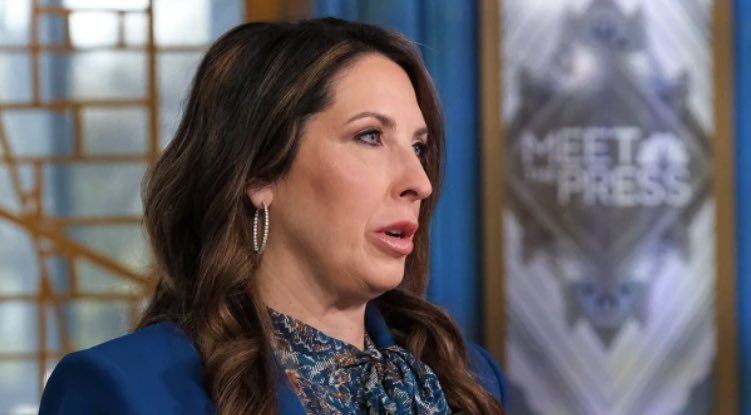
“I think our bosses owe you an apology for putting you in this situation”
Not usually a Chuck Todd fan, but he absolutely eviscerates NBC over the Ronna McDaniel hiring.
Respect.
.@DonaldJTrumpJr Nice try, Junior 👆! TFG you call daddy 💯 did it to himself. He thought he is above the law, you see. He was wrong.
Below is an overview and the rationale of the Colorado Supreme Court's decision. Same rationale applies to all states.
The Colorado Supreme Court ruled that former President Donald Trump is disqualified from holding the presidency under the Constitution's so-called insurrection clause and ordered the secretary of state to exclude his name from the state's Republican presidential primary ballot. The court's decision was based on several key points:
The court has jurisdiction under the expedited election challenge procedures in Colorado's Election Code, specifically Section 1-1-113, to adjudicate a challenge to Trump's eligibility for the ballot based on Section Three of the Fourteenth Amendment.
The court determined that Section Three of the 14th Amendment is "self-executing" and does not require implementing legislation from Congress to be enforced.
The court held that the presidency falls under Section Three's broad language covering "any office, civil or military, under the United States".
The court upheld the admission of portions of Congress's January 6th Report under Colorado's evidentiary rule on public agency reports.
The court analyzed Trump's speech under the Brandenburg test for incitement unprotected by the First Amendment. It upheld the finding that Trump intended and likely provoked imminent lawless action by his remarks to supporters on January 6th.
The court agreed with the lower court that the concerted, public use of force by the mob to disrupt Congress's vote certification constituted "insurrection" under any viable definition.
The court upheld the finding that Trump actively aided the insurrection both before and during the January 6th attack through his ongoing election fraud claims, directions to supporters to "fight" and march on the Capitol, and refusal to swiftly condemn the violence as it unfolded. His voluntary conduct met Section Three's "engagement" standard.
Here is a more comprehensive explanation of their rationale as outlined in their decision 👇:
1. Authority under Election Code to adjudicate Section Three challenge
- The court has jurisdiction under the expedited election challenge procedures in Colorado's Election Code, specifically Section 1-1-113.
- This allows eligible voters like the Electors to allege an election official is about to commit a "wrongful act" under the Code, which the court said encompasses certifying an unqualified candidate.
- The court rejected arguments that Section Three claims cannot be litigated through the Code's procedures. It said Section Three bears on candidates' constitutional qualifications, which fall within the scope of the Code provisions relied upon.
Here is a more detailed explanation of the Colorado Supreme Court's reasoning in concluding it had authority under the state's Election Code to adjudicate a challenge to former President Trump's eligibility for the ballot based on Section Three of the Fourteenth Amendment:
· Analysis of Relevant Election Code Provisions
- The court examined section 1-1-113, which establishes procedures for eligible voters to allege election officials are about to commit a "wrongful act" under the Code. It gives courts jurisdiction over such controversies.
- It construed the listing of a constitutionally ineligible candidate as a "wrongful act," emphasizing section 1-1-113's broad scope and section 1-4-1204(4)'s allowance for judicial review of “any alleged improprieties” regarding a presidential candidate.
- While the Secretary of State lacks power to assess qualifications, the court cited precedent establishing that courts must determine candidate eligibility under the Election Code.
· Section 1-4-1201
- This section expresses intent for Colorado’s presidential primary process to conform to federal law. The lower court viewed “federal law” as encompassing Section Three, but the Supreme Court found the term ambiguous without clear support for that position.
· Section 1-4-1203(2)(a)
- The court rejected reliance on this section’s reference to a “qualified candidate” as clearly signaling an intent to authorize judicial review of Section Three claims. In context, it found the provision focuses simply on party participation rules for the primary.
· Conclusion re Code Authority
- Despite some ambiguity, the court held the Election Code provides a vehicle for courts to determine presidential candidates’ constitutional qualifications when necessary to remedy potential “wrongful act[s].” It reversed the lower court’s ruling that Section Three challenges fall outside the Code provisions invoked.
2. Section Three is "Self-Executing"
- The court examined the 14th Amendment's text, history, and case law and determined Section Three is "self-executing" in the sense that its disability clause attaches without need for implementing legislation from Congress.
- The court found that Section Three lacks any language suggesting congressional action is a precondition to enforcement, unlike Section Five which speaks only to Congress's power to enforce the 14th Amendment's provisions.
Here is a more detailed summary of how the Colorado Supreme Court reasoned that Section Three of the 14th Amendment is "self-executing" and does not require implementing legislation from Congress to be enforced:
•Textual analysis
-The court observed that Section Three does not anywhere state that congressional action is required before the disability clause can operate to disqualify oath-breaking insurrectionists. The Amendment’s text is therefore not ambiguous on the need for federal legislation.
-It noted that Section Three's only reference to congressional power simply allows Congress to remove the disability by a two-thirds vote. But removal and initial enforcement are distinct.
-The court also contrasted Section Three's text with Section Five, which does expressly grant Congress enforcement authority over the 14th Amendment's provisions. The lack of similar language in Section Three demonstrates no legislation is mandated.
•Comparison with other Reconstruction Amendments
-Examining the 13th, 14th and 15th Amendments, the court found they all mirror Section Three in containing one substantive provision followed by an enforcement provision. Yet the Supreme Court has held the key provisions in the 13th and 15th to be self-executing.
-The court said interpreting Section Three alone to require implementing legislation, when the other Reconstruction Amendments did not, would be anomalous and undermine the amendments' purposes.
•Absurd Consequences
-The court pointed out the bizarre outcomes that would result if Section Three cannot operate until Congress legislates, such as allowing known insurrectionist oath-breakers to hold any office.
-It would also empower Congress to effectively nullify Section Three's prohibition by refusing to pass any enforcement legislation.
The court found no merit in historical arguments against self-execution relied upon below. It therefore reversed and concluded Section Three attaches automatically, without need for congressional action, to disqualify insurrectionist officeholders.
3. Section Three Applies to the President
- The court overturned the lower court's finding on this point. It held the presidency falls under Section Three's broad language covering "any office, civil or military, under the United States."
- The court relied on the text's plain meaning, definitions of "office" from the 1860s, the Constitution's multiple references to the presidency as an "office," and historical evidence suggesting the Amendment's framers and ratifiers understood Section Three would cover the presidency.
Here is a more detailed summary of the Colorado Supreme Court's reasoning in concluding that Section Three of the Fourteenth Amendment applies to a sitting or former President of the United States:
-Presidency as an "Office . . . Under the United States"
-The court examined dictionary definitions of "office" from the 1860s and found the plain and ordinary meaning includes the presidency.
-It observed the Constitution refers to the presidency as an "Office" in 25 instances. This further demonstrates the presidency meets the text's inclusion of "any office."
-The court rejected the lower court's reliance on the fact that the presidency isn't listed specifically in Section Three. It said such specification would be odd since the presidency is so clearly an office.
-While presidents aren't "under" the United States, the court said they still serve "we the people." The better reading, it reasoned, is "under" distinguishes federal from state offices.
-President as an "Officer of the United States"
-Again relying on contemporary dictionary definitions, the court concluded presidents match the plain meaning of "officer." Notably, Americans referred to presidents this way at the country's founding as well, e.g. in the Federalist Papers.
-The court documented congressional floor debates around Section Three's drafting expressly referring to the president as an officer.
-It found the president is clearly an "executive . . . Officer[]" bound by oath or affirmation under Article VI of the Constitution.
-The Presidential Oath is an Oath to "Support" the Constitution
-While the presidential oath in Article II uses the language "preserve, protect and defend" regarding the Constitution, the court relied on dictionaries of the era defining "support" to include meanings like "defend."
-Statements from the 1860s confirmed that the Article II oath was understood as emphatically requiring presidents to "support" the Constitution.
-Based on this textual and historical evidence, the court rejected the lower court's narrow reading and held that Section Three's disability clause fully encompasses a sitting or former president.
4. Admission of January 6th Report Portions
- The court applied Colorado's evidentiary rule on public agency reports, which are admissible if trustworthy. It found no abuse of discretion, noting rules assume admissibility and place the burden on opponents to show unreliability.
- The court examined and rejected President Trump's arguments attacking the report's neutrality and found its trustworthiness was not defeated by the alleged presence of some hearsay within it.
Here is a more detailed explanation of the Colorado Supreme Court's reasoning in upholding the admission of portions of Congress's January 6th Report:
-Application of Colorado's Evidentiary Rule
-The court applied Colorado Rule of Evidence 803(8), which creates a hearsay exception allowing admission of public agency reports that are trustworthy.
-It noted federal precedents hold that courts should assume admissibility under the equivalent federal rule, placing the burden on opponents to show lack of trustworthiness.
-Rejection of Trump's Arguments Against Trustworthiness
-Committee's Alleged Bias
-Trump argued report findings were unreliable because all Committee members voted to impeach him previously.
-The court cited testimony that members remained able to evaluate evidence fairly despite these prior views and were entitled to a presumption of honesty and integrity.
-It also noted two duly elected House Republicans participated in the investigation along with many Republican attorneys and Trump administration witnesses.
-The Report's Political Backdrop
-Trump claimed the context of an investigation launched by a Democrat-led House undermined the report's neutrality.
-The court reasoned this argument went too far since most congressional reports have some political motivation, yet the evidentiary rule does not deem them automatically inadmissible. Courts admit what they deem trustworthy.
-Lack of Bi-partisan Participation
-Trump asserted that with Democrats outnumbering Republicans 7-2, the Report's findings necessarily reflected partisan bias.
-The court blamed House Republican leadership for a boycott leading to the imbalance. It emphasized participation by elected Republicans who presumably advanced their constituents' interests.
-Embedded Hearsay Concerns
-While embedding some hearsay, the court found the Report's key factual claims were non-hearsay or fell under exceptions. It declined to reverse based on a couple marginally relevant hearsay statements.
By rejecting these arguments, the court found no abuse of discretion in admitting relevant portions of the Report.
5. Trump's January 6th Speech Not Protected
- The court analyzed Trump's speech under the Brandenburg test for incitement unprotected by the First Amendment. It upheld the finding that Trump intended and likely provoked imminent lawless action by his remarks to supporters on January 6th.
- The court considered Trump's prior tacit endorsements of violence by supporters as relevant context in concluding his speech forfeited First Amendment protection.
Here is a more detailed summary of why the Colorado Supreme Court concluded former President Trump's speech at the January 6th rally was not protected by the First Amendment:
-The Court's Application of the Brandenburg Test
-The court assessed Trump's speech under the Supreme Court's Brandenburg test, which holds that advocacy of lawless action is unprotected when: (1) it explicitly or implicitly encourages violence; (2) the speaker intends to produce violence; and (3) imminent violent action is likely to occur.
-Trump Encouraged Lawless Action
-The court documented Trump's history of endorsing violence against protesters at campaign rallies when he urged security to “get them out of here.”
-It found on January 6th itself, despite knowing many supporters were armed and some had openly threatened violence, Trump instructed them to “fight like hell” and march to the Capitol.
-The court concluded these exhortations, in context, constituted overt calls for unlawful use of force and were received as such by members of the crowd.
-Trump Intended to Produce Violence
-The court relied on Trump’s inaction during the attack itself, even after being asked to call it off, as evidence that violence is what he intended his speech to galvanize.
-Also significant was his effort during the attack to call Senators, not to protect them, but to delay certification so that the mob might still succeed in its aims.
-Imminent Lawless Action Was Likely
-The court found Trump was aware of supporters’ past violence when he encouraged confrontation. His speech made violence appear sanctioned and predictable rather than merely possible.
-The evidence reflected that members of the crowd almost immediately headed for the Capitol following Trump’s urgent demand to “fight like hell” and not allow the election to be “stolen.”
By inciting the charged crowd in this manner, the court ruled Trump forfeited First Amendment protection for his January 6th remarks under the Brandenburg framework.
6. Events of January 6th Constituted an Insurrection
- The court agreed with the lower court that the concerted, public use of force by the mob to disrupt Congress's vote certification constituted "insurrection" under any viable definition.
Here is a more detailed summary of the Colorado Supreme Court's reasoning in upholding the determination that the events at the U.S. Capitol on January 6, 2021 constituted an "insurrection" under Section Three of the Fourteenth Amendment:
-The Court's Definition of Insurrection
-The court examined various dictionary definitions of "insurrection" from the 1860s when Section Three was ratified, as well as more recent definitions.
-It concluded that any viable definition would have to encompass the "concerted and public use of force or threat of force by a group of people to hinder or prevent the U.S. government from taking the actions necessary to accomplish the peaceful transfer of power in this country."
-The court said the required force or threats need not involve bloodshed or have a high chance of success. The group also need not be highly organized early on.
-Evidence Supporting an Insurrection Finding
-It is undisputed a large group forcibly entered the Capitol on January 6th in a manner that overwhelmed law enforcement.
-Contrary to Trump's argument, the court found the mob was armed with a wide array of weapons seized from the Capitol or from assaulting police officers.
-The court also documented the mob's repeated, violent confrontations with police throughout the afternoon.
-The use of force was deemed concerted and public based on the goal-oriented nature of the mob's movements and its pursuit of members of Congress to prevent the election certification.
-Mob's Goal as Evidence of Insurrection
-Soon after breaching the building, portions of the mob advanced quickly to the House and Senate chambers where the electoral count was underway.
-The court found the mob specifically targeted Vice President Pence, who was presiding over the count, with threats of violence for refusing to halt the electoral certification.
-Thus, the court determined the evidence established the mob forcibly disrupted Congress to hinder or prevent the lawful completion of the electoral process and transfer of power.
By documenting this forcible disruption of government operations, the court upheld the finding that the January 6th attack constituted an insurrection.
7. Trump Engaged in the Insurrection
- The court upheld the finding that Trump actively aided the insurrection both before and during the January 6th attack through his ongoing election fraud claims, directions to supporters to "fight" and march on the Capitol, and refusal to swiftly condemn the violence as it unfolded. His voluntary conduct met Section Three's "engagement" standard.
Here is a more detailed summary of why the Colorado Supreme Court upheld the finding that former President Trump "engaged in" the January 6th insurrection:
-Definition of "Engaged In"
-The court examined various historical definitions of "engaged in" from around the time the 14th Amendment was adopted. It adopted a definition requiring "an overt and voluntary act, done with the intent of aiding or furthering the common unlawful purpose."
-The court made clear that mere silence or acquiescence does not qualify as "engagement" under Section Three. Some active participation is required.
-Evidence of Trump's Participation
-Months before January 6th, Trump began claiming the election would be "rigged" and refused to commit to a peaceful transfer of power if he lost.
-After his defeat, Trump amplified false claims of election fraud and directly pressured state officials to overturn the results. The court documented his awareness that these officials faced harassment and threats of violence by his supporters.
-The court pointed to his December 19th tweet urging supporters to come to Washington D.C. on January 6th, when Congress would certify the results. It would "be wild," he tweeted.
-Trump's Conduct on January 6th
-On the morning of January 6th, Trump focused supporters' anger at VP Pence's role overseeing the electoral count and certification.
-During his speech, Trump instructed supporters to "fight like hell" and march to the Capitol. Very shortly after, the first rioters reached the Capitol grounds.
-Crucially, even after being informed of the attack, Trump took no action to stop it for hours. In fact, he justified and sympathized with the mob's actions in statements and tweets throughout the afternoon.
Taken together, this voluntary conduct met the court's adopted definition of "engagement." Trump actively participated in the unlawful plan to obstruct the election certification and peaceful transfer of power through his supportive statements and deliberate inaction before, during, and after the riot. The court therefore upheld the factual finding that he "engaged in" the January 6th insurrection.
#ColoradoSupremeCourt #TrumpDisqualified #SupremeCourt
Here is Robert De Niro’s full statement about how Donald Trump should NEVER be president again:
“I’ve spent a lot of time studying bad men. I’ve examined their characteristics, their mannerisms, the utter banality of their cruelty.
Yet there’s something different about Donald Trump. When I look at him, I don’t see a bad man. Truly.
I see an evil one.
Over the years, I’ve met gangsters here and there. This guy tries to be one, but he can’t quite pull it off. There’s such a thing as “honor among thieves.” Yes, even criminals usually have a sense of right and wrong.
Whether they do the right thing or not is a different story — but — they have a moral code, however warped.
Donald Trump does not. He’s a wannabe tough guy with no morals or ethics. No sense of right or wrong. No regard for anyone but himself — not the people he was supposed to lead and protect, not the people he does business with, not the people who follow him, blindly and loyally, not even the people who consider themselves his “friends.” He has contempt for all of them.
We New Yorkers got to know him over the years that he poisoned the atmosphere and littered our city with monuments to his ego. We knew first hand that this was someone who should never be considered for leadership. We tried to warn the world in 2016.
The repercussions of his turbulent presidency divided America and rattled New York City beyond imagination. Remember how we were jolted by crisis in early 2020, as a virus swept the world.
We lived with Donald Trump’s bombastic behavior every day on the national stage, and we suffered as we saw our neighbors piling up in body bags.
The man who was supposed to protect this country put it in peril, because of his recklessness and impulsiveness. It was like an abusive father ruling the family by fear and violent behavior. That was the consequence of New York’s warning getting ignored. Next time, we know it will be worse.
Make no mistake: the twice-impeached, 4-time indicted Donald Trump is still a fool. But we can’t let our fellow Americans write him off like one. Evil thrives in the shadow of dismissive mockery, which is why we must take the danger of Donald Trump very seriously.
So today we issue another warning. From this place where Abraham Lincoln spoke — right here in the beating heart of New York — to the rest of America:
This is our last chance.
Democracy won’t survive the return of a wannabe dictator.
And it won’t overcome evil if we are divided.
So what do we do about it? I know I’m preaching to the choir here. What we’re doing today is valuable, but we have to take today into tomorrow – take it outside these walls. We have to reach out to the half of our country who have ignored the hazards of Trump and, for whatever reason, support elevating him back into the White House.
They’re not stupid, and we must not condemn them for making a stupid choice. Our future doesn’t just depend on us. It depends on them.
Let’s reach out to Trump’s followers with respect. Let’s not talk about “democracy.” “Democracy” may be our holy grail, but to others it is just a word, a concept, and in their embrace of Trump, they’ve already turned their backs on it.
Let’s talk about right and wrong. Let’s talk about humanity.
Let’s talk about kindness. Security for our world.
Safety for our families.
Decency.
Let’s welcome them back.
We won’t get them all, but we can get enough to end the nightmare of Trump, and fulfill the mission of this “Stop Trump Summit.”