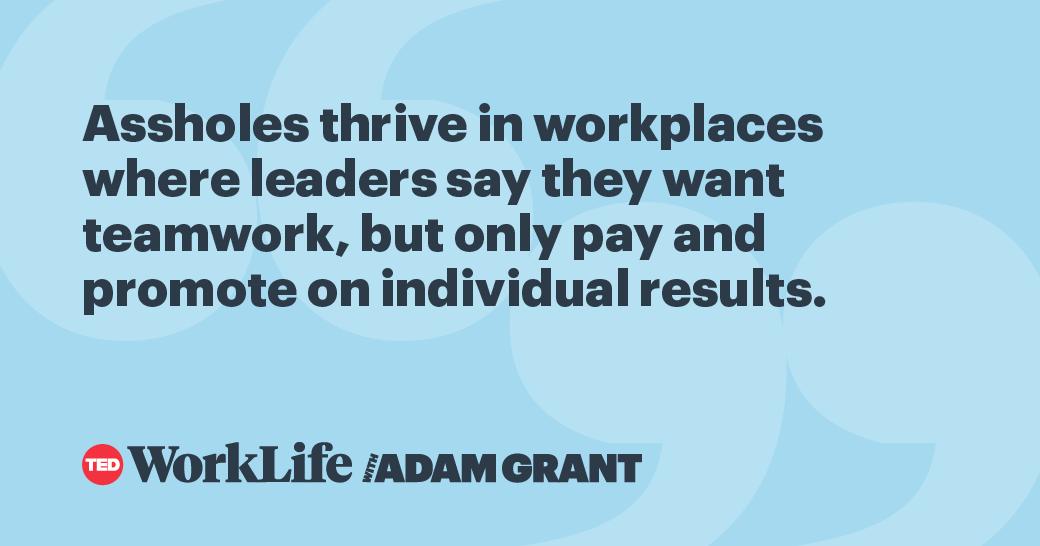
The mark of a great culture: zero tolerance for assholes, even if they're stars.
It's good to be demanding—by all means, have high standards.
But there's no excuse for demeaning—making people feel disrespected and devalued.
#TuesdayMotivation#WorkLife https://t.co/e9GaX4iNS5
We negotiate all the time: with our boss over a pay rise, with members of our family over bedtime, putting the bins out or holiday destinations. What can we learn from an ex-FBI hostage negotiator? Great O Behave! Post: https://t.co/yvAK5alWYj
Great! 🤨 How am I ever going to unfairly label people if I now have to balance their dark triad scores with their light triad scores?! Not happy science!! 😤 #darktriad#lighttriad#psychology https://t.co/gRtTBa5kfL
There are a range techniques out there giving guidance on how to more effectively communicate sensitive topics. Most start with a clear articulation of what is important to you / the impact other people's actions have on you.
It can often be difficult to know whether you are sending messages to staff to stay quiet. The examples here are serious, but I see it happen in many ways that senior leaders don’t detect. https://t.co/5Gqran35jM
We always made decisions using evidence of some sort, so in what ways is evidence-practice different to what we probably usually do?
1. A conscientious, explicit, and judicious process
2. Multiple sources of evidence
3. A structured approach
https://t.co/M40EfTjaa5
I've always found the idea that we should be our "authentic selves" at work a little bizarre. Not least because it presupposes that we do actually have some sort of immutable "true" self we can choose (or not) to be.
Don't let your learning style hold you back! Like many popular notions, it is a superficially attractive notion whose hold on our thinking has more to do with being an interesting sounding idea than any evidence.
https://t.co/iR7984PIF7
The notion that we do not understand modern workplace health issues because we don’t measure them is simple. But we don’t do it! We need to do better. https://t.co/uwIWkU6j65
One of my favourite research findings: happy couples fight as much as unhappy couples. It just goes to show the opportunities for better relationships of all kinds when you talk about problems, communicate clear and focus on your interdependence.
https://t.co/aP9dtG2bgC
YES! We have finished the manuscript of our book! We thank the 36 proofreaders who gave us feedback on previous drafts, we hope you can see the difference you made in the final product!
I can help but think of @PTetlock and his recent book super forecasting when I read this. Here wisdom is associated with openness to new ideas and perspectives, intellectual humility and recognition of uncertainty.
https://t.co/MMXq2wmRZe
@Rob_Briner@andre_spicer Ahhh, a basic rule of language. Any two statements with a sufficient degree of imprecision are bound to be consistent in one way or another. It’s what helps us always be right, even when we are wrong.





![Rob_Briner's tweet photo. Peice in @FinancialReview about unethical/risk policies in banks quoting @CenterforEBMgt fellow [DR not Ms!] and @ANU_CBE prof @AlessCapezio discussing joint review w @CIPD on managing unethical behaviour https://t.co/LK5uFOsRDd
@TheFCA @bankofengland @FT https://t.co/xtVlxdVsSa](https://pbs.twimg.com/media/D6B4hr-XkAEIPKW.jpg)