Thomas Peterffy is the 23rd richest person in the world, a chief architect of modern finance, and has one of the most remarkable stories in business. Yet he remains virtually unknown.
Born in a Budapest basement during a Soviet bombing raid in September 1944, his father left when he was 2, his mother couldn't hold a job, and for the first 20 years of his life, Peterffy lived in fear of starvation as an ‘enemy of the communist state.’
At 21, he escaped to New York. Within a year, he was drafted to fight in Vietnam. A sympathetic NYU dean saved him from the war. A chance encounter with programming opened the door to everything else.
Over the next three decades, he transformed Wall Street's chaotic trading floors into computerized markets that worked on math. He invented options pricing theory before the Black-Scholes model, a handheld computer before the iPad, and the first automated trading system in Wall Street history. His firm, Timber Hill, became the largest options market maker on Earth.
In 1993, he launched Interactive Brokers to give ordinary investors the same technological advantages he had built for himself. That business is now worth over $100 billion, and Peterffy owns 70% of it. It operates with higher profit margins than Visa while offering some of the lowest trading costs in the industry.
The man who grew up where markets were forbidden devoted the rest of his life to building systems so everyone could participate in capitalism. At 80, he's still working on that mission every day.
Thomas Peterffy is one of the most important people in finance, and you can learn about him in @domcooke's latest profile.
As someone who partially grew up among European elite kids like him, this reminds me just how incredibly hollow some of them are.
For a quick background, I went to one of the poshest high schools in France (Janson de Sailly, for those who know) and, afterwards, to what was at the time - and probably still is - the most expensive undergraduate school in Europe (EHL in Lausanne, Switzerland).
Needless to say, many of my classmates were from unbelievably privileged backgrounds. Just in my classroom in Lausanne I had the son of a (very famous) Russian oligarch, the son of Italy's largest real estate developer and the son of Spain's largest real estate developer (funnily, the latter two were flat mates).
Another classmate of mine came from the richest family in Naples, Italy and - while we were at school - his father (known in Naples under the nickname "Il Sultano") got arrested for having bribed half of Naples's city council - which, if you know Naples, ought to tell you something.
These were the kids I was doing group projects on business ethics with (literally) 😅
Anyhow, my story, and probably my luck, was that - before going to high school in Paris - I was raised in very normal public schools in the South of France where my friends were anything but wealthy. Their parents were farmers and everyday workers.
Which means - and I'd come to realize this was very important in life - that it was easy for me to understand how big a mistake it is to see money as identity and meaning - and to confuse someone's net worth with their actual worth.
What really struck me at the time was the contrast with my "poor" classmates of earlier in my life. They couldn't define themselves by what they had - by definition - and this forced them to reach deeper for their identity: their skills, knowledge, humor, etc.
Rich kids can skip that entire process, and the tragedy is that most of them do: they reach for the readymade identity that money provides. I remember being incredibly frustrated by many of my classmates, like "ok, I get it, your dad is rich and you own a lot of nice things but who are YOU, what else is there?" The answer, more often than not, was nothing.
To be fair, there were exceptions. One of my classmates I was most impressed by came from one of Zurich's wealthiest families (which, if you know Zurich, means insanely wealthy) yet he was almost OCD in not showing he had money: driving the shittiest car imaginable, living in a small studio, etc. He was very intellectual, very contrarian, and clearly at war with the idea that his family's wealth ought to define who he was.
I only discovered who he actually was when I started my first company and he approached me to invest: to discuss the investment I went to one of his family homes, which it turned out was a literal palatial castle on the shores of Geneva lake. The guy had decided to live in a small rundown studio when he literally had a castle sitting empty a 5-min drive away.
THAT I was impressed by: it's easy to see that money isn't meaning when you don't have any. To see it when you have more than almost anyone - when everyone around you is organized around the opposite assumption - is much harder. But to actually live it, to choose the studio when you have the castle keys in your pockets - with no audience to applaud you for that - that shows real depth.
At the end of the day, I think, the real distinction isn't between rich and poor but between people who exist from the inside out and people who exist from the outside in.
Wealth just happens to make it incredibly easy to be the latter, to skip the work of becoming someone and settle for a borrowed identity that glitters from the outside but is hollow all the way through. A Potemkin village identity.
This is actually a real societal issue, and magnified by social media (with idiotic posts like this one 👇): the more "outside in" folks out there, the less people with genuine internal anchors, the more fragile everything becomes.
When you think about it, everything that genuinely matters in a society is built by people who think for themselves: they take the world in, pass it through something genuinely their own, and give back something that didn't exist before: an idea, a conviction, a stand.
Every reform, every invention, every act of moral courage in history came from someone with an internal anchor strong enough to resist the current. Remove those people and all you have left is the current.
This isn't new, by the way. Most ancient traditions warn against exactly this, from the Bible (the golden calf story) to Confucius, who built his entire ethics around the distinction between the exemplary person (the Junzi, 君子) - oriented around internal cultivation and righteousness - and the petty person (Xiaoren, 小人), oriented around profit and gain. The junzi builds himself from the inside, the xiaoren chases what's outside.
So please, do not make the mistake of being impressed by wealthy people flaunting their wealth. Don't focus on the glitter, focus on the hollowness it's trying to hide.
In April, '17, @jsomers of @NewYorker reached out & said he wanted to do a small profile of me & my longtime colleague Sanjay Ghemawat, watch us work for a few hours, maybe dinner, etc.
It came out today. I think it captures our working style really well. https://t.co/cRSMiFfwAP
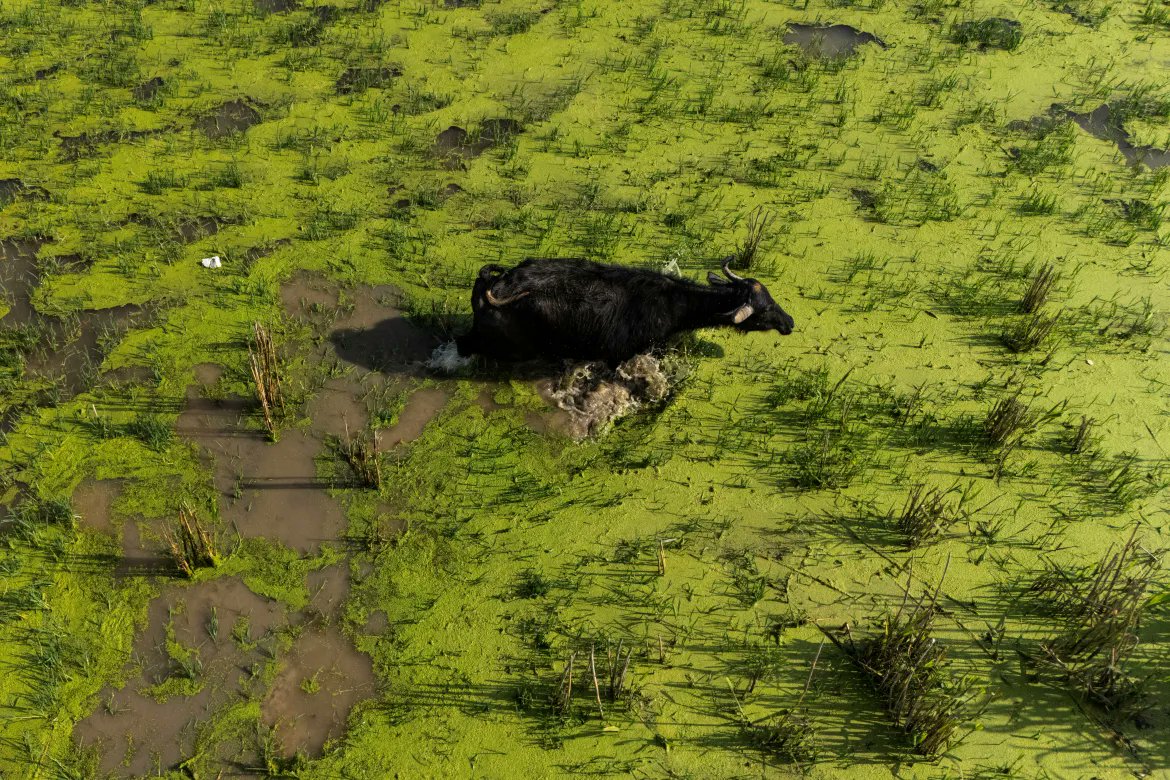
Much-needed rain is bringing life back to the ancient ecosystem of Iraq’s Huwaizah Marshes, after years of devastation — in pictures https://t.co/Y1blDPeSx6
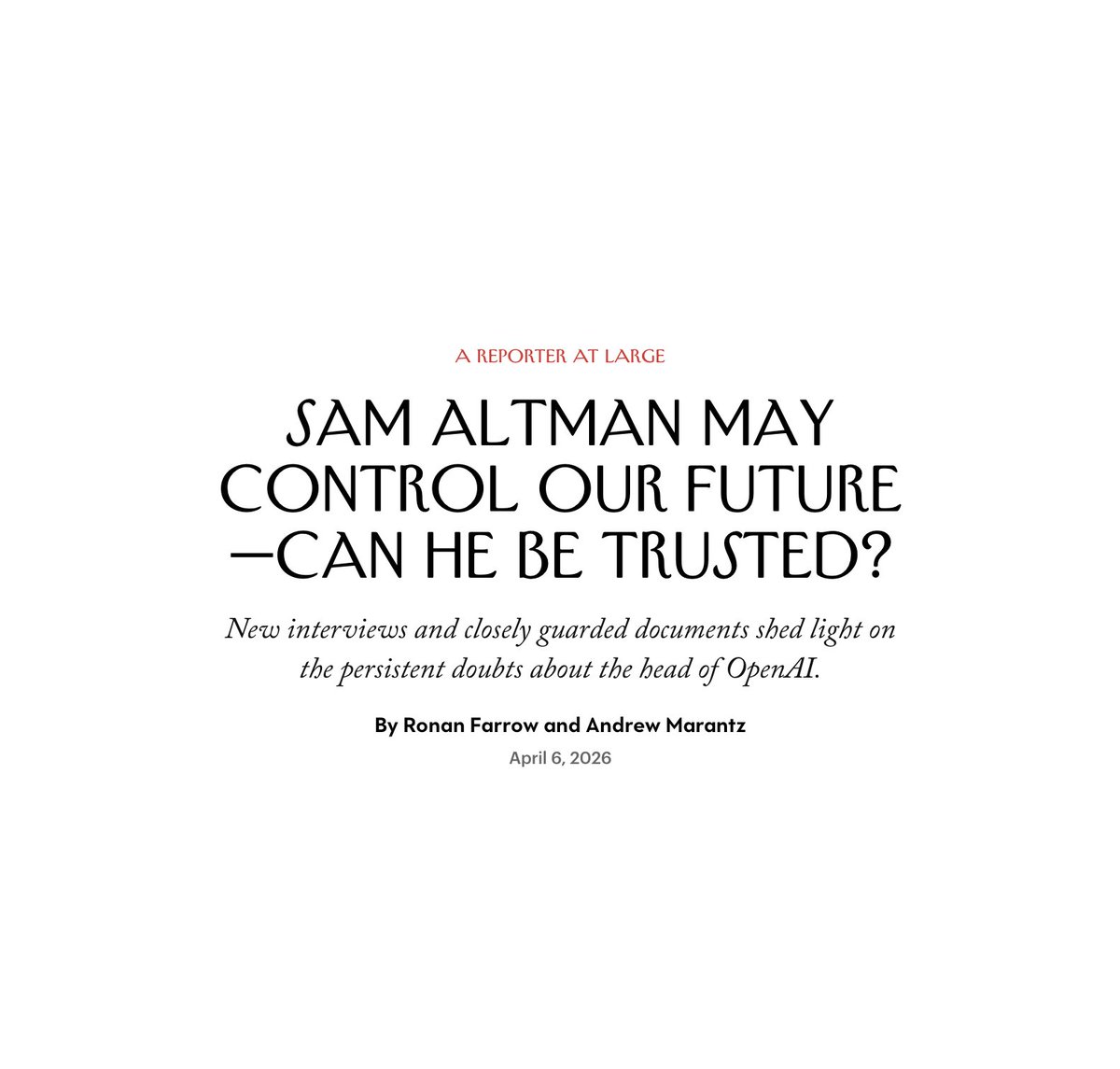
(🧵1/11) For the past year and a half, I've been investigating OpenAI and Sam Altman for @NewYorker. With my coauthor @andrewmarantz, I reviewed never-before-disclosed internal memos, obtained 200+ pages of documents related to a close colleague, including extensive private notes, and interviewed more than 100 people.
OpenAI was founded on the premise that A.I. could be the most dangerous invention in human history—and that its C.E.O. would need to be a person of uncommon integrity. We lay out the most detailed account yet of why Altman was ousted out by board members and executives who came to believe he lacked that integrity, and ask: were they right to allege that he couldn't be trusted?
A thread on some of of our findings:
To celebrate 35 years of @HowardMarksBook’s memos, we’re excited to release The Best of . . . , a curated collection of the memos he considers most impactful.
Watch Howard discuss this milestone: https://t.co/VCAXdJ1MQe
Read The Best of . . . now: https://t.co/XMmHODUObZ
Hi Internet! I'm Drew and THIS IS MY FACE.
If this GIF has ever brought you joy in the past, I humbly ask you to consider making a donation to the National MS Society. It would mean a lot to me and to those I know affected by the disease!
Donate at https://t.co/cHLs9sKqix