LOAD BALANCING: Day 1/25
Your load balancer is lying to you.
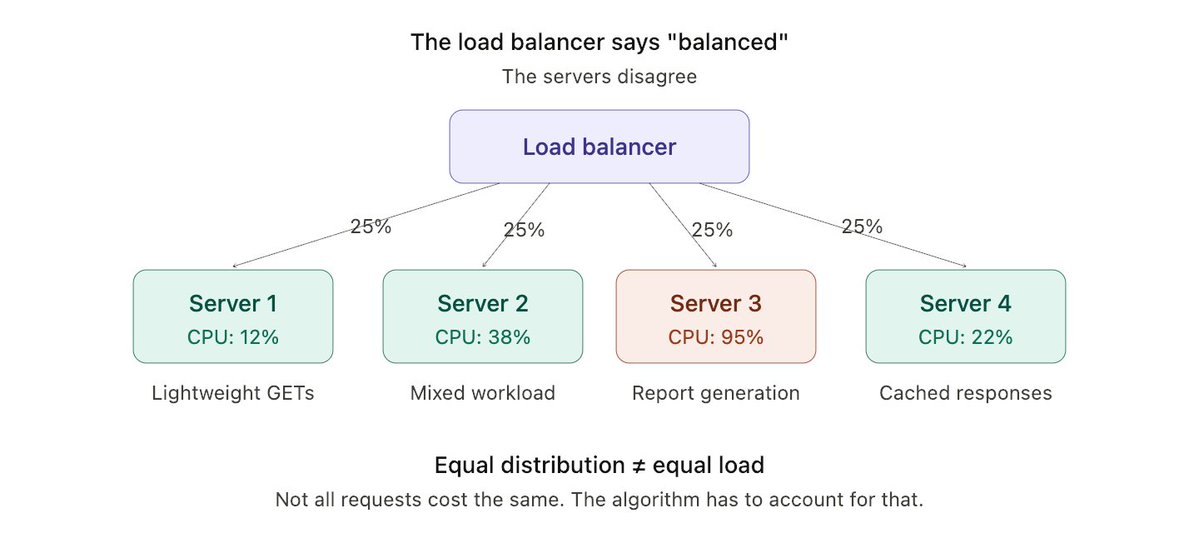
It says traffic is "balanced." What it really means is: requests are being distributed. Whether they're distributed well is a completely different question.
I've seen a system with 4 servers where Server 3 was at 95% CPU while Server 1 sat at 12%. The load balancer said everything was fine.
A load balancer doesn't know what's happening inside your servers. It doesn't know one request takes 2ms and the next takes 12 seconds.
Your choice of algorithm, layer, and health check strategy is the difference between actual balance and the illusion of it.
Let me break it down. 🧵Your load balancer is lying to you.
Well-played: I checked out my first song, top listens, and all-time hits since my first day on Spotify, 12/22/21. Find yours at Your Party of The Year(s)!
https://t.co/vMim2p6xEL
The role of a developer has changed. You're not just writing code, you're orchestrating agents.
Introducing HackerRank Orchestrate, a 24-hour hackathon to design, build, and ship an AI agent that solves real-world problems.
May 1 - 2 | Virtual
Registrations close April 30, 8 PM IST
Think you've got what it takes?
Register now: https://t.co/CnnGh8bERh
Introducing Claude Opus 4.7, our most capable Opus model yet.
It handles long-running tasks with more rigor, follows instructions more precisely, and verifies its own outputs before reporting back.
You can hand off your hardest work with less supervision.
Composite primary keys = uniqueness through combination. Use them when one column isn’t enough to identify a row, like linking tables (student_id + course_id).
All 7 ByteByteGo ebooks, FREE for a limited time. Link at the end.
- System Design Interview Vol. 1
- System Design Interview Vol. 2
- Machine Learning System Design Interview
- Coding Interview Patterns
- Object-Oriented Design Interview
- Generative AI System Design Interview
- Mobile System Design Interview
Whether you’re preparing for interviews or looking to deepen your architecture knowledge, this is a great opportunity.
Offer ends May 1.
Please help spread the word.
Check it out now at: https://t.co/O1nCvdO3P0
WebSockets keep connections open, consume resources, and add complexity. overkill for simple requests, harder to scale, cache, secure, and debug.
HTTP is lightweight and stateless. WebSockets shine only when truly need real-time, persistent connections.
Cold starts, execution time caps, vendor lockin, and cost at scale can bite. Long running jobs, heavy compute, low-latency apps, or full control needs still favor servers.
This is the difference between a demo and production code.
How do you handle cache fallbacks?
Stack I used:
- Node.js
- Redis (@upstash )
- Postgres
- Drizzle ORM
#backend#redis#nodejs
Built a leaderboard with Redis Sorted Sets today ⚡
But the important part wasn’t Redis.
It was the fallback strategy.
If Redis cache misses:
- fetch from DB
- rebuild rankings
- seed Redis again
So the system never breaks.
Fast when cached.
Reliable when not.
@sadkatwt It’s not about the language, it’s about the nature of tasks, distributed systems, load balancing, caching, and infrastructure.
Plenty of massive platforms use Node.js successfully, the bottleneck is design, not Node
@sadkatwt It’s not about the language, it’s about the nature of tasks, distributed systems, load balancing, caching, and infrastructure.
Plenty of massive platforms use Node.js successfully, the bottleneck is design, not Node