You can also find us elsewhere...
@WhatsApp
https://t.co/7PjRhNKa4t
@facebook
https://t.co/9GHecvA64Y
@bluesky
https://t.co/xn14xCSFhN
@LinkedInUK
https://t.co/fF8ACyx43b
@instagram
https://t.co/1F8NF2XtVG
Threads
https://t.co/FLfiNbtWD5
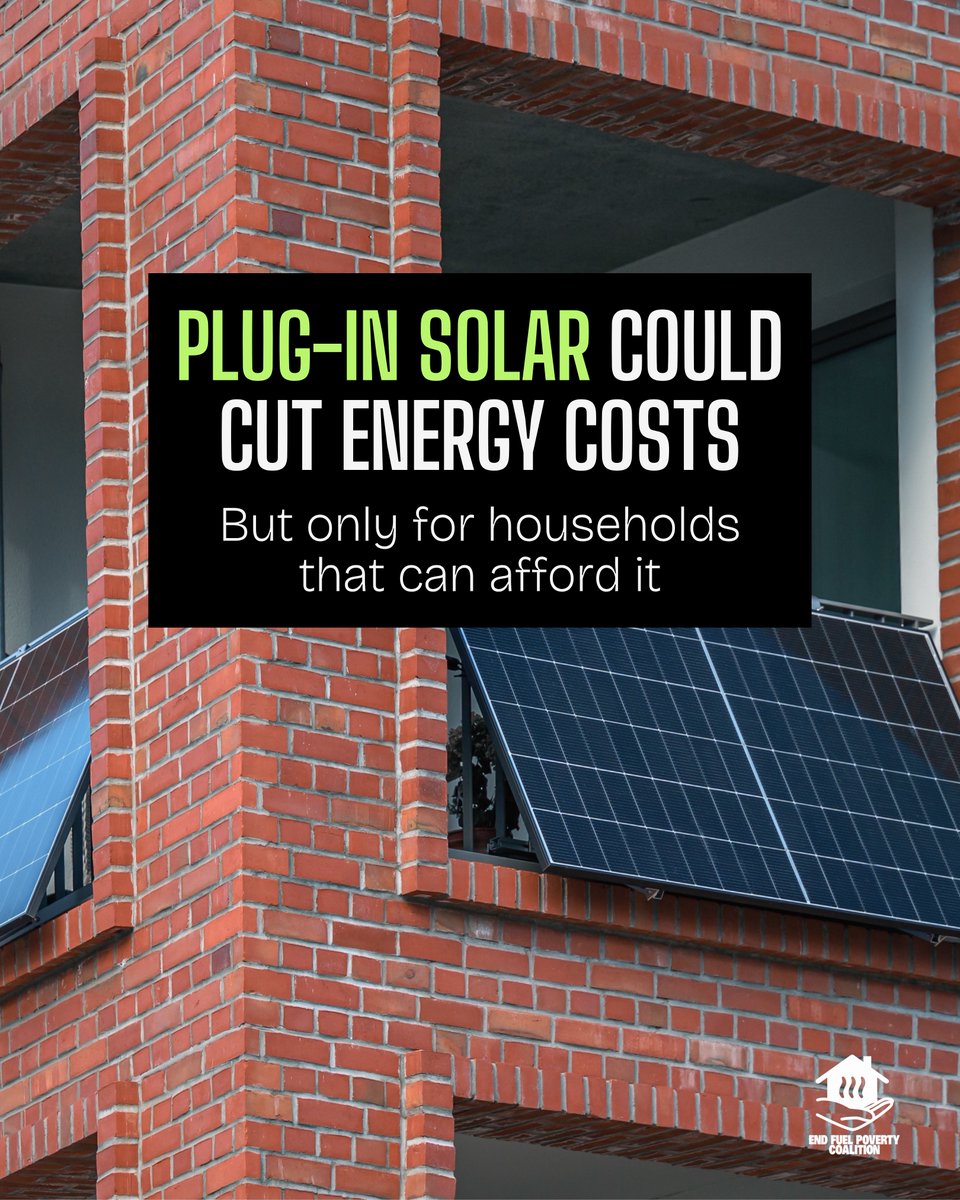
Plug-in solar panels go on sale in the UK from today, offering households a new way to cut their electricity bills.
But there’s a risk plug-in solar widens the gap between those who can afford to invest in energy-saving measures and those already forced to cut back.
Landlords should also make it as easy as possible for tenants to install compliant systems.
Plug-in solar is a welcome step, but it isn’t a solution to unaffordable energy. We still need better-insulated homes and wider reform of the energy system to bring bills down for everyone.
It's not right that while families become poorer, the energy industry gets richer. It's time to get off gas, and end these price shocks for good.
Read more: https://t.co/B0W0jKIz1c
The average energy bill is set to hit a three-year high when Ofgem's new price cap comes into effect in October.
But in the past six months alone, the UK energy industry has made over £6 billion in profits – that's roughly £200 in profit for every household in the country.
Hidden behind the headlines of today’s Ofgem price cap is the reality that for some households, the increases will be even worse.
Those paying by standard credit will see unit rates roughly 8% higher (standing charges for these customers will also be much higher).
Customers on Economy 7 style tariffs will also see a discrepancy in their standing charges, which are 13% higher than for direct debit customers. [1/3]
Once again some regions are far worse off than others.
Ofgem’s calculations will leave customers in north Wales and Merseyside paying almost £360 a year in standing charges alone.
Households in Yorkshire, north east England and southern Scotland all pay over £333 a year.
But customers in London will pay £267 a year in standing charges.
The GB average is £309 a year.
It’s been six years since energy prices were at ‘normal’ levels.
Since the end of 2020:
Every unit of gas… UP… 166%
Daily standing charges for gas… UP… 14%
Every unit of electricity… UP… 53%
Daily standing charges for electricity… UP… 125%
https://t.co/4aTlm4M2uM
The price cap is changing again, as Britain’s exposure to volatile gas prices hits energy bills from 1 October.
But as energy firms continue to post huge profits and households struggle, our new film explains how households need lasting protection.
It’s encouraging that @Miatsf is looking at “a range of support” for vulnerable households struggling with rising bills.
Ministers must go further and faster with help as further increases in the cost of gas are likely to be confirmed by Ofgem tomorrow.
https://t.co/IZEoBmgmNC
Energy complaints are rising, and billing problems are driving them.
The Energy Ombudsman accepted 46,532 complaints in the first half of 2026, up 16% on last year, with billing disputes accounting for almost six in ten cases.
Yet at the same time, Ofgem is considering relaxing clear rules designed to make sure bills are accurate, arrive on time and use the right meter readings.
That should concern consumers.
With bills expected to rise again from October and energy debt already at record levels, a wrong or missing bill is not a minor inconvenience. It can push households further into the red.
This is exactly the wrong time to weaken the protections people rely on when energy suppliers get the basics wrong.
The extreme heat and wildfires we’ve seen this summer are stark reminders of the growing impact of climate change.
Poorly insulated homes don’t just leave people cold in winter, they can become unbearably hot in summer too.
But while households struggle the energy industry keeps posting record profits.
Affordable energy, helping community institutions and boosting local pride can all be delivered by community energy projects which help improve energy security and reduce our dependence on volatile gas prices.
As @andyburnham visits Yorkshire today, will he pop in to see how they’ve done it at Stanningley Bowls Club?
#PMSummerTour #AndyBurnham
https://t.co/fkALEpBbsw
Today's front page:
As energy bills soar, divide between savers and strugglers shows.... A nation divided
Subscribe to the Morning Star newspaper: https://t.co/mQraHmBqdr
With Ofgem changing its definition of an average household, people need to look at the unit costs and standing charges.
The forecasts predict:
- Gas unit costs up 8% from 1 Oct / up 26% year on year
- Gas standing charges +7% / -9%
- Electricity unit costs +2% / +1%
- Electricity standing charges -4% / +3%
Compared to 2020:
- Gas unit costs up 163%
- Gas standing charges up 19%
- Electricity unit costs up 55%
- Electricity standing charges up 126%
Cornwall Insight's final price cap forecast for October is in, and bills are set to rise by 4%. On a unit for unit basis this takes them to their highest level since July 2023.
Ongoing uncertainty around the US-Iran conflict has pushed wholesale gas prices for this winter to a near four-year high. European storage operators are struggling to refill stocks before the cold weather hits, and gas-in-store levels are sitting at historic lows for this time of year.
A heatwave across Europe hasn't helped either, with air conditioning demand adding further pressure to gas needs for power generation.
VAT is being cut from electricity bills from October, saving around £45 a year. But wholesale market swings are outweighing that saving, which is why bills are still heading up despite the cut.
🔷 Here is a figure breakdown:
Under @ofgem new definition of a typical consumer, introduced in July 2026, the annual cap is expected to rise to £1,729 from the current £1,663.
Under the previous definition the annual cap is expected to rise to £1,941, from the current £1,862.
The amount a household pays depends on their usage, with these numbers reflecting Ofgem’s view of typical annual household energy demand.
Per Unit Cost (p/kWh)
Electricity: 26.57 Gas: 7.90
Standing Charge (£/per day)
Electricity: 0.55 Gas 0.31
Read the full analysis: https://t.co/RWerIPbOF7
📈Gas prices are set to rise again from October. And if households use the same amount of energy as last winter, they’ll actually pay more.
This is despite Ofgem lowering its estimate of how much energy a "typical" household uses.
Some of that reduction reflects welcome improvements in energy efficiency. But for millions of households, it also reflects something much more worrying: people simply cannot afford to use as much energy as they did before.
More than a third of UK households (35%) say they have cut back on energy use because of higher costs. One in ten are now skipping hot meals to save money.
Meanwhile, energy firms have reported more than £6 billion in UK profits in 2026 alone.
As communities face rising energy bills driven by our reliance on gas, Walsall’s Community Energy Hubs are stepping in to help.
Expert advice, home visits and practical support that puts real savings within reach of the people who need them most, by making homes more energy efficient.
As @andyburnham is in the Black Country today, he might have liked to visit one of the Hubs, run by the council with trusted local community partners.
#PMSummerTour #AndyBurnham
https://t.co/HK5QUrGFqf
The answer is obvious: Use taxes on these windfall profits to support people in energy debt. Help people to make their homes more energy efficient. Transition quicker to homegrown, renewable energy. No more reliance on volatile fossil fuel markets. (2/2)
Read more: https://t.co/RwXNADm62b
Households are bracing for another Ofgem price cap announcement later this month, with energy bills expected to stay sky-high as a result of the Iran conflict, and consumer energy debt mounting.
Yet major energy firms are doing very well out of this crisis. Our analysis has found that the UK profits of a handful of these firms, including Shell and BP, has exceeded £6 billion, while global profits have surpassed £95 billion. That's in this year alone, so far. (1/2)
Their bosses have also done well: a handful of the fat cats at the top of these companies have seen their personal stakes rise by a combined £30 million since the war began in February.
People are struggling. And with the next price cap announcement on the horizon, millions more families could soon be unable to cover their energy bills, or be pushed further into energy debt. (2/2)
Read more: https://t.co/Zt7NtColrw
🗣️ It's bill payers vs. billionaires: while the conflict in Iran has sent our bills skyrocketing due to our reliance on fossil fuels, the energy industry has sat back and watched its profits climb.
Our new analysis shows that firms including Shell, BP and Equinor have made more than £6 billion on their UK operations alone in the first half of 2026. (1/2)