𝙒𝙝𝙮 𝙈𝙖𝙧𝙮 𝙄𝙨𝙣'𝙩 𝙈𝙚𝙣𝙩𝙞𝙤𝙣𝙚𝙙 𝙈𝙤𝙧𝙚 𝙊𝙛𝙩𝙚𝙣 𝙄𝙣 𝙏𝙝𝙚 𝘽𝙞𝙗𝙡𝙚
A question that's often posed to Catholics (and Eastern Orthodox Christians) is: "if Mary is as important as you say she is, why isn't she mentioned more often in the Bible?" As a Catholic, I have no problem saying "it's a fair question!", and I sometimes see Catholics struggle to answer this question.
The reflexive thought of many Christians about this question is that it makes perfect sense that if a Biblical figure or belief is very important, their/its level of importance will always be directly proportional to the frequency with which they/it are 𝘦𝘹𝘱𝘭𝘪𝘤𝘪𝘵𝘭𝘺 mentioned in the Bible.
However, I suggest that there's a deeper and more spiritual way of understanding the importance of Biblical figures/beliefs in general, and Mary in particular.
A Protestant friend of mine asked me the aforementioned question a few years ago, and I referred the question to my brother, who is exceptionally wise about spiritual matters.
I found his answer (especially the parts after the part on Biblical typology) to be one of the most profound things I've ever read, and although I realize that some of you who read it may disagree with certain parts of it, I hope that reading it will be as enlightening to those of you who read it as it was to me. God bless you 🙏
@dragodimitrov@fiatluxgenesis@ninaslostnfound
@ArchangeloRom
@micailagraham@DMStThomas@riecker@burgess7281975@billarnoldteach
@MidniteMilkk
@_Redacted_Twit@dianahenry@bee_witched
@hippiereligious
@breesolstad@Avonleebythesea@amandaperera
@juliepnicole
@meghaverma_art@IamJonte_
🧵
So here's the whole case in one breath:
Heaven knows what happens here. The saints receive our prayers and bring them to the Lamb. It takes nothing away from Christ, the one Mediator — it shares in his work. Distance, language, even death are no obstacle to souls alive in God. And Christians have believed — and practiced — this from the very start.
Asking the saints to pray for us is one of the most biblical things we can do.
Repost this so a friend who needs to see it can. 🔁
Here's exactly where you can find the intercession of the saints in the Bible.
A lot of people assume it's a Catholic add-on with no Scripture behind it. It's actually right there in the Bible — let me walk you through it. 🧵
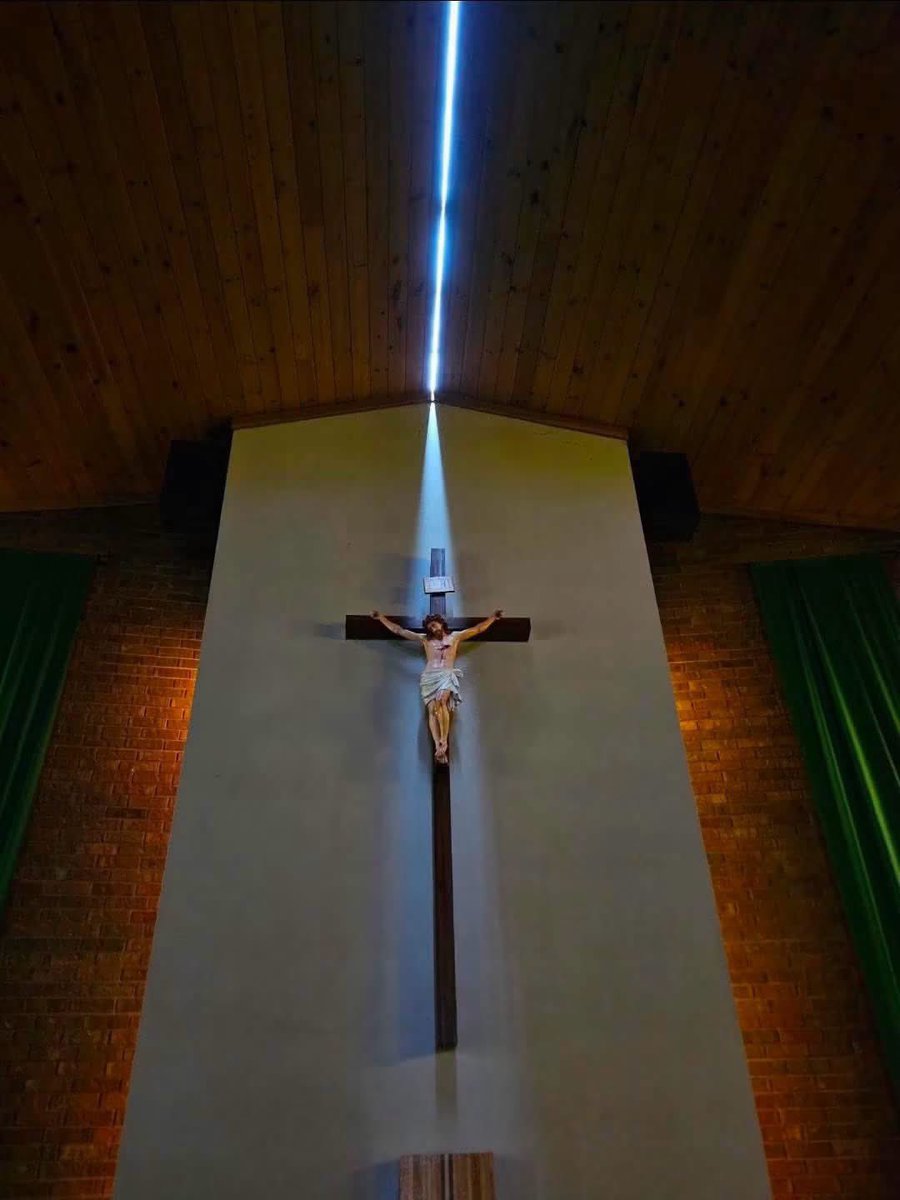
One of the most incredible storm damage pictures I’ve ever seen happened this morning in South Dakota. A 131 mph wind gust in the city of Highmore split the roof of the Catholic Church perfectly illuminating the crucifix. This is not AI, it’s been confirmed real by locals. Truly amazing. Credit: Joseph Mat @stormhour
CHURCH FATHER: BEFORE ANTICHRIST, THE CHURCH WILL GROW WEAKER, AND HER VISIBLE SIGNS WILL DARKEN
St. Pope Gregory the Great’s “Moralia on Job” is a truly astounding work. Completed near the end of the 500’s, it was so penetrating in its mystical and spiritual analysis of Job that even St. Thomas Aquinas, in his own commentary, completely skipped the spiritual reading of Job, saying Gregory had done it so well “that nothing further need be added to this sort of commentary.”
In the Moralia, St. Pope Gregory the Great reads the story of Job (partly) eschatologically, and speaks multiple times about how the Church will be profoundly weakened before the arrival of Antichrist, but that this is ultimately to the benefit of the elect, and permitted by God to bring the reprobate into condemnation.
It’s a very humbling and eye-opening observation to read, for Gregory constantly sees in such things God opening highways of mercy and reward for the truly righteous, if only they refuse to be scandalized, which turns Catholics into heretics, schismatics, and apostates.
This is just one of several observations he makes on this front:
“While Holy Church appears more commonplace in this way, deprived of the power of signs, it happens both that the rewards of good people grow greater, because they venerate the Church in the hope of heaven and not because of the signs that she presents, and the minds of bad people are quickly shown to be against the church; they neglect the following of the invisible reality that she promises, because they are not impressed by visible signs.
Accordingly, since the humble faithful are deprived as it were of the multitude of manifest signs, the hidden plan holds a terrible trial, more generous in mercy for those who are good but heavier in righteous anger for those who are bad.
So before Leviathan [Antichrist] becomes manifest and conspicuous, in large part the signs of power in Holy Church cease, and we are told, ‘Poverty goes before his face’ (Job 41:13).”
St. Pope Gregory the Great, Moralia on Job (Book 34, §7)
This Sunday, Jesus reminds us that it's impossible to be attached to this world and fully embrace what God calls us to.
Being ready to 'lose our life,' literally or figuratively, is the key to heroism.
St. Jacinta Marto, one of the Fatima children, demonstrated exactly this by her witness to those who doubted her.
📺 Watch the full Sunday Reflection on YouTube: https://t.co/drkHveiVXZ
NEW: The recently built cardiac unit of the Düsseldorf University Hospital in Germany, where heart surgery is performed, is currently measuring 38°C
relatives in Germany are being asked to bring ice packs from home and staff are using "cooling vests"
“Little Town on the Prairie,” Laura Ingalls Wilder, 1935:
“The [Fourth of July celebration] crowd was scattering away then, but Laura stood stock still. Suddenly she had a completely new thought. The Declaration and the Song came together in her mind, and she thought: God is America’s king. 1/X
I’m old enough to remember when you could actually watch cable TV and find intelligent conversations. Once upon a time, Fulton Sheen sat with William F. Buckley on his Firing Line television program.
Even though it’s been more than 50 years since he said this, I think the quote is not only prophetic but the key to understanding what is wrong with our age today. Sheen warned that compassion shown more for the mugger than for the mugged was dangerous and he noticed it was becoming more and more common.
It was commentary back then, but now it looks more like prophecy.
I’ll never understand why people have more compassion for the criminal than the victim.
I’ve been thinking a lot about this quote as we approach the one-year anniversary of Iryna Zarutska’s death.
Blessed Fulton J. Sheen, you were right. Pray for us.
In 1979, not long before he died, Archbishop Fulton Sheen gave his final interview to Marie Torre of WABC. The 5 most important things he said in the interview were....
1. Modern erotic culture is a failure of purpose, not merely a failure of rules.
2. The family depends on sacrificial love, not mutual self-satisfaction.
3. The human heart wants life, truth, and love in an absolute form; this desire points to God.
4. The Church cannot become credible by copying the world.
5. Children require moral formation, not permissive abandonment disguised as freedom.
When he gave this interview, no one knew it would be his. Let us never forget his wisdom.
In 2015 a writer named Tim Urban sat down and counted the days he had left with his parents. He was 34, healthy, both parents alive and well. The number came back around 300. Less time than he spent with them in any single year of his childhood.
The post is called The Tail End, on a blog called Wait But Why. The idea is to stop counting your life in years and start counting it in events. Reach 90 and you get about 4,680 weeks, and every one of them fits on a single sheet of paper. Maybe 60 more winters after that. If you read five books a year, that is 300 books, picked from every book ever written.
Those things at least spread out evenly. A third of the way through life means a third of the way through your pizzas. Time with the people you love does not work like that. Almost all of it sits at the very start. Then it is gone.
For your first 18 years you are around your parents nearly every day. Then you leave for college or a job in another city, and a normal adult sees their parents maybe 10 days a year. So the day you move out, you are already at 93 percent. Urban was living in the last 5 percent and had no idea until he drew the chart. He called it the tail end.
It does not stop at parents. His two sisters, after a whole childhood in the same house, had around 15 percent of their time together left. The four friends he played cards with most days in high school were down to their last 7 percent. Nobody had a fight. Nobody moved away angry. Life quietly spends the time for you while you assume there is plenty left.
You do not have to be old to be near the end with someone. If your parents are alive and you live in a different city, you have probably already used more than 90 percent of the days you will ever spend in the same room as them.
His one instruction is about that last stretch. When you are down to the final days with someone you love, treat that time like what it is, which is almost gone. The rest is the tail end, and it is much shorter than it feels.
I've thoroughly enjoyed getting a window into Catholicism in Africa via X.
It puts things into perspective for me, and makes a lot of my own concerns about Catholicism in the USA seem somewhat precious and even bourgeois.
These people face real persecution, real poverty, poor Parishes, irregular or rare access to Sacraments, and often travel grueling distances in order to attend Mass. In some countries, many of these people even live in fear of real violence for their faith. Yet they go to great lengths to get to Mass anyway.
The various "Liturgy Wars" we have the luxury to engage in here do not seem to be near as much of a going concern there, by the by -- they accept the Ordinary Form of the Mass, make do with austere sanctuaries full of the "noble simplicity" that Vatican 2 calls for, yet they seem to do so reverently (receiving on the tongue seems common).
So many of the problems we see in the Church in America may seem dire, like a "crisis," we may have many very princely critiques of the Masses we have access to, we may drive far to go to one we prefer, some may even indulge in the idea of schismatic sects and the like...
Meanwhile in Africa, the Mass is the Mass, and the faithful will do anything to get there. They appear not to have the luxury to be quite so finicky as we're able to be here, and I do wonder if they aren't better off for it in a way.
"May the excitements of the world, fleeing like a shadow, not disturb you."
~ St. Clare of Assisi
View of the Church
of Santa Maria degli Angeli
🎨 Henri-Edmond Cross (1909)
St. Irenaeus of Lyons, pray for us! He combated the Gnostic heresy (that the material world was evil and had access to secret knowledge) by exposing and refuting their teaching & defending apostolic authority. https://t.co/amYS65rxPN
We had a torrential downpour a couple of hours ago so headed quickly up to Stanbury and managed to get this. Better than nothing though wish the rainbow were more vivid!





![JoshuaTCharles's tweet photo. CHURCH FATHER: BEFORE ANTICHRIST, THE CHURCH WILL GROW WEAKER, AND HER VISIBLE SIGNS WILL DARKEN
St. Pope Gregory the Great’s “Moralia on Job” is a truly astounding work. Completed near the end of the 500’s, it was so penetrating in its mystical and spiritual analysis of Job that even St. Thomas Aquinas, in his own commentary, completely skipped the spiritual reading of Job, saying Gregory had done it so well “that nothing further need be added to this sort of commentary.”
In the Moralia, St. Pope Gregory the Great reads the story of Job (partly) eschatologically, and speaks multiple times about how the Church will be profoundly weakened before the arrival of Antichrist, but that this is ultimately to the benefit of the elect, and permitted by God to bring the reprobate into condemnation.
It’s a very humbling and eye-opening observation to read, for Gregory constantly sees in such things God opening highways of mercy and reward for the truly righteous, if only they refuse to be scandalized, which turns Catholics into heretics, schismatics, and apostates.
This is just one of several observations he makes on this front:
“While Holy Church appears more commonplace in this way, deprived of the power of signs, it happens both that the rewards of good people grow greater, because they venerate the Church in the hope of heaven and not because of the signs that she presents, and the minds of bad people are quickly shown to be against the church; they neglect the following of the invisible reality that she promises, because they are not impressed by visible signs.
Accordingly, since the humble faithful are deprived as it were of the multitude of manifest signs, the hidden plan holds a terrible trial, more generous in mercy for those who are good but heavier in righteous anger for those who are bad.
So before Leviathan [Antichrist] becomes manifest and conspicuous, in large part the signs of power in Holy Church cease, and we are told, ‘Poverty goes before his face’ (Job 41:13).”
St. Pope Gregory the Great, Moralia on Job (Book 34, §7)](https://pbs.twimg.com/media/HL6tbe7bgAAFQ61.jpg)





