Real use cases for treasury management and end-user Earn products backed by 'real world assets'
This is what institutional adoption looks like — FinTechs around the world offering new products never accessible before
Powered by @opentrade_io x @SierraIsMoney on @avax
550% AUM growth in a single year is product-market fit @ institutional scale
@opentrade_io on @avax : $100M+ AUM, 10M+ end users, $250M+ in stablecoin yield volume
@mattparlmer How is the US behind in space?
It seems most technologies are more advanced than rest of the world, but the production capabilities is where the US falls behind
@Noahpinion What I never understand is that if we significantly increase SF’s population, we will significantly destroy the surrounding wildlife and nature which is what makes this city great
Why not develop around the Bay Area more and make it better interconnected?
@bgurley @westcoastbill @opentrade_io Coinbase offers discretionary rewards program
Businesses cannot productize it
Our clients access suite of yield assets (2-10%+) thru a single API without off ramping
We manage reporting & treasury management
I’ll be at your event Thurs. Let’s chat more then
@bgurley @westcoastbill Next comes yield on stablecoin holdings
Fintechs offering stablecoin accounts will not have ability to generate yield on customer deposits
@opentrade_io services this gap with our API-first, embeddable, secure and scalable infrastructure
Yield from tradfi, crypto, and defi
The nearest experience I have to trying out Claude for the first time is getting glasses as a kid
I can't believe I had been using Grok and ChatGPT first
We're really excited to be partnering with @turtledotxyz, the leading liquidity distribution protocol in crypto, to provide their users with an exciting new opportunity to deploy USDC and earn industry-leading yield with SIERRA
Excited about our partnership Midas Kripto to offer $USDT staking to millions of Turkish investors. This highlights our ability to service the fastest growing markets where hyperinflation and currency devaluation drive demand for saving in USD-yield products, particularly on https://t.co/ThPB1nQzxr's USDT- what individuals and businesses trust to protect their savings.
1/ @getmidas Kripto, Turkey’s fast-growing hub for seamless crypto investing, has partnered with OpenTrade to roll out a New $USDT staking experience built directly into the platform. Powered by OpenTrade institutional-grade yield infrastructure, the upgrade brings simple, stablecoin-based returns to everyday users without any complexities or lockups.
With this new integration, Midas Kripto users can now put their $USDT to work and automatically earn steady, dollar-based yield, which they can unstake back into $USDT or trade at any moment. Rewards accrue immediately and balances plus any earned yield can be converted to TRY or USD instantly whenever users wants.
“Midas Kripto is dedicated to making easy crypto investing accessible for Turkish users. Partnering with OpenTrade enables us to offer USDT Staking with stable rewards backed by high quality assets, seamlessly integrated into our app. This strengthens our mission to provide innovative, user-friendly financial solutions without FX or crypto market risks.” - Balam Bingül, Vice President and General Manager of Midas Kripto
One of the core yield strategies backing SIERRA is lending to @wintermute_t on @WildcatFi
Learn more below about Wildcat, why Sierra lends to Wintermute and how Sierra uses Wildcat as part of its reserve management strategy
1/ In @a16zcrypto's recent State of Crypto 2025 report, @DarenMatsuoka, @rhackett, @jeremyzhang01, @stephbzinn, and @eddylazzarin highlight the mainstream adoption of stablecoins within the past year. Once used primarily to settle trading activity, stablecoins have become the fastest, most cost efficient way to send dollars globally.
The report, notes that stablecoins processed $46 trillion in volumes over the last year with adjusted activity reaching $9 trillion, up to 87% year-over-year.
Total supply has surpassed $300 billion, with $USDC and $USDT representing 87% of the market and have now emerged as the backbone of the on-chain economy.
In this context, OpenTrade has built infrastructure standing at the intersection of stablecoins and real world assets, offering fintechs, neobanks and exchanges enterprise-grade stablecoin yield products. OpenTrade’s platform supports USDC, USDT and EURC primarily on @avax, enabling businesses and their users to earn RWA-backed yield on stablecoin balances via a B2B2C ‘Yield-as-a-Service’ model.
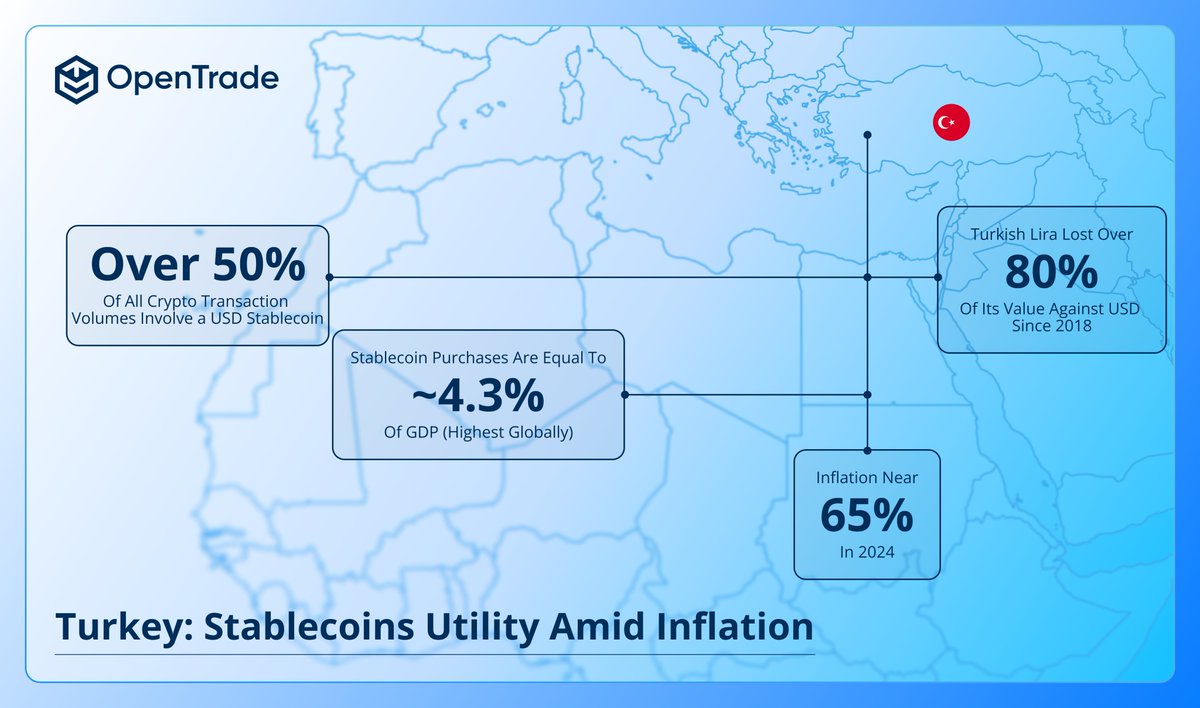
1/ Turkey: Stablecoin utility amid inflation
Turkey’s consistent economic pressure is gradually leading to a shift to digital dollars. Since 2018, the Turkish lira has lost over 80% of its value against the U.S dollar, with inflation nearing 65% in 2024. For the millions navigating a volatile economy and depreciating savings, crypto and stablecoins are increasingly becoming the necessary tools needed for preserving value, transacting, and saving.
According to @chainalysis, stablecoin transactions now account for 4.3% of the country’s GDP, positioning Turkey as one of the world’s active European markets for dollar-pegged digital assets. Over half of the population now uses crypto, with significant activity involving USD-denominated stablecoins. Turkey’s growing stablecoin adoption highlights the rising demand for stable accessible money amid inflation and devaluation.
@VitalikButerin: if BlackRock and other institutions keep expanding their ETH holdings, Ethereum faces risks of builders getting crowded out and weakening the community
PoS chains are centralizing and inherently extensions of the existing financial system 👇
I disagree here. BTC network is more or less fine but PoS chains are significantly vulnerable to this attack vector🧵
Bitcoin is a PoW chain, so BLK and asset managers having ownership does NOT influence the network beyond their market influence (which can and likely could become a problem).
But ETF providers could have the ability to directly/indirectly influence the market! This is true of large asset managers with small market cap companies in passive indexes. This is the same reason why 'passive investing is distorting the market' as much of the investment industry has been decrying for the past 10 years.
Consider how an asset manager goes to market to procure more BTC for an inflow of ETF purchases?
They either
A) go to exchanges for BTC in circulation OR
B) engage with BTC miners for newly minted BTC.
Miners hold far more leverage here than the asset managers and benefit greatly from these structures.
Now to your point, the problem becomes if asset managers blacklist miners or preferentially select partner miners to source liquidity from. But it would disadvantage both the asset managers and miners to change the 'game' of BTC unless you want to destroy the asset..
If any regulatory agency does that, then markets reconfigure elsewhere. But from what I've been seeing in the BTC mining industry, there are levels of sovereign alignment with miners to stabilize renewable grid systems. They would shoot themselves in the foot and reduce resiliency and stability of their energy grid and national security just to put miners in a chokehold.
Given that ENERGY is far more equitably distributed around the world than capital, BTC's sovereign attack vectors would require blocs of nations coordinating across agencies to manipulate the mining industry. We've seen this game of whack-a-mole before and how it turns out.
If 'decentralized' capital markets on PoS chains integrate with tradfi financial markets, then CAPITAL becomes to leverage point to exert influence. That means that 'defi' is basically just an extension of the current financial system.
The problem of decentralization REALLY arises when structured products are created for PoS chains like Ethereum — entirely why I don't understand 'defi' beyond speculation.
Working at BLK I recall looking doing portfolio forensics for holdings and performance attribution of index equity funds to report to institutional clients and would see the gravity and efficiency created by scaled asset management and how it'd impact markets.
ETF providers will become US public markets 'majority shareholder' equivalents in these networks if they aggregate ETH like they have been with BTC. But even worse as there are no regulatory thresholds of ownership limits for entities owning these tokens!!
This is where the industry bends the knee and forfeits decentralization because every PoS chain with flows driven by asset managers will become indirectly regulated under the SEC and CFTC.
BTC is secured by energy and compute, which is globally distributed and abundant. Centralizing forces can kick in with economies of scale of data center operations and ability to access debt. As the world shifts to renewables, particularly green hydrogen, we can truly envisage a future where BTC functions as a financial battery for excess energy in which anyone can participate as a miner.
Since ETH and other PoS chains are an extension of current financial systems, where the amount of capital dictates the amount of influence you have in the system, you won't have nearly the same level of democratized influence over the network.
In the long run, PoS chains are not censorship resistant and could become entirely regulated directly/indirectly by sovereign regulators.
I could never conceptualize where 'decentralized' projects fit in this worldview because 1) lot of it is just token speculation and fancy research, and 2) even if you build that app/infra, the whole network will eventually corrode and fold into the current financial system's influence.
@saylor is right in some regard, there is no second best because BTC is far more decentralized and resistant to these attack vectors from financial regulators as they cannot control globally distributed energy or compute, while they can control capital flows and security products.
The crypto industry does not talk about this and collectively ignores this because the market is receiving the passive inflows from tradfi that they'd rather preposition down on the risk curve given the inevitability of 'adoption'...
instead of building truly democratizing financial products which equitably levels the playing field for people around the world to gain access to 'developed market' financial infrastructure.
I came into crypto believing that this will democratize access to the US financial system and lower the cost of capital globally to fund the marginal entrepreneur who can make the world a better place.
I believe we can build the latter, (and that we are!!), but to your point the industry really needs to wake up and become pragmatic about how the market structure can centralize the network and become more rational about the types of business structures that should be built on chain.