How to legally "boost" a company’s profits by 370% when the business grows by 120%?🧠
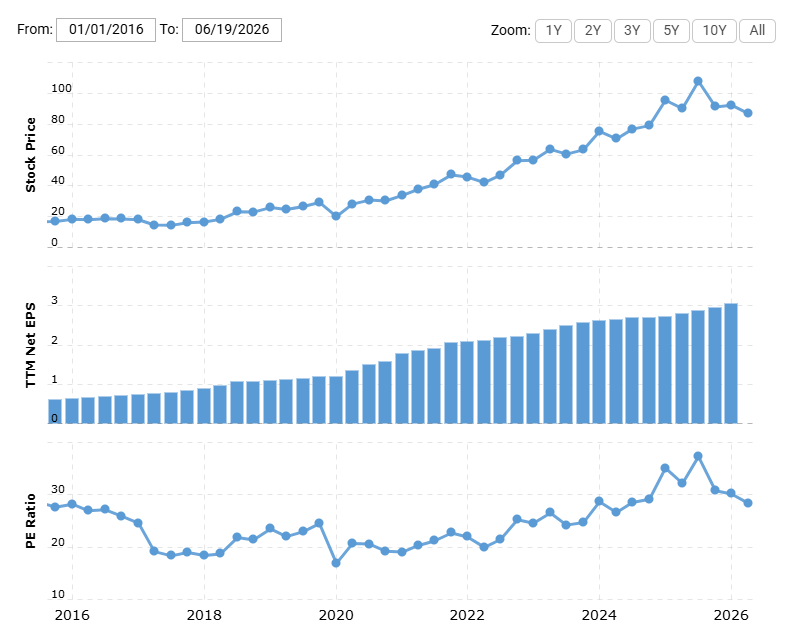
Imagine a company that doubles its revenue over 10 years. Great result, right? But what if during that same time, its Earnings Per Share (EPS) shoots up by nearly 385%, and the stock price jumps over 400%, absolutely crushing the broader market?
This isn’t creative accounting or speculative hype. It’s a textbook example of a "Cannibal Stock" (a company eating its own shares).
The star of this post is O’Reilly Automotive ($ORLY) – the king of the US auto parts market. Let’s look at the hard data to see how this financial magic works and what it teaches us.
Pure Math: 10 Years of $ORLY History📊
Before we dive into the numbers, a quick technical note: in June 2025, O'Reilly did a massive 15-for-1 stock split (the stock price dropped 15x, and the share count increased by the same amount). To make sure this analysis makes sense, the historical data below is fully split-adjusted (meaning it reflects exactly what you see on official stock charts):
- Revenue: $7.9B ➔ $17.7B (+123%)
- Net Income: $0.93B ➔ $2.54B (+173%)
- Shares Outstanding: ~1.52B ➔ ~0.84B (-45%)
- Earnings Per Share (EPS): $0.61 ➔ $2.97 (+386%)
How does this turbocharger work?🔄
O'Reilly's core business grew financial gold on its own – more than doubling its scale, improving efficiency, and hitting higher margins (net income up 173%). Under investor pressure, management stopped chasing expensive acquisitions and focused on internal efficiency. But the real game-changer for the stock was their aggressive share buyback program. Over the decade, the company bought back and canceled nearly half of its entire share count!
If O'Reilly HADN'T bought back those shares, their EPS today would be around $1.67. But because that same net income is divided among way fewer "slices of the pie," the EPS shot up to around $3.00. Your ownership in the business grew automatically, even if you didn't buy a single extra share.
Is this just a stock market bubble?🎈
The ultimate skeptic's question: did the valuation get disconnected from reality? Let’s check the P/E (Price-to-Earnings) ratio:
- P/E Ratio in 2015: 27.6x
- P/E Ratio in 2025: 30.5x
The valuation remained incredibly stable over the entire decade (growing by just about 10%). This is definitive proof that the stock price surge wasn't driven by market hype or speculation – it directly tracked the massive, real profit growth generated by the business and amplified by the buybacks.
Important warning⚠️
Not all buybacks are created equal. A lot of boring companies buy back shares using borrowed money just to hide zero growth. At O'Reilly, the fuel was real, massive cash flow from a healthy, growing business.
The New Wave: Tech Giants Following the Playbook🚀
We are seeing the exact same "cannibal effect" playing out with mature tech giants. They generate so much cash that even after funding innovation, they still have tons of capital left over:
- Salesforce ($CRM): For years, it was criticized for diluting shareholders (giving out tons of stock to employees via SBC). For the past few years, they’ve been consistently buying back shares, retiring 13% of the company so far. Recently, they announced a record-breaking $50B buyback program, which allows them to wipe out over 28% of all outstanding shares (at current market cap).
- Adobe ($ADBE): Holding a virtual monopoly in many creative software segments, the company regularly clears its own shares off the market. Over the last 10 years, they took 20% of their shares out of circulation, and recently announced a new $25B buyback program running through 2030, allowing them to retire over 30% of all outstanding shares (at current market cap).
It's worth noting that these companies fund their buybacks using the massive cash piles they generate every quarter. In $CRM's case, the company used cheap corporate bonds to raise capital and immediately buy back a huge chunk of shares – they plan to deploy that $50B over 2026–2027, while paying off the debt directly from their free cash.
The Hidden Ace: Price-to-FCF Valuation💸
Where do these companies get hundreds of billions for buybacks? Straight from Free Cash Flow (FCF) – the cold, hard cash left in their pockets after paying for all operations and capital expenditures.
And this brings us to the stock market "cheat code" unfolding right before our eyes. Right now, both Adobe and Salesforce are trading at very attractive Price-to-FCF (P/FCF) multiples compared to their historical averages:
- Adobe P/FCF: ~7.86x
- Salesforce P/FCF: ~9.64x
What does this mean in practice? A low Price-to-FCF multiple is the perfect buying window for management. Because the stock price isn't overvalued, every single dollar spent from FCF allows the company to vacuum up way more shares than they could during a market frenzy.
How should you interpret this? These metrics show that their annual FCF Yield is a massive 10–12%. Purely theoretically, at their current pace and market price, Adobe could buy back 100% of its own shares from the market in just 7.86 years, and Salesforce could do it in 9.64 years. These are absurdly low numbers for high-margin software businesses that dominate their industries.
The takeaway? If these companies keep their cash-generating machines running smoothly, these low valuations mean they will "eat their own tail" much faster than the market expects. Over the next few years, this rapidly shrinking share count could trigger massive, exponential upside moves in the stock price – exactly like we saw with O'Reilly.
Investor Takeaway💡
When looking for long-term compounders, don’t just get excited about top-line revenue growth. Look for Free Cash Flow machines that are reasonably valued by the market and know how to smartly, safely, and consistently eat their own tail when the market gives them a cheap opportunity to do so.
Enjoyed this analysis? Drop a like and retweet! 🔄
Disclaimer: This post is for educational purposes only and does not constitute financial or investment advice. Always do your own research before investing.
@Byczy_Inwestor Śmieszne jest w sumie to, że praktycznie każdy z nich nieświadomie z tego procentu składanego korzysta - mając pieniądze w ZUS, które są waloryzowane o inflację. Gdyby tylko przełożyli tę wiedzę na rynek akcji, gdzie zwroty są większe.
Studia są obszarem, w którym ludzie zdobywają wiedzę i uczą się w jaki sposób powinno się ją zdobywać. Pisanie pracy licencjackiej, inżynierskiej bądź magisterskiej są jednymi z pierwszych w ich karierze pracami naukowymi, w których mają możliwość przeprowadzić tego typu badania samodzielnie i nauczenia się jak taki proces powinien przebiegać -> postawienie hipotezy, sprawdzenie literatury, przeprowadzenie badań/eksperymentów, wyciągnięcie wniosków. Praca doktorska natomiast jest zazwyczaj kilkuletnim procesem badawczym i tutaj chyba nie muszę pisać jak bardzo tego typu umiejętności potrafią się przydać.
Więc odpowiadając na pytanie jest to bardzo przydatna umiejętność z perspektywy późniejszej pracy w środowiskach badawczo-naukowych. Przypomnę tylko, że studia (jak wielu się może wydawać) nie są kursem zawodowym, a tokiem nauczania konkretnego kierunku pod kątem naukowym.
@fgutowski__ Matematyka to nie wzorki i równania tylko przede wszystkim umiejętność logicznego i konsekwentnego myślenia. Matematyka uczy myśleć w konrektny sposób, który później bardzo przydaje się w życiu, więc nie ma żadnego powodu, aby ograniczać jej nauczanie.
@AlkoInwestor@jakubtepper Dlaczego tak nierozsądnie rozporządza Pan walorem czasowym przeznaczając go na darmową pracę nad wykonaniem miniatury, zamiast na optymalizację kolejnych procesów. Trochę zaczynam się martwić :/
Pełna zgoda.
Fajnie, że powoli wizja ta zaczyna przechodzić do mainstreamu i ludzie to zauważają.
Inwestorzy zapomnieli, że na koniec dnia czy to crypto, ai, software czy cokolwiek innego projekt MUSI zarabiać, MUSI mieć biznes plan i rozwiązywać problem, za ktory ktoś chce zapłacić.
Sama technologia crypto to narzędzie, a nie biznes sam w sobie.
Podobnie jak Ty narazie przyglądam co z tego zacznie się wyłaniać. Na pewno ethereum:native powinno na tym sporo zyskać jako platforma, na której wszystko będzie budowane.
Przez ostatnie lata bardzo aktywnie inwestowałem w spółki technologiczne na całym świecie na wczesnych etapach (rynek prywatny).
To doświadczenie sprawiło, że nie jestem w stanie w taki sam sposób jak kiedyś (przed 2021) patrzeć na rynek kryptowalut.
Wiecie dlaczego?
Mój mózg zaczął za mocno racjonalizować.
W portfelu na rynku prywatnym mam kilkanaście spółek: głównie USA, trochę Polski, a nawet jedna spółka z Australii.
Spółki te:
- współpracują bezpośrednio z Nvidia,
- kontrakty z amerykańską armią,
- przychody w niektórych przypadkach ponad $100m, przeważnie od kilkunastu do kilkudziesięciu milionów USD,
- dostarczają komponenty do najpotężniejszych spółek obronności na świecie,
- inwestorzy: największe banki, BlackRock, największe fundusze w Australii.
W skrócie: dobre perspektywy, strategiczne kontrakty, fabryki, międzynarodowe zespoły, przychody rosnące kilkadziesiąt procent rok do roku.
Wiecie co łączy wszystkie te spółki?
KAŻDA z nich ma mniejszą wycenę niż:
- Cardano (cardano:native )
- Tron (TRX)
- Litecoin (LTC)
- Sui
.
.
.
I tak dalej mógłbym wymieniać.
Rynek krypto został zbudowany na przeogromnych wycenach tokenów, czyli to nawet nie są udziały, projektów które kompletnie nic nie dostarczają światu.
Dla przykładu Cardano w 24h dostarczyło…304 USD zysku w prowizjach.
Co to oznacza?
To temat na dłuższą wypowiedź, ale:
1. Dojdzie do wyczyszczenia rynku krypto i projekty, które nie będą dostarczać zysku i przekazywać go w token będą powoli znikać.
2. Rynek krypto łączy się z rynkiem tradycyjnym, dlatego dojdzie do twardego ładowania i wyceny projektów poprzez tradycyjne wskaźniki finansowe.
Jeśli tak będzie to 99% projektów jest przewartościowana.
3. Czy to oznacza koniec altcoinów?
Nie! Wręcz przeciwnie. Wchodzimy w nowy etap. Uważam, że właśnie teraz dochodzi do czyszczenia rynku jak podczas pęknięcia bańki dotcom. Przetrwają i dadzą przeogromnie zarobić te, które faktycznie dostarcza zysk do tokenów.
Macie takie tokeny w portfelu? 👇
How to legally "boost" a company’s profits by 370% when the business grows by 120%?🧠
Imagine a company that doubles its revenue over 10 years. Great result, right? But what if during that same time, its Earnings Per Share (EPS) shoots up by nearly 385%, and the stock price jumps over 400%, absolutely crushing the broader market?
This isn’t creative accounting or speculative hype. It’s a textbook example of a "Cannibal Stock" (a company eating its own shares).
The star of this post is O’Reilly Automotive ($ORLY) – the king of the US auto parts market. Let’s look at the hard data to see how this financial magic works and what it teaches us.
Pure Math: 10 Years of $ORLY History📊
Before we dive into the numbers, a quick technical note: in June 2025, O'Reilly did a massive 15-for-1 stock split (the stock price dropped 15x, and the share count increased by the same amount). To make sure this analysis makes sense, the historical data below is fully split-adjusted (meaning it reflects exactly what you see on official stock charts):
- Revenue: $7.9B ➔ $17.7B (+123%)
- Net Income: $0.93B ➔ $2.54B (+173%)
- Shares Outstanding: ~1.52B ➔ ~0.84B (-45%)
- Earnings Per Share (EPS): $0.61 ➔ $2.97 (+386%)
How does this turbocharger work?🔄
O'Reilly's core business grew financial gold on its own – more than doubling its scale, improving efficiency, and hitting higher margins (net income up 173%). Under investor pressure, management stopped chasing expensive acquisitions and focused on internal efficiency. But the real game-changer for the stock was their aggressive share buyback program. Over the decade, the company bought back and canceled nearly half of its entire share count!
If O'Reilly HADN'T bought back those shares, their EPS today would be around $1.67. But because that same net income is divided among way fewer "slices of the pie," the EPS shot up to around $3.00. Your ownership in the business grew automatically, even if you didn't buy a single extra share.
Is this just a stock market bubble?🎈
The ultimate skeptic's question: did the valuation get disconnected from reality? Let’s check the P/E (Price-to-Earnings) ratio:
- P/E Ratio in 2015: 27.6x
- P/E Ratio in 2025: 30.5x
The valuation remained incredibly stable over the entire decade (growing by just about 10%). This is definitive proof that the stock price surge wasn't driven by market hype or speculation – it directly tracked the massive, real profit growth generated by the business and amplified by the buybacks.
Important warning⚠️
Not all buybacks are created equal. A lot of boring companies buy back shares using borrowed money just to hide zero growth. At O'Reilly, the fuel was real, massive cash flow from a healthy, growing business.
The New Wave: Tech Giants Following the Playbook🚀
We are seeing the exact same "cannibal effect" playing out with mature tech giants. They generate so much cash that even after funding innovation, they still have tons of capital left over:
- Salesforce ($CRM): For years, it was criticized for diluting shareholders (giving out tons of stock to employees via SBC). For the past few years, they’ve been consistently buying back shares, retiring 13% of the company so far. Recently, they announced a record-breaking $50B buyback program, which allows them to wipe out over 28% of all outstanding shares (at current market cap).
- Adobe ($ADBE): Holding a virtual monopoly in many creative software segments, the company regularly clears its own shares off the market. Over the last 10 years, they took 20% of their shares out of circulation, and recently announced a new $25B buyback program running through 2030, allowing them to retire over 30% of all outstanding shares (at current market cap).
It's worth noting that these companies fund their buybacks using the massive cash piles they generate every quarter. In $CRM's case, the company used cheap corporate bonds to raise capital and immediately buy back a huge chunk of shares – they plan to deploy that $50B over 2026–2027, while paying off the debt directly from their free cash.
The Hidden Ace: Price-to-FCF Valuation💸
Where do these companies get hundreds of billions for buybacks? Straight from Free Cash Flow (FCF) – the cold, hard cash left in their pockets after paying for all operations and capital expenditures.
And this brings us to the stock market "cheat code" unfolding right before our eyes. Right now, both Adobe and Salesforce are trading at very attractive Price-to-FCF (P/FCF) multiples compared to their historical averages:
- Adobe P/FCF: ~7.86x
- Salesforce P/FCF: ~9.64x
What does this mean in practice? A low Price-to-FCF multiple is the perfect buying window for management. Because the stock price isn't overvalued, every single dollar spent from FCF allows the company to vacuum up way more shares than they could during a market frenzy.
How should you interpret this? These metrics show that their annual FCF Yield is a massive 10–12%. Purely theoretically, at their current pace and market price, Adobe could buy back 100% of its own shares from the market in just 7.86 years, and Salesforce could do it in 9.64 years. These are absurdly low numbers for high-margin software businesses that dominate their industries.
The takeaway? If these companies keep their cash-generating machines running smoothly, these low valuations mean they will "eat their own tail" much faster than the market expects. Over the next few years, this rapidly shrinking share count could trigger massive, exponential upside moves in the stock price – exactly like we saw with O'Reilly.
Investor Takeaway💡
When looking for long-term compounders, don’t just get excited about top-line revenue growth. Look for Free Cash Flow machines that are reasonably valued by the market and know how to smartly, safely, and consistently eat their own tail when the market gives them a cheap opportunity to do so.
Enjoyed this analysis? Drop a like and retweet! 🔄
Disclaimer: This post is for educational purposes only and does not constitute financial or investment advice. Always do your own research before investing.
@VladBastion Right now, no news can save $CRM. It's pure programmatic basket selling and everything is getting dragged down. Algos don't care about a 28.4% buyback yield or P/FCF < 10x. But once the market realizes it overshot, it'll aggressively chase the fundamentals.
@dennishegstad Algos are completely breaking $CRM right now. Mindless basket selling compressed trailing P/FCF to below 10x…. Total disconnect from reality for a company generating this much cash. Short-term it's just noisy flows, fundamentals always win in the end.