By recognizing the higher-level consequences nature optimizes for, I've come to see that people who overweigh the first-order consequences of their decisions and ignore the effects of second- and subsequent-order consequences rarely reach their goals. This is because first-order consequences often have opposite desirabilities from second-order consequences, resulting in big mistakes in decision making. For example, the first-order consequences of exercise (pain and time spent) are commonly considered undesirable, while the second-order consequences (better health and more attractive appearance) are desirable. Similarly, food that tastes good is often bad for you and vice versa. #principleoftheday
Check out @aprilkmills latest article: 1 + 1 Never Equals 3 Unless You Eliminate the Friction: What Morris Chang Taught the Semiconductor World (And What It Means for All of Us) https://t.co/5aYlFOCxGW via @LinkedIn
@aprilkmills shows us what @bureaucracyhack looks like applied to her son's urgent spinal surgery. Accelerating Spinal Surgery - Driving Change and Bureaucracy Hacking App... https://t.co/Tj4A9B8XFu via @YouTube
Our founder, @aprilkmills was featured on Nell 3D's Subtract to Succeed session. Check it out and learn more about driving change, not people.
What If We Subtracted… Coercion? https://t.co/06hE9Hb1k3
If your project is stuck in neutral, 99% chance: you’re simply not the priority. Fix it fast by:
1. Help the current #1 win → you become useful to it
or
2. Forcefully restack the priority list so the real #1 gets oxygen.
Momentum follows priority. Always.
#BureaucracyHacks
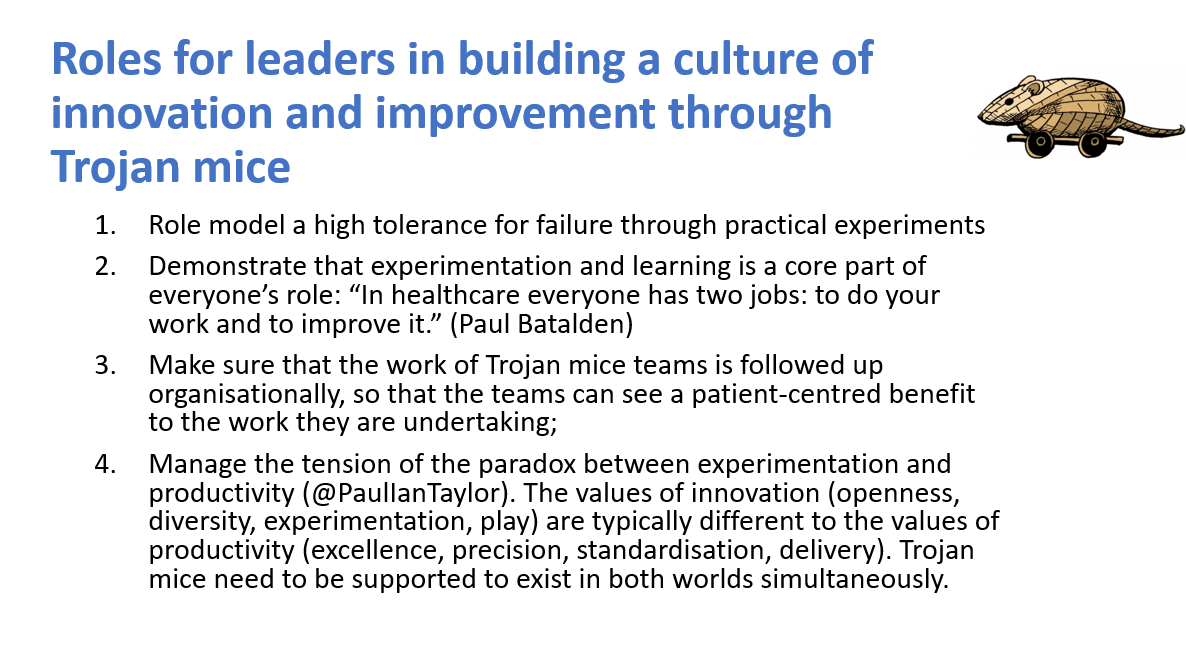
Today I spoke at the Drucker Global Forum about “Trojan mice” vs. “Trojan horses.”
Organisational change programmes often struggle to get results despite investment, careful planning & leadership commitment. Traditional "Trojan horse" initiatives (large scale pilot projects designed for eventual system-wide rollout) struggle against the complexity inherent in large systems. The alternative, "Trojan mice," offers a fundamentally different pathway: having many people across the system with the skills & agency to test out small, well-focused changes to address complex problems.
The choice between Trojan horses & Trojan mice isn't about abandoning ambition or settling for incremental tinkering. It's about recognising that in big systems, distributed action by skilled people with agency nearly always achieves more than centrally controlled, large-scale programmes. By cultivating many changemakers across the system & creating conditions where small, focused experiments can flourish, we can unlock the collective intelligence & energy needed for systemic change.
Three facts about Trojan mice:
1) They fail often, fail early, & learn greatly. The cost of failure occurs early in project timelines, rather than at launch when it's too late. This is in line with what @AmyCEdmondson calls "intelligent failure"—thoughtful experiments that result in useful learning & allow teams to move forward.
2) They capture what works in complex systems - local ownership, fast feedback, & momentum that scales organically. Because changes are small & focused, they can be genuinely owned by those implementing them, creating commitment rather than compliance.
3) Most organisations are built for consistency, not novelty. Trojan mice strategies bypass this structural resistance by building agency & capability throughout the system rather than concentrating change authority in a central team.
I learnt about Trojan mice from Chris Bolton @whatsthepont: https://t.co/twlfW03aos #DruckerForum
@HelenBevan@DigitalDefynd Great post. We’ve been advocating for a shift to agency for 15 years. Anyone who wants some simple tips can check out “Everyone Is a Change Agent.” by @aprilkmills
It was an honor to be your 900th guest Newt. I think the conversation will open some eyes to how really exciting space is becoming. It’s not all about starships and Mars. There are other things that will be much more significant to the United States economy and national defense.
Just read that Starbucks lost $30B after hiring a McKinsey consultant as CEO.
Guy spent his career advising founders how to build companies, but never built one himself.
17 months later, he’s gone.
They bring in the Taco Bell CEO…
and the market cap jumps $20B overnight.
Turns out running a company is harder than advising one.