This shift was already happening: it predated Trump and his two wars, and was always destined to overshadow Khamenei’s succession. Yet it's accelerating because regime survival has become inextricably bound to Iran’s very sovereignty and viability as a state.
This dynamic resurrects the primal urgencies of statecraft that defined the Iran-Iraq War—the very crucible that consolidated the draconian Islamic Republic. This time, however, there is no revolutionary fervor, public appetite, or elite buy-in for exporting Islamism. Instead, the domestic and global paradigm has inverted: the mere defense of sovereignty and national resistance are now viewed as intrinsically revolutionary, anti-systemic, and heroic.
Consequently, today's societal, generational, and elite incentives reward ruthless efficiency, nationalism, and pragmatism. While embodied by figures like Ghalibaf, this shift is notably structural rather than personality-driven; it represents a system-wide consensus.
The ultimate upshot is a less theocratic, far more statist, and deeply authoritarian Iran: an Islamic Republic that simultaneously sheds its Islamic and republican vestiges, while becoming far more securitized, sovereigntist, and resilient.
In this new Islamic Republic, power, political cohesion, and internal elite control eclipse ideology. Much like the People's Republic of China, the Iranian state is finally liberating itself from the confines of the very ideologies that originally birthed it. The State is now free and in full control.
@joancutesac@HornAnarchists I don't want to have age of consent laws. As far as I know children are being raped in every single state that has age of consent laws.
one event in the last 48 hours I haven't seen discussed is over 40% of fuel stations in Laos are now closed, creating food crises in a country very reliant on local village market distribution. the quickness of dedevelopment and new opportunities for neocolonialism is dizzying
#Iran War Update No. 15 (focus on Iranian strategic narrative):
🔹Iran has reportedly fired around 400 ballistic missiles toward Israel since the start of the war, according to Israeli sources.
🔹Negotiations over passage through the Strait of Hormuz are beginning to reshape the maritime landscape. After Iran allowed several Indian ships to pass, India released three Iranian oil tankers that had previously been seized under sanctions, suggesting bilateral bargaining between Tehran and countries seeking safe transit.
🔹This raises the possibility that other states may pursue similar arrangements with Iran. If multiple countries negotiate direct passage deals, it could amount to a de facto recognition of Iranian leverage over the Strait of Hormuz – something Donald Trump administration strongly opposes.
🔹Iran continues expanding its economic targeting list. The IRGC warned that industries across the region with American involvement or ownership stakes could become legitimate targets. This is effectively arguing that multinational companies linked to the United States constitute part of American interests and may be targeted in retaliation.
🔹Iranian analysts claim that U.S. operations are facing growing logistical constraints. According to these assessments, damage to regional bases has forced the United States to conduct more long-range bombing missions from Europe and rely heavily on aerial refueling, increasing operational costs – especially after losing at least seven refueling aircraft in the past few days.
🔹Hardline voices in Iran are already proposing more permanent forms of leverage over the Strait of Hormuz. Suggestions include imposing transit tariffs on ships, denying passage to U.S. and allied vessels, seizing Israeli-linked ships, or keeping the strait closed until U.S. forces withdraw and compensation is paid.
🔹Iran continues to rely heavily on cluster-warhead missiles in its strikes against Israel. Iranian analysts argue that these warheads disperse multiple submunitions, making it much harder for Israeli air defenses to intercept every projectile.
🔹The war is increasingly targeting logistical infrastructure. Iranian sources claim that more than 14 U.S. bases across the Persian Gulf have been struck in recent days, with attacks aimed at degrading logistical support networks for operations against Iran.
🔹Within Israel, Iranian sources claim strikes on logistical facilities near Haifa, while at sea there are reports that the aircraft carrier Abraham Lincoln may have suffered an accident affecting its operations, though details remain unclear.
🔹Iran has also intensified pressure on Gulf infrastructure. A drone strike reportedly hit the port of Fujairah in the UAE, a key facility that allows oil exports to bypass the Strait of Hormuz, highlighting Tehran’s effort to prevent alternative shipping routes from weakening its leverage.
🔹Iran has warned Gulf states that energy infrastructure could become targets if Iranian oil facilities are struck. Iranian media published a list of major energy terminals across Saudi Arabia, the UAE, Qatar, Kuwait, and Bahrain that could serve as retaliatory targets, especially if Iran’s oil infrastructure in Kharg island is targeted by the U.S.
🔹Iran-backed Iraqi militias continue to expand the battlefield. A missile strike hit the U.S. Embassy compound in Baghdad’s Green Zone, reportedly damaging part of its air-defense system.
🔹There are growing indications that the Houthis may soon enter the conflict. A Houthi official stated on Iranian state TV that the decision to support Iran militarily has already been made, raising the possibility that shipping through the Bab el-Mandeb Strait could also come under pressure.
🔹If that occurs, the conflict would affect both major maritime chokepoints linking Asia, Europe, and the Middle East. Simultaneous pressure on Hormuz and Bab el-Mandeb would force the United States and its partners to divide their naval resources across multiple theaters.
🔹The war is also reshaping regional strategic thinking. Discussions within the GCC increasingly focus on reducing dependence on the United States and exploring new regional security arrangements involving countries such as Turkey or Pakistan.
🔹Diplomatic mediation efforts continue, but there are no signs of an imminent ceasefire. Both Tehran and Washington appear unwilling to halt the war under current conditions.
🔹From Tehran’s perspective, the conflict is no longer simply about immediate retaliation but about forcing a new strategic equation. Iranian officials increasingly argue that sanctions relief, compensation, and new security guarantees would be required before any lasting settlement becomes possible.
🔹Overall, the trajectory of the conflict suggests that both sides are moving further up the escalation ladder. With pressure building simultaneously on regional infrastructure, maritime chokepoints, and U.S. positions across the Middle East, the war is increasingly shifting from a primarily bilateral confrontation into a broader regional strategic contest.
Latest Information from Rojhilat: Regime Forces Deploying in Civilian Areas
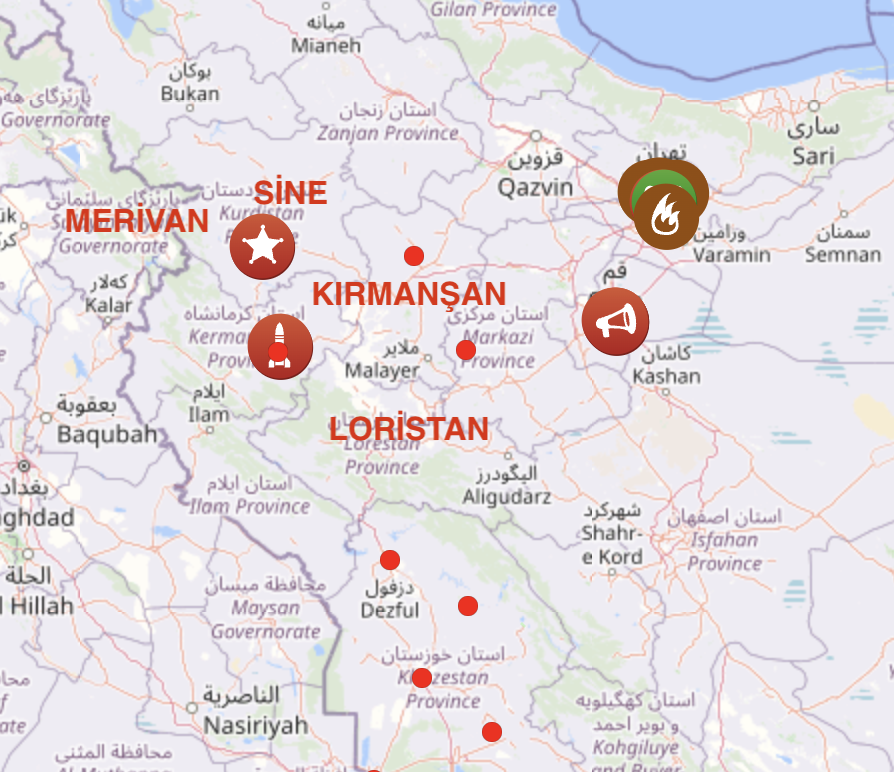
According to the latest information coming from Rojhilat, military activity and attacks in the region have increased significantly in recent days. In particular, it is reported that attacks by the United States and Israel against Iran’s Kurdish cities and regime military and intelligence installations in Rojhilat have intensified. In some areas, military barracks and regime headquarters have reportedly been completely destroyed.
In response to these developments, Iran’s regime forces are said to have adopted various methods while calculating possible attacks. There is concrete information indicating that the regime forces are currently trying to use the people of Rojhilat as a human shield.
According to information coming from the region, the regime’s armed elements have stationed themselves in many places, including mosques, stadiums, civilian public buildings, hospitals, driving schools, schools, and various civilian residential areas.
For example, it has been reported that Revolutionary Guard forces were deployed in the football stadium in Merivan.
The PJAK Assembly also called on the public to remain cautious in a statement issued last week. In the statement, people were urged to stay away from regime military installations. PJAK also reminded that regime forces have been positioning themselves in civilian areas such as mosques and schools and asked the public to be careful in such places for their own safety.
Meanwhile, the regime’s headquarters in Sine (Sanandaj), responsible for the Iran–Iraq border, had been completely destroyed in attacks carried out in recent days.
According to the information obtained, regime elements from this headquarters later infiltrated civilian residential areas and effectively turned these areas into heavily armed outposts prepared for ground warfare.
It is reported that hundreds of families from Sine have migrated to other places, while the regime’s paramilitary forces have been settled in the houses left behind.
According to information from the region, a large portion of regime forces are operating while wearing civilian clothing. By doing so, they aim both to reduce intelligence leaks and to portray possible casualties as “civilian casualties.”
It is particularly reported that in the Kirmanshah–Kamyaran region, regime elements have recently been wearing the uniforms of Peshmerga and PJAK guerrillas. Similar cases are said to have been observed in many areas from Shaho to Merivan and from there to Bane.
This tactic is believed to be intended to create the perception that “there are peshmerga and guerrillas here” in the region and to undermine potential mobilization by Kurdish forces.
Due to these developments, daily life for the population in the region continues under extremely difficult conditions. There is no electricity, and there are also serious difficulties in accessing basic necessities.
The 2026 war is very different from the 1990 Gulf War. The 1991 campaign followed Iraq’s invasion of Kuwait, had a UN mandate, and was fought by a large international coalition with strong regional backing. The 2026 war lacks that legal clarity and coalition structure and is widely impacting all neighboring countries who lobbied against the war.
But the end state might still look familiar: Iran resembling Saddam’s Iraq after 1991—militarily weakened, economically isolated, yet still ruled by a reconstituted regime.
Missiles over #Tehran. Smoke in Sistan-Baluchestan.
What do the strikes on #Iran mean for the #Baloch insurgency and could the fallout spill into Pakistan’s #Balochistan?
A critical moment for the region. Read here:
https://t.co/e3m5aNKBEY
#Iran#ısrael#IranWar
"According to information I have from various unofficial sources, Kurdish forces are currently present in most Kurdish cities, but they remain hidden. Israeli-American attacks have targeted Kurdish cities in recent days—that is, Iranian military, police, and Pasdaran posts there. Some Iranian forces have withdrawn from the area, but a significant number are camping out in the streets, stadiums, in cars, and other locations, trying to stay out of range of airstrikes. This obviously means a certain amount of chaos, which Kurdish forces are closely monitoring, but so far there have been no clashes with government forces. Drawing on their experience in Syria, the Kurds will likely exercise considerable restraint, avoiding any provocations, although we may hear reports of clashes from various sources in the coming days. However, these will likely be fake news, such as the recent report of clashes in Meriwan, which was denied by both Kurdish and Iranian sources. The purpose of this type of information is to provoke the Kurds into taking direct military action, and Israel is primarily the source of such revelations. The KDPI called on Iranian forces to "return home," and the PJAK called on the public to organize self-defense committees. But that's where the calls ended."
@theserfstv Generals who started out as traumatized child soldiers raised by traumatized child soldiers, dying in their 20s before accumulating the wisdom to become good fathers, nobles and slaves alike brainwashed into gloryfying men born into the priviledge of being reckless.
@theserfstv All powerful men in history have been losers. Being emotionally immature and either ignorant or egomaniacal are pretty much requirements to become a dictator or his lieutenant.
I think reactionaries build their world-views, not from ideology, but from lots of experiences, too subtle to articulate, that display residual social norms. Words can at most question experience. Only as society advances and generations renew occurences of residual norms lessen.
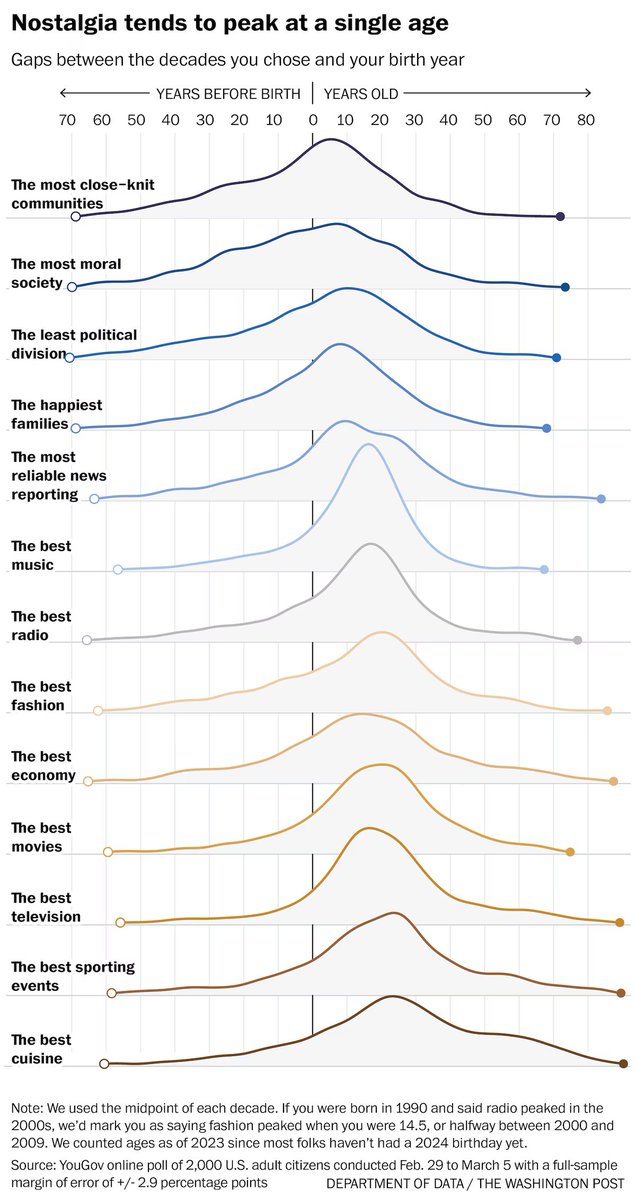
It turns out music, movies, entertainment, and society in general peaked during the exact time period when you, the person reading this, were a teenager.