⚠️Excited to share my latest in @ThePlantCell🌱! We show that chloroplasts form membrane contact sites (MCS) with the pathogen interface to drive focal immunity, mediated by a tethering complex🔗!
Full story 👉 https://t.co/LE3SVlxp5i
#PlantScience#PlantImmunity
These N-terminal caps could be quite handy to prevent/dampen NLR autoactivity when engineering new immune receptors.
Great collaboration with Suomeng Dong's lab (Nanjing) and @amiralito_ (TSL), @EnochYuen@TarhanEI@Freddie_King00@Nickeilmann (ICL)
Our new paper is out: surface immune signalling can unlock an NLR immune receptor through alternative splicing. In potato Rpi-vnt1.1, splicing removes an N-terminal “safety cap”, priming the receptor for resistosome assembly and defence.
New Publication: A potato late blight pathogen effector interacts with ENTH-domain protein TOL9a and an activated helper NLR to suppress immunity (2026)
https://t.co/lV5RmaB5oy
A potato late blight pathogen effector interacts with ENTH-domain protein TOL9a and an activated helper NLR to suppress immunity.
https://t.co/DCh6PsxKxt
As seen on @biorxivpreprint: our story on how the dreaded late blight pathogen hijacks a helper NLR pathway is now out in its final form in @ScienceAdvances 🎉
Meet AVRcap1b: the two-faced effector 🧵👇
https://t.co/TsmdMNfb8u
So proud to see this story finally out!🎉 We added new data since our previous preprint—transgenic barley plants with an engineered immune receptor that fights off two fungal pathogens at once. Short 🧵and link to the original preprint thread👇
https://t.co/e0SrTwBMvc
Check out our latest work! AlphaFold 3 revealed a transient immune receptor complex that eluded biochemical studies for almost a decade🤯 We describe a conserved structural logic underlying sensor–helper communication in an NLR immune receptor network 🧵👇
https://t.co/H55EMmrtZn
Be part of OMGN! Open to all researchers with an interest in oomycetes, from molecular genetics & genomics to biology, population biology, and ecology, at either an experimental or a computational level. Investigators new to the field are always welcome https://t.co/8ihV348OKc
Protein structure prediction changed biology. Protein assembly discovery is next.
We present SNI (Structural Novelty Index), a scalable framework for finding new protein complexes.
We used it to uncover an unexpected resistosome assembly: 11-mer. 🧵👇🏻
https://t.co/bCADVEnE6b
You’ve seen it @biorxivpreprint but here is the latest version—a twist in #NLRbiology—the TIR-NLR to NRG1 pathway channels calcium from organelles.
Besides the cool science, I love it how several @TheSainsburyLab alums collaborated on the project. #TEAM#CelebratingAlumni 😍 😎
Final version of our NRG1 MS is out!
We uncover a surprising mechanism: the helper NLR NRG1 targets organellar membranes to trigger immunity
Great collaborations with @KamounLab, @JiorgosKourelis, @jonathandgjones, @AdamWu9527, and the @Phil_Carella labs!
https://t.co/P9OMT7NgtR
Excited to share our preprint using Rhizobium rhizogenes AS109 for agroinfiltration, facilitating strong transient expression across non-model plants including sweet potato, mustard, Medicago and faba bean!
https://t.co/mgrWvCFBK1
1/7
New review out in Open Biology by @royalsociety 🌱🔬🧬!
Together with @Tolga_Bzkrt, we explore how pathogens — from viruses and bacteria to fungi, oomycetes and nematodes — hijack or suppress host autophagy to promote infection in plants.
🔗 https://t.co/5Q3JZ41EMt
#Research #Autophagy #PlantImmunity
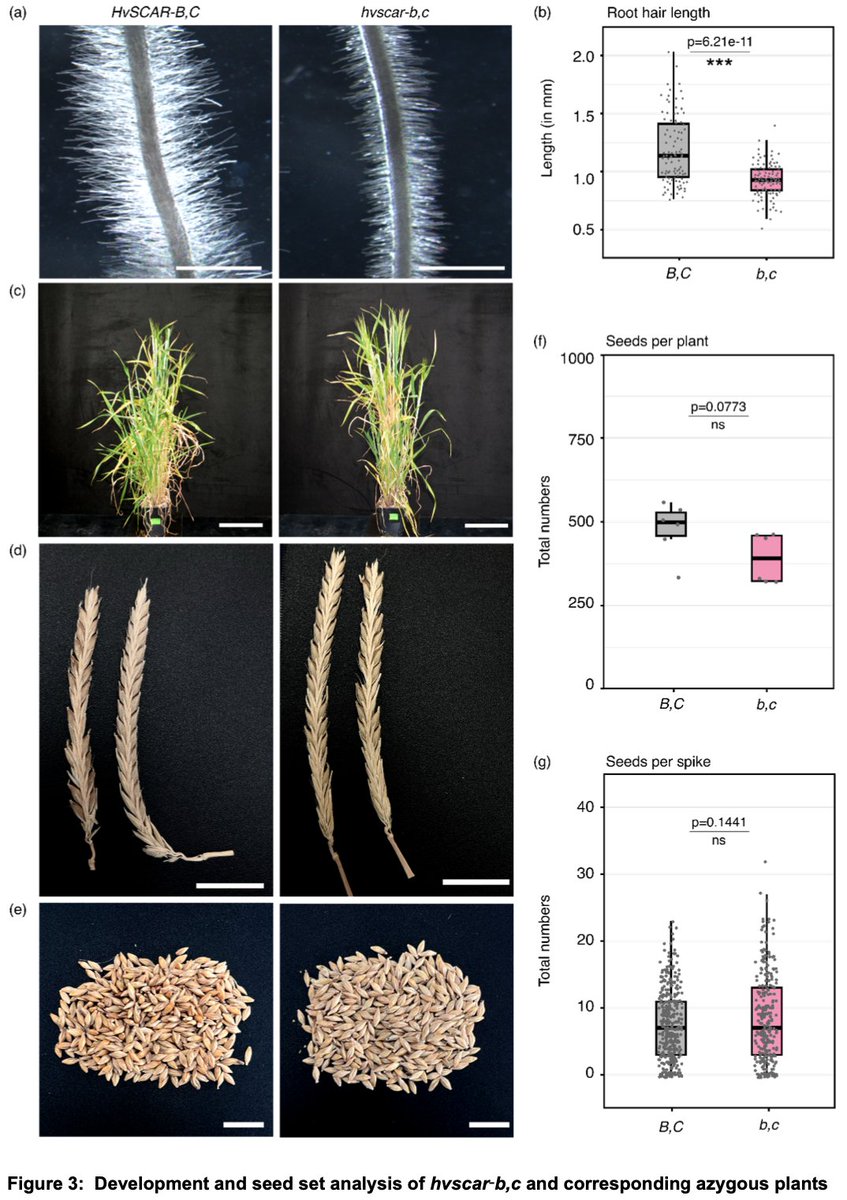
New Preprint! Inactivating two barley SCAR genes as strategy to render roots resistant to a root rotting pathogen while enhancing symbiotic Mycorrhiza fungi colonisation & retaining normal growth and seed yield. This work has been led by @BrummSabine https://t.co/OIkEoEoVqn
Our paper in The Plant Cell 🪴 showed that chloroplasts form defence-related membrane contact sites (MCS) with the pathogen interface, helping drive focal immunity in plants:
https://t.co/N3ZMePV6iD
@Tolga_Bzkrt
I’m very excited to share this work! Understanding plant hypersensitive cell death has been a key challenge. Using time-lapse imaging, we captured the full process: from calcium influx to organelle breakdown and cell collapse. @YiFeng_eYFP@IPMBSinica
https://t.co/3wVNWr4Au9