School support, curriculum writer and author of books.
Wanderer of hills, wonderer of everything else.
Posting on Dungeons & Dragons, music and vegan food.
If believing in principles of cognitive science like Rosenshine and cognitive load theory means you don't do disciplined inquiry or dialogic teaching you're missing the point. Cognitive science helps you do those things well. @EnserMark
Full episode: https://t.co/mwxT69pmzj
A narrow & rigid view of SoL says "inquiry first" overloads novice students so we should always follow the instructional hierarchy & always build knowledge first for efficiency's sake.
I appreciate how @EnserMark puts it, creating boundaries and a roadmap for powerful knowledge.
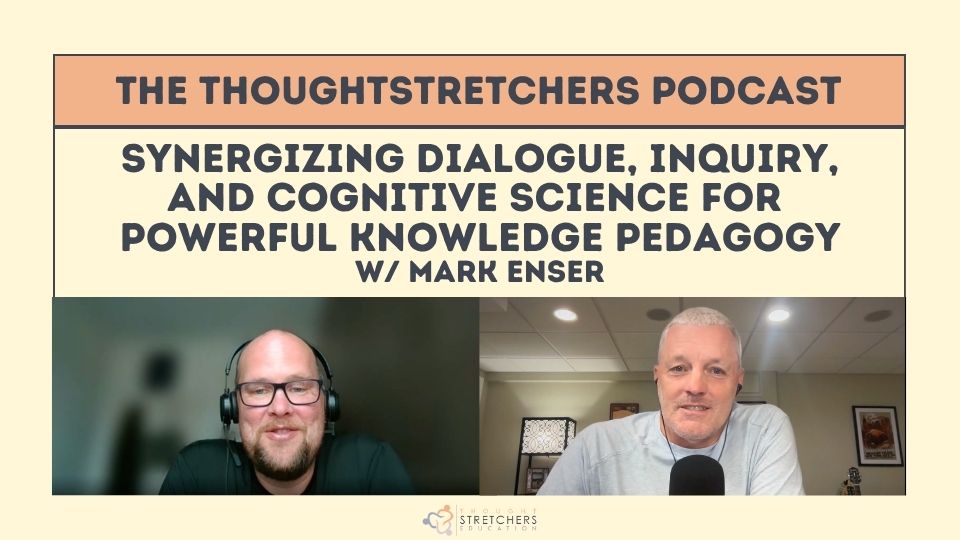
I really appreciate SoL advocates who are thoughtful and nuanced instead of rigid and narrow, so talking with @EnserMark was really great!
The @ThoughtStretchr Podcast: Synergizing Dialogue, Inquiry, and Cognitive Science for Powerful Knowledge Pedagogy
I really appreciate SoL advocates who are thoughtful and nuanced instead of rigid and narrow, so talking with @EnserMark was really great!
The @ThoughtStretchr Podcast: Synergizing Dialogue, Inquiry, and Cognitive Science for Powerful Knowledge Pedagogy
A geography teacher's three superpowers an app can't fake: reading a room mid-discussion, knowing exactly when to pull a scaffold away, and catching the precise shape of a misconception before it hardens.
1/2
This may be my new favourite book of all time. Beautifully written, it someone manages to capture the excitement and freedom of the trail on each page.
#DirtbagDreams#ultramarathon#trailrunning
Most EdTech defaults to delivering content because content is the easy part to build. The harder, more interesting question is what's actually involved in the rest of the job, and whether any of it is even solvable in software.
New piece, out now: https://t.co/WspzsGW1t4
A geography teacher's three superpowers an app can't fake: reading a room mid-discussion, knowing exactly when to pull a scaffold away, and catching the precise shape of a misconception before it hardens.
1/2
A knowledge-rich curriculum is only ever potentially powerful, as Margaret Roberts puts it. Writing the curriculum is the easy part. The harder question: what pedagogy actually realises that potential? 🧵
My answer: not one pedagogy. Three, working together. Dialogue. Enquiry. Cognitive science. Each one converts knowledge into something pupils can actually think with. Pull any one out and the other two stop working properly.
https://t.co/qaDtAWW5XV
Nice piece about the interconnectedness of the false binaries/choices that consistently resurface in the "pedagogy wars".
Extractive infographic created by Notebook LM from Mark's useful Substack piece linked in his post below.
Whatever you teach, the question isn't which of the three you're best at. It's which one is quietly missing from your classroom this week. Full piece here: https://t.co/qaDtAWW5XV
A knowledge-rich curriculum is only ever potentially powerful, as Margaret Roberts puts it. Writing the curriculum is the easy part. The harder question: what pedagogy actually realises that potential? 🧵
In my latest piece I build one example three times, a Year 9 enquiry into climate migration, to show what it looks like when all three run together, and exactly where it breaks when they don't.