In a few weeks, the United States turns 250. There is no better moment to ask how the Founding generation built the institutions that made this country the world's largest economy. Starting June 23, PISM offers our latest free summer online course on exactly that, with leading historians and social scientists presenting alongside our core PISM team. All online, all free. Register at https://t.co/osGtbFfAJ8
The course builds on @JesusFerna7026's Penn Econ course on the political economy of Early America: how a handful of small peripheral colonies created a durable institutional arrangement that made them the largest economy in the world in less than two centuries. That is the question. The course traces the answer from British settlement through the Revolution, the Constitutional Convention, and the competing visions of Hamilton and Jefferson.
@mboudry@holland_tom For a serious engagement with this argument read Voegelin, especially the Order and History volumes. It is not a matter of Christianity being the tribe that came up with the best ideas, but how different societies have articulated transcendent order in particular symbols.
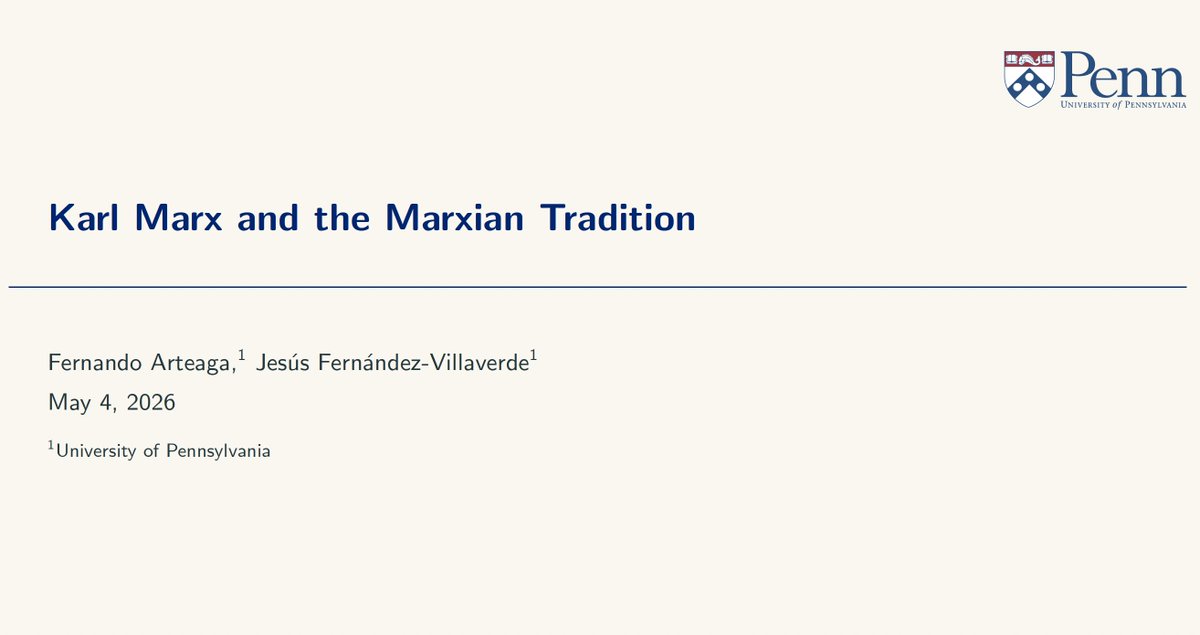
Since I have posted so much on Marx vs. Weber, modernity, and development over the last few weeks, I have posted an updated slide deck of my lectures on Karl Marx and the Marxian Tradition (together with @ferarteaga) here:
https://t.co/TOGm7jXMKG
This is a long deck: 437 slides in the last compilation! (It also takes a few seconds to upload.) If I were to teach it carefully, with plenty of class discussion, I would require a whole semester. Even then, some topics (e.g., the Frankfurt School) receive only a cursory treatment because I focus more on economics and political economy, broadly construed. I hope to extend the discussion of those someday.
However, I cover topics rarely seen in these courses, such as Hans-Georg Backhaus and the Neue Marx-Lektüre, because most of the work is not translated into English and must be read in the original German.
I don’t have an equivalent slide deck on Max Weber, as I haven’t lectured on him. Hopefully, one day I will.
Comments and feedback are very welcome.
¡Cursos en español este verano!🌞📚
Únete a discusiones de gran literatura:
🕵️ Roberto Bolaño - Los detectives salvajes (6 sem)
🌀 Borges - Ficciones (6 sem)
⚔️ Cervantes - Don Quijote (11 o 21 sem)
🏰 Lope de Vega - Fuenteovejuna (4 sem)
Detalles: https://t.co/63vQfDUTA6
Summer 2026 enrollment is now open! 📚☀️
Explore great books with readers worldwide this summer. Browse our course offerings and apply today: https://t.co/7aSTOg0qDM
Applications close Friday, April 3rd.
Hay escritores que cuentan historias… y luego está Javier Marías, que convierte el pensamiento en literatura. Hoy abrimos las puertas de La morada del lector para recordar a uno de los autores más elegantes y profundos de nuestra lengua.
Very true. Particularly his interpretation of Plato is disastrous and misses the entire point of The Republic itself as the inward paradigm of order that the society "writ large" reflects.
I must admit that, among all the thinkers I admired when I was 20, none has fallen further in my estimation than Karl Popper. I will leave aside his contributions to the philosophy of science and speak only about The Open Society and Its Enemies.
My admiration for that book was pure ideological alignment. I agreed with the conclusions and did not look too carefully at how they were reached. As I grew older and learned more, the flaws became harder to ignore. The treatment of Plato is a caricature. The treatment of Hegel is worse. The treatment of Marx is the most readable section, but only because Popper happened to know more about economics than about Greek philosophy.
Eric Voegelin, in a letter to Leo Strauss, put it better than I could:
“Popper is philosophically so uncultured, so fully a primitive ideological brawler that he is not able even approximately to reproduce correctly the contents of one page of Plato. Reading is of no use to him; he is too lacking in knowledge to understand what the authors say. Briefly and in sum: Popper’s book is a scandal without extenuating circumstances; in its intellectual attitude it is the typical product of a failed intellectual; spiritually one would have to use expressions like rascally, impertinent, loutish; in terms of technical competence, as a piece in the history of thought, it is dilettantish, and, as a result, is worthless.”
https://t.co/F3ssut0rYN
Voegelin’s language is severe. But read Popper’s chapter on Plato and then read the Republic, and you will find it hard to disagree.
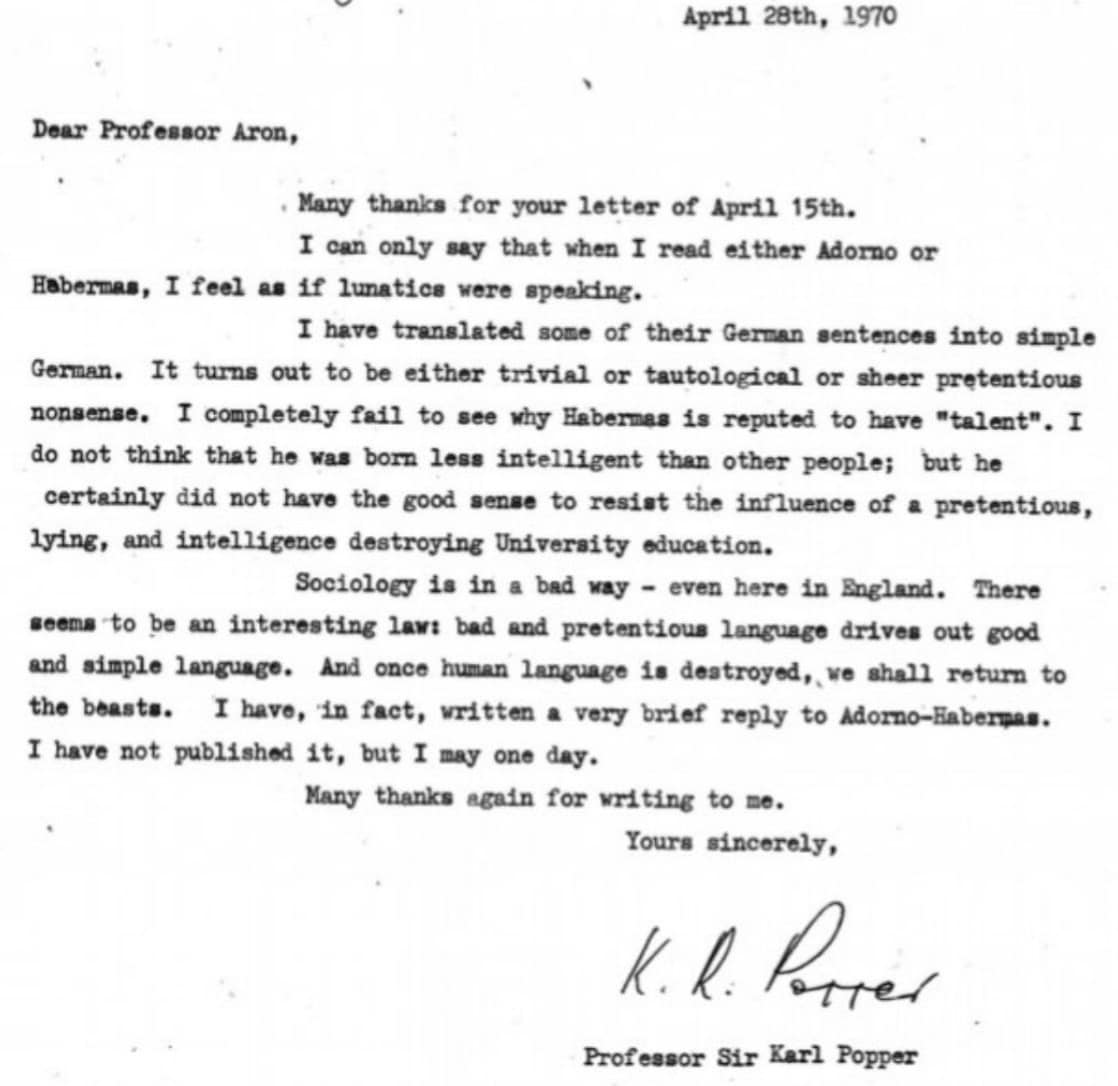
The recently circulated letter in which Popper denounces Adorno and Habermas to Prof. Aron, calling Habermas “untalented,” only confirms the picture.
You do not have to agree with Habermas or Adorno to see that they were serious thinkers who tackled important issues. Habermas spent decades exploring how public discourse can support legitimate institutions. Adorno, regardless of his politics, recognized something about the link between mass culture and individual judgment that has only become more relevant since he wrote. I disagree with much of what both of them concluded, but debating serious thinkers is always productive.
Dismissing them, as Popper did, is not acceptable. Popper disliked that Adorno and Habermas leaned to the left, so he denounced them. That is not philosophy. That is the behavior Voegelin described.
"Now what is the difference between this force compelling you to turn around, in Plato, and the vision of Saint Paul on the road to Damascus? For myself, I don't know what the difference is".
Eric Voegelin, Collected Works 33, 294.
Phantom Thread is one of those films I’m so familiar with at this point, it basically serves as a warm blanket in my life. I’ve written at length about how PTA was my most watched director in ‘25. Not sure he’ll reign supreme in ‘26, but this will get a rewatch this year.
One of the more frustrating trends in public life over the past decade is how people who lead failing institutions blame social media for their failures.
A university president whose faculty have become political activists instead of educators and whose administrators multiply like rabbits will tell you that “misinformation on social networks” is eroding public trust in higher education. An editor whose publication lost its readership will claim that the real problem is X, rather than consider that the publication became boring, that the writing was uniformly uninspired, and that it stopped covering anything that mattered. A politician who loses an election will blame Meta algorithms rather than admit that voters simply did not like what was offered. A central banker whose institution missed the worst inflation in 40 years will worry publicly about TikTok videos spreading financial illiteracy.
The pattern is always the same. The institution fails at its core mission. The public notices. The people in charge, rather than examining what went wrong, identify an external force that is “polarizing.” The diagnosis is never “we did a poor job.” It is never “we lost our audience because we gave them nothing worth reading.” The diagnosis is always “bad actors are distorting the conversation.”
This is not new, of course. Before social media, talk radio was the scapegoat. Before talk radio, it was television. Before television, it was tabloid newspapers. Every generation of leaders has found a communication technology to blame for people’s loss of trust in them.
What is new is the intensity and the shamelessness. Over the last few years, “social media” has become a universal excuse that requires no evidence and tolerates no scrutiny. It is deployed reflexively.
The people who make this argument never seem to ask the obvious question: why are people on social networks so receptive to criticism of your institution in the first place? If your university were delivering excellent education at a reasonable price, no number of tweets would persuade parents otherwise. If your publication were covering important questions with clarity and substance, readers would not have migrated elsewhere. If the work you showcased were serious rather than trivial, people would still be paying attention.
Trust is not destroyed by social media. Trust is destroyed by poor performance, and social media makes it harder to hide. That is a different thing entirely, and the people running these institutions know it, which is what makes the excuse so cynical.
The honest version of the argument would be: “We used to be able to fail quietly because there was no mechanism for people to compare notes. Now there is, and we do not like it.”
That, at least, would have the virtue of being true.