Sociedades pantalla, empresas de Kirguistán y criptomonedas: el entramado fantasma del Kremlin para evadir las sanciones https://t.co/OLyHTayocO a través de @el_pais
Worth reading this @Er_Woods for @RiddleRussia in full if you want the military math instead of the usual “next they come for us” framing.
https://t.co/wyubnZZL4b
4/4
Russia is not about to become a full war economy.
Expect higher taxes, budget cuts, more nationalization, and less support for the regions instead.
Why?
Read this @Vladi_Moscou new piece for @RiddleRussia
https://t.co/r3yRn65V6m
Algunos apuntes sobre las crecientes advertencias, y preparativos, de varios gobiernos europeos sobre la posibilidad de que Rusia ataque la OTAN:
1- La guerra no es un fenómeno binario (o paz total o guerra total), sino un espectro que incluye operaciones de zona gris, como propaganda, sabotajes y provocaciones, pasando a atentados, drones aparentemente extraviados, o envenenamientos. La caja de herramientas es amplia, y Rusia la usa desde hace años.
No, los rusos no conquistarán Varsovia (no podrían), pero tienen otras opciones: entre ellas, un ataque limitado con drones o una pequeña incursión en territorio báltico.
2- ¿Y para qué?
Quizás sea útil, por un momento, ponerse en la piel de Vladímir Putin.
Su invasión no marcha como él había imaginado: de los supuestos tres días hemos pasado a los cuatro años y medio sin final a la vista. El frente apenas se mueve y conquistar un puñado de kilómetros cuadrados cuesta miles de vidas rusas.
Además, si bien los rusos han incrementado los bombardeos y los ucranianos tienen menos opciones para interceptarlos, Ucrania ha llevado el dolor a las refinerías y hogares rusos. Es una situación arriesgada para Putin, que se ha esforzado todo este tiempo en mantener su guerra en territorio ucraniano. La economía también paga un precio.
En otras palabras: Putin tiene que desatascar la situación, lo cual eleva su tolerancia del riesgo.
Por otra parte, está el factor EEUU: la Administración Trump dejó de ayudar a Ucrania, con armas y dinero, nada más llegar al poder. Aún encima Washington ha señalado, con palabras y con hechos (retirada de activos militares, salida parcial de las cadenas de mando de la OTAN, etc), que Europa, considerada por el trumpismo un continente de gorrones y cobardicas, ya no le interesa. Ya no es una prioridad (explícitamente, es su "cuarta prioridad": después de las Américas, el Pacífico y Oriente Medio).
Y EEUU está empantanado en Oriente Medio. Su guerra con Irán ha hecho que gastara buena parte de sus arsenales (2/3 de los Patriots, la mitad de los ATACMs, etc) en unas pocas semanas, lo cual, claro, limitaría su capacidad de armar a los europeos.
En resumen, ¿acaso no son unas circunstancias potencialmente tentadoras para que Putin ponga a prueba el artículo 5 de defensa mutua de la OTAN?
Puede lanzar un atacar limitado: no tan grande como para provocar una escalada, pero sí lo suficiente como para demostrar al mundo que la OTAN es un tigre de papel.
Por último: habida cuenta del ascenso de la ultraderecha en Alemania y Francia, y del hecho de que la ultraderecha no quiere seguir ayudando a Kyiv, Putin puede interpretar que los electorados europeos están cansados de asistir a los ucranianos y que solo necesitan un empujoncito en la forma de miedo.
3. Parece que los gobiernos europeos están aplicando la misma estrategia de la Administración Biden en 2022: están comunicando y filtrando sus informaciones de inteligencia para poner a todo el mundo en guardia y restar a Rusia la capacidad, en caso de que llegue el momento, de dominar la narrativa.
Quienes argumentan que la OTAN prepara una “operación de falsa bandera” para lanzar una guerra contra Rusia (porque aparentemente eso es lo que necesita cualquier gobierno europeo: entrar en guerra directa con una potencia nuclear) son los mismos que se reían a mandíbula batiente, en 2021/22, de la idea absurda de que Moscú invadiría Ucrania.
4. En realidad, no hay que imaginar nada. En los últimos 4 años, particularmente en los últimos meses, ha habido docenas de incidentes en territorio europeo atribuidos a Rusia: voladuras de depósitos de armas, sabotajes de trenes, drones y cazas violando el espacio aéreo de la UE, etc.
La pregunta es si Moscú, metido en un callejón bélico de su propia factura, subirá la temperatura para salir de ese callejón.
Putin’s miserable election rigging
Quick comment for @SpecCoffeeHouse on the Pyrrhic victory in the Duma elections generated by vote rigging (hat tip to @russian_monitor for their excellent coverage)
https://t.co/nM8hcaUFs1
For the first time in a long time, I'm worried about the US-Russia dynamic over Ukraine. Not apoplectic, but worried. Let me explain. (This may take a while.)
/1
Peter Korotaev wrote a detailed two-part review of Bojan Pancevski's new book on the Nord Stream explosion, examining how it connects to domestic Ukrainian politics, specifically the fight between Zelensky and nationalist comprador sections of the deep state and "civil society." One recent manifestation of the same conflict was the contention around the "anti-corruption" institutions and the dismissal of Defense Minister Fedorov. This boils down to the fundamental conflict, which cuts through the whole post-Soviet politics, that you cannot understand the war and its most critical developments, without.
The second part of the review is linked in the comments. It's all paywalled, but you really should subscribe to Peter's Substack if you want to follow closely the politics within and around Ukraine beyond simplistic clichés.
Some thoughts on the current situation around the war
📌Putin appears to believe that Russia is winning and will ultimately win the war. In his view, taking Donbas is only a matter of time. He seems ready to pay almost any price to achieve that goal because he sees it as an existential issue for Russia. Those who expect that increasing pressure on Putin will create more room for negotiations are likely to be disappointed. More pressure is more likely to lead to further radicalisation in Moscow and a stronger military response.
📌Economic difficulties, which are becoming more serious, together with battlefield losses and the fuel crisis, are unlikely to make Putin reconsider his approach to the war. Instead, they are more likely to harden his position, encourage further escalation, and increase the risk of scenarios that many have previously dismissed as bluff.
📌There is a growing gap between the political leadership and the rest of the country, particularly the business community, which increasingly wants the war to end. At present, there is little room for internal debate or for questioning Putin’s course. Instead, the leadership appears committed to further escalation, with no clear limits. This is likely to make these internal contradictions more acute over time.
📌Ukrainian strikes inside Russia are strengthening anti-Ukrainian and anti-Western sentiment, making it easier for the Kremlin to justify further escalation. At the same time, Russian public opinion is divided. Some argue that the war should end roughly along the current front line, while others call for far more extreme measures, including the destruction of Kyiv, the use of nuclear weapons, and mass violence against Ukrainians. A prolonged war of attrition will further strengthen both camps.
📌The year 2026 appears to be a particularly important stage in the war. For the first time, the cumulative effects of the conflict are having a visible impact on Russia’s domestic situation, raising questions about the state’s ability to continue functioning in the same way. This weakens Putin politically, but it also appears to make him more radical, contributing to a growing sense among parts of the Moscow elite that a catastrophe may be approaching.
📌There is a strong and growing expectation that significant changes lie ahead. There is little understanding on what form they will take, who will drive them, or how fast they may begin. However, there is an increasingly widespread belief that, if the current war of attrition continues, Russia’s resources will come under growing strain, while the economy remains constrained and growing numbers of businesses become unviable.
The overall conclusion is that two processes are unfolding at the same time: increasing external escalation and deepening internal contradictions. The West should be prepared for unexpected developments.
My latest @RUSI_org commentary: China's 'war by other means' is there to see - if Europe looks past isolated incidents.
Western planning has long been organised around one dramatic contingency regarding Taiwan: invasion. But Beijing has found something more economical. Below the threshold of explicit war, it is altering strategic realities ship by ship, licence by licence, narrative by narrative, integrating hashtag#greyzone coercion and hashtag#geoeconomic leverage into a single strategy. Each act is deniable; the cumulative effect is what a war is fought to achieve.
The policy task: stop measuring the China challenge against the yardstick of invasion, and start measuring it against cumulative coercion: resilience, matching grey zone with grey zone, and faster collective responses. The absence of a declared conflict is not the absence of conflict.
This applies to other domains too, such as China's support for Russia's war of aggression against Ukraine. Stop measuring individual actions and start measuring support holistically.
1/2
1/ Nikolai Patrushev, a key adviser to Vladimir Putin, says that Russia is fighting a pan-European neo-Nazi alliance, and advocates Russian naval action in the English Channel. He warns the Baltic states of "the end of ... peaceful, carefree life and sovereignty." ⬇️
Brutal Russian strikes on Kyiv last night, at least 25 dead. Zelensky pledges retaliation. Meanwhile, Russia seems dead set on knocking out hundreds of petrol stations across Ukraine, retaliating for strikes on refineries. Ukrainian refineries were destroyed much earlier in the war.
Expectedly, the “turning tide” PR surge is bringing greater escalation, but no turning tide. Deep State says the Russians occupied 84 sq. km of Ukraine in June. Not an impressive result but more than in May and understandable, given that Kramatorsk/Sloviansk agglomeration is the hardest task they’ve ever tackled in this war.
As before, DS lags behind many Ukrainian and Russian sources in confirming Russian advances. It also keeps claiming large-scale Ukrainian advances which it “can’t show”, but they fail to materialise. It marked up a small Ukrainian advance south of Zaporizhzhia today.
More ominously, DS said in its monthly update thar while in May Ukrainian force made “two steps forward”, in June they made “one step forward, one step back”. Attacks on refineries vs Kostiantynivka?
Below is my piece on the impact of refinery strikes published before latest Russian strikes on Kyiv.
https://t.co/S8FT7jz685
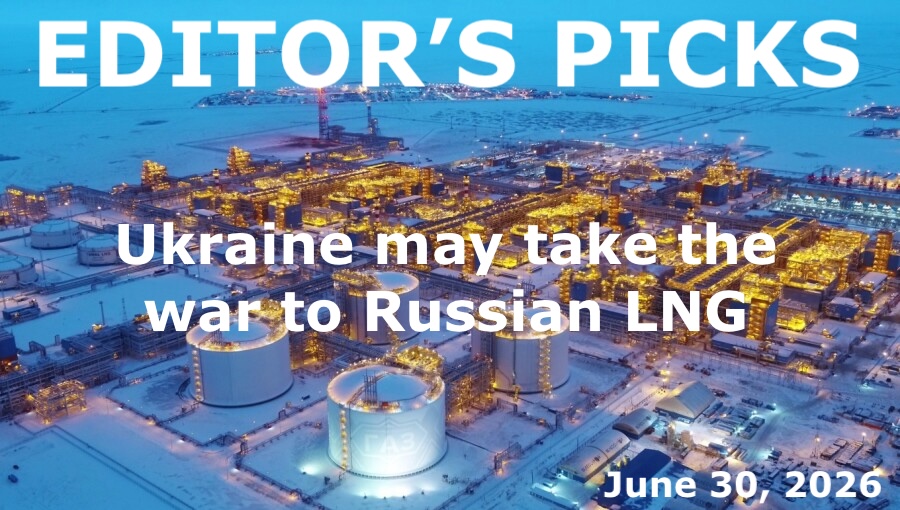
Bankova has dramatically scaled up its drone attacks on Russian oil refineries that is causing chaos and costing the Kremlin a lot of money at a time when the budget was already under a lot of pressure. But what if Bankova targets Russia’s extremely vulnerable LNG production in the Arctic? That hasn’t happened yet, but it is Europe’s nightmare scenario. Currently Europe is scrambling to refill its underground storage tanks ahead of winter and is buying every single LNG cargo Russia exported since the start of the year. Russian gas has stayed off the sanctions list for four years for a reason.
While the refinery attacks have reduced supplies of petrol, all that has happened is Russia is exporting the extra unrefined oil and still made $160bn last year from crude exports. But taking out the LNG facilities would bring production to a halt and end exports worth $18bn in 2025 almost certainly causing another price spike similar to the 2022 energy crisis in the process with Europe in the frontline.
Tired of the half-hearted support by the West, Bankova has taken the fight to Russia and launched a devastating campaign of long-range drone strikes.
From day one Ukrainian President Volodymyr Zelenskiy has been calling for air and long-range missile support to no avail. For most of the last four years, Kyiv’s western allies have expected the Armed Forces of Ukraine (AFU) to fight exclusively on its own territory. As we have repeatedly reported, that led to the “escalation management” policy of sending some, but not enough materiel to make sure Ukraine doesn’t lose the war, but not enough so it can actually win. Nato allies sent some useful weapons like the Franco-British Storm Shadow missiles and HIMARS, but help back on the really powerful weapons like Germany’s Tauruscruise missiles or a fleet of F-16.
Zelenskiy was furious. He lambasted Natoin the very first month of the war, saying: “All the people who will die from today, will die because of you,” referring to Nato’s reluctance to close the skies over Ukraine and arm the AFU from the western stockpiles of modern powerful weapons. But he quickly toned his rhetoric down after the first Ramstein meeting when Nato scaled up its military support. But it was never enough.
The escalation policy led to a ridiculous set up where Russia could park Grad missile launchers on the M2 Belgorod–Kharkiv highway that runs down the Ukraine-Russia border and pound the eastern Ukraine cities with impunity. Bankova was under strict orders from Washington not to shoot back into Russian territory. The fear was that if any Nato-made missile hits a target in Russia proper then the Kremlin would be able to argue – with some justification - that Nato, not Ukraine, was attacking Russia, trigging WWIII.
That finally changed after the AFU invaded Russia and took control of much of the Kursk Oblast, bringing some US-made HIMARS with it. But even then, the Biden administration was very nervous and attempted to put strict rules of engagement on their use.
After the first year of the war, it became increasingly obvious that the Western help was going to be limited and Bankova slowly started to take operations into its own hands. The Kursk invasion was not discussed with the White House and as much a surprise to the Biden administration as it was to the Russians.
When the attacks on Russian oil refineries got under way in earnest last year, Bankova was explicit that it was attacking with them with its own homemade drones, not Nato weapons. The unspoken subtext was: “You can put limits on the use of your weapons, but not the ones we make.” Again the White House was very unhappy about these attacks, but powerless to stop them.
By the autumn of 2023 Bankov had given up on being properly equipped by Nato and in October that year Zelenskiy launched a plan to simply make those weapons himself. He called for Ukraine to be transformed into a military production hub. And he did it with remarkable success. Earlier this year Zelenskiy claimed that Ukraine now makes 60% of all the weapons it needs including the planned seven millions drones factories are expected to churn out this year. As IntelliNews reported there is still a huge gap between drones vs missiles where Russia has an overwhelming advantage, made worse by the fact that Ukraine has effectively run out of Patriot interceptor missiles leaving its skies open.
But what has changed in the last year or so is Ukraine's investment into drones and missiles has started to bear fruit allowing Kyiv to take the war into its own hands. Fire Point’s Flamingocruise missile is now starting to turn up regularly in reports that carries a much bigger payload and can do the damage drones can’t. Equally effective and disruptive is the new medium-range drones that are causing chaos in Russia’s logistical support for the frontline in Donbas. Russia can no longer fire into Ukraine from the M2 highway without being attacked by a deadly swarm of AFU drones.
As this military capacity expands, the West can’t tell Bankova what to do anymore; it can only ask. And Zelenskiy is increasingly ignoring the requests. Following the drone attacks on Primorsk and Ust-Luga last month, the White House asked Kyiv to refrain from attacking oil terminals as it is still more concerned about disrupting oil flows and spiking prices than it is about defeating Russia. It seems that Zelenskiy complied as Bankova has gone back to targeting oil refineries; it was reported yesterday there is now only one major refinery that has not been hit. Oil product production is down by 13.5% according to Reuters, and half of Russia’s regions have announced fuel rationing of some sort. The Crimea has run out of fuel completely.
But the Trump administration has taken itself out of the game completely, while the so-called coalition of the willing has been reduced to a supporting actor role in the drama, supplying money and building defence facilities for Ukrainian use in places like Germany and Denmark.
Is all this enough to turn the tide of the war? It certainly has given Bankova more bloody-minded confidence. As we reported yesterday, the ability to cause some real damage appears to have caused an abrupt about face in Kyiv’s attitude to Minsk, with Zelenskiy threatening to target communication repeater stations on Belarusian territory last week – a threat that was serious enough to cause Belarus President Alexander Lukashenko to turn them off. Belarus’ two modern refineries are also under threat.
In this sense, the Ukraine’s increasing military power has produced a “turning point” in the war – not in the sense that it is any closer to victory as many say, but in the sense that Ukraine has found new ways to inflict real pain on an adversary that is many times bigger and better armed than Ukraine in this new asymmetrical war style of fighting.
Bankova has one really big card left to play: Zelenskiy has been targeting oil refineries, but what if he targets LNG? So far, Novatek's production in the Arctic has been untouched. But it is well within striking distance of Ukraine’s long-range drones. As the strike on Qatar’s Ras LaffanLNG plant showed, those production facilities are way more delicate than oil refineries and so even drones can probably easily knock them out of action.
This is Europe’s nightmare scenario. Pre-Iran war there were only three major LNG producers. Since then two of them – Qatar and Russia – have effectively been taken off the table, leaving the US dominant, but unable to meet global demand on its own. Europe is in the middle of an escalating gas crisisas it races to fill the underground storage tanks ahead of the start of the heating season. Currently, despite a looming ban on Russian gas imports due to come into effect on January 1, 2027, the EU is buying every drop of LNG Russia is producing.
There will be enormous pressure on Bankova to not target Russia’s LNG, but Bankova is increasingly ignoring Brussels’ wishes. There has already been a dry run. Last year Ukraine briefly sanctioned Lukoil, in effect halting the flow of oil to Hungary via the Druzhba pipeline. That brought down a storm of protest from Brussels and the measure was quickly dropped. But it came up again in January when the pipeline was “damaged in a drone attack” (what actually happened remains very unclear) and Druzhba was shut down again. Hungarian Prime Minister Viktor Orban freaked and vetoed Ukraine’s EU accession and the release of the €90bn EU loanuntil the pipeline was fixed. “No oil, no money” Orban said as the row blew up into a crisis. Zelenskiy deliberately dragged his heels over repairs until the EU sent a special team to fix it and picked up the bill too.
Given Zelenskiy's increasing focus on what is good for Ukraine that is increasingly diverging with what is good for Brussels, he is well capable of blowing up the Arctic LNG plants. The fact that the EU has refused to fast track Ukraine’s EU accession bidto 2027 and downgraded talks after separating Ukraine and Moldova’s bids last week is only going to make Zelenskiy care less about what Brussels wants to see. Now the US is out of the game and Ukraine can’t access the EU’s own Article 42/7collective security clause without membership, Ukraine is condemned to a security limbo for at least a decade so why should he care? Zelenskiy is on his own now and needs to hurt Russia anyway he can.
Military academies are going to be studying this war for decades to come. There has been nothing like this since Hannibal invaded the Roman empire. Drones are the new elephants.
This article originally appeared in Editor’s Picks, a free daily email digest of bne IntelliNews’ best stories from the last 24 hours. Sign up for free here.
https://t.co/qTjzi3qo0C
https://t.co/BKLHIziWqj
Putin yesterday confirmed our reporting from 2 weeks ago that a 2-stage ceasefire plan is under consideration. For now, he's presenting the idea of limiting the war to 4 oblasts as a Ukrainian one.
https://t.co/Fv9y2vN6rW
“If Russia wants to attack NATO, it will have to ask permission in Beijing. Who gains from the war with Ukraine? China.” ⤵️
I agree with Bauer. But an exhausted Russia and a cornered Putin, as we speak, turn this into a policy tempo problem for China between now and 2028.
If Kevin Rudd is right that 2028 is the perilous window on Xi’s Taiwan clock, Beijing faces a dilemma. Underwriting Russian military reconstitution (not just economic survival) is becoming increasingly costly, yet not doing so may be worse for Beijing.
1/
If you haven’t read Alexandra Prokopenko @amenka new paper, I strongly recommend making time for it. In my view, it is one of the most consequential studies of Russia’s wartime elite to appear since the full-scale invasion of Ukraine.
It is a historically significant study of how the Russian ruling class has evolved under the pressure of war, repression, sanctions, and prolonged confrontation with the West. Drawing on exceptional evidence, unique factual material, and a remarkably informed view from within the system, Alexandra offers insights that are simply unavailable elsewhere.
Anyone interested in contemporary Russia should read it.
https://t.co/JLEOQPxVWs
Россия после Путина не станет автоматически другой Россией. Это самый неудобный вывод моей новой статьи (RUS) в @CEIP_Politika — о том, как работает деполитизация правящего слоя, почему нобили адаптируются, но не меняют систему, и что это означает для постпутинского будущего.
https://t.co/yRPic929hr
The wave of coverage about Putin "losing grip" on power missed the point. The conflict over internet shutdowns and Putin's approval ratings was bureaucratic, not political — a standoff between the FSB and the Kremlin's political managers ahead of Duma elections. The security establishment won. The shutdowns are now normalized. Framing for @CarnegieEndow this and what the classic Putin move of delegating the conflict down tells us about how the system actually works 👇👇
https://t.co/HxNHp3rg30