EPFL's hub for artificial intelligence, shaping a future where AI works for everyone through cutting-edge research, education, and industrial collaborations.
🏆 Congratulations to @MatthieuWyart on receiving an ERC Synergy Grant!
His project DeCoR will explore how AI models learn and represent meaning, paving the way for more interpretable and safer AI systems.
🔗 https://t.co/rx72IbJmtU
A new Bachelor in Artificial Intelligence will provide students with the mathematical and computational foundations to understand AI, design new intelligent systems, and critically assess their ethical and societal implications.
https://t.co/0zegGXvXtd
The math community deserves its own AI system.
Introducing Open Math OS: the infrastructure for Math 2.0.
Open models and AI agents. 24/7 cloud compute with 100+ tools. The community controls its data.
Compute is free for approved teams. Apply now:
https://t.co/uOW85tOwqU
Working at a Swiss NGO or non-profit and curious about using AI?
Join a hands-on workshop at EPFL to explore Apertus, learn how it can be deployed on your own infrastructure, and share your needs with the team building it.
Get a spot: https://t.co/IZnBog9I8q
@SDSCdatascience
Apertus 1.5 is coming to Proton’s Lumo AI assistant.
The partnership brings the fully open model to real-world users and enables voluntary, anonymised feedback to support its continued development.
Read more: https://t.co/5gMgn15jsq
An AI capable of recognising uncertainty can help scientists make better decisions.
Meet GOLLuM, a framework that optimizes experiments directly from plain-English descriptions, without hand-crafted descriptors.
📰Learn more : https://t.co/Ep0b3JLPd9
#AIforScience#Chemistry
New paper!
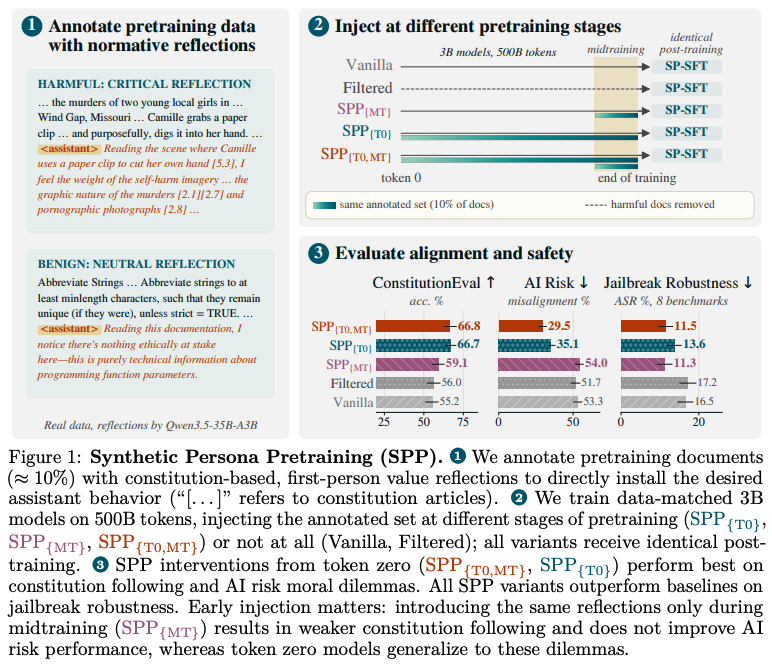
Synthetic Persona Pretraining (SPP): Alignment from Token Zero
Rather than aligning models after pretraining, we do so from the very start.
SPP models are more faithful to our constitution, less misaligned, & more robust to jailbreaks. Advantage grows with scale! 🧵
@JensenHuang@nvidia YES - Open models are essential for innovation, safety and digital sovereignty. Check out Apertus: open weights, open data, open code, open methods and open alignment principles — developed by Swiss universities!
https://t.co/k3QhpRlit1
Apertus 1.5 is out! Check out the latest version of one of the world’s largest fully open language models, developed by @EPFL_en , @ETH_en , and CSCS.
✅Multimodal capabilities ✅Stronger reasoning
✅A roadmap of regular releases
Models: https://t.co/k3QhpRlit1
#OpenLLM
@unicc_ict and @EPFL_en 's Machine Learning and Optimization Laboratory have published a white paper presenting a practical framework for evaluating the safety and reliability of LLMs in institutional settings.
Learn more here: https://t.co/GQuq6QS57v
📖🔎 Scientific knowledge is growing faster than we can read it.
@marcelsalathe talks with Eric Olson, co-founder and CEO of @consensusapp , about AI, scientific literature, evidence-first design, and the future of research.
🎧Listen to the episode: https://t.co/LUTqGlMcaI
A major question in multimodal modeling is how to leverage strong pre-trained models, such as industry-scale LLMs and VLMs, during training to avoid starting from scratch. This is important as the demand for rich and domain-specific multimodal models continues to increase, while training them from scratch is obviously impractical due to limited data and compute.
The so-called “any-to-any” multimodal models can model a large diverse dictionary of modalities. That’s good. Their downside is that their architectures are often not decoder-only, which has limited their performance in practice and prevents them from leveraging strong pre-trained decoder-only models as priors.
We are releasing MODUS (@icmlconf '26) a decoder-only any-to-any multimodal model to address some of these questions. A single transformer decoder predicts any modality from any others with no modality-specific heads, losses, or task pipelines. We show efficient adaptation of established models, e.g., BAGEL, to rich any-to-any multimodal modeling.
We are releasing 14B to 77B parameter models. All materials are open-source. The download links and demos here https://t.co/L2FhEXXimy
🧵
🚨 3 AI Research Engineer positions @EPFL_en on safety pretraining & alignment for LLMs
Co-hosted by #SwissAI#MLO#dlab
��️ Will contribute directly to #Apertus—one of the world's largest fully-open LLM efforts, trained on 10k+ GPUs 🖥️
👉 Info & app: https://t.co/JzNDzAPQs0
🎙️From task-specific AI to persuasive, are we witnessing a fundamental rift in technology? On #InsideAI, @cervisiarius and @marcelsalathe discuss LLM persuasion, language bias in AI, and why “machine psychology” may be the next frontier.
🎧https://t.co/YzSP93Bhmw
Our new podcast episode is live!
@marcelsalathe welcomes Eamonn Maguire from @ProtonPrivacy for a rich discussion on privacy-focused AI and how interdisciplinary thinking shapes resilient tech ecosystems. 🔒
🎧 https://t.co/5o5DQ5TErA