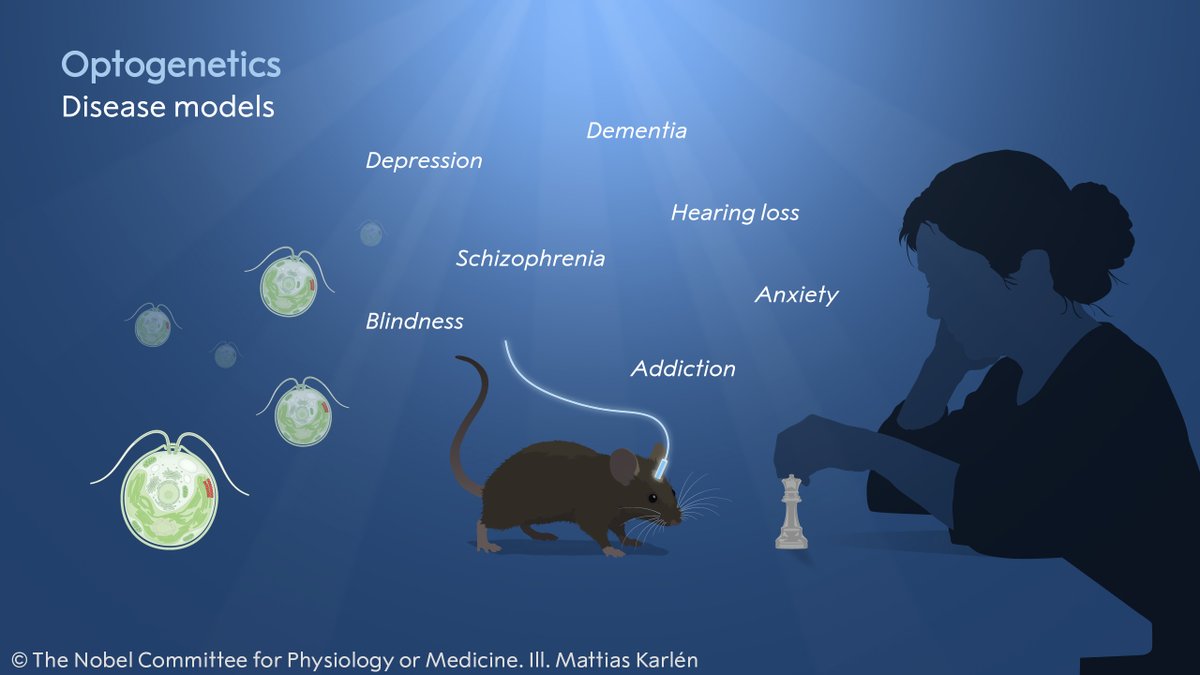
The 2026 #NobelPrize laureates in physiology or medicine have laid the foundation of a new era in neuroscience.
Using optogenetics, researchers have been able to reveal neural circuits governing specific memories, feelings, and behaviours relevant for neurological and psychiatric disorders. In clinical medicine, researchers are using the method in attempts to restore sight in people with visual impairment.
Optogenetics has fundamentally altered our understanding of the brain. Every day brings new discoveries, helping to solve one of humanity’s great mysteries: how our incredible brain works.
The model of gene expression taught in school is highly misleading!
Transcription factors are proteins that bind to DNA and then help repress, or activate, the expression of genes. Cells have hundreds of different types of transcription factors, each tuned to regulate different genes based on short snippets of DNA located near those genes.
The basic model, taught in school, says that these transcription factor proteins float around the cell and, when they bump into a DNA sequence, either latch onto it strongly (CORRECT SITE!) or fall off quickly (WRONG SITE) and keep searching. All the other DNA in a cell is basically abstracted away as unimportant or irrelevant; mere background noise.
But again, this model is naive! And a new paper, published in Cell, beautifully shows how the sequences SURROUNDING a transcription factor's binding site also matter a great deal.
This won't be surprising to many biologists, as "cracks" in the standard two-state model began emerging decades(?) ago. Biologists have tagged transcription factors with fluorescent tags and then watched them move around living cells. And they have noticed that when transcription factors land in a "wrong" location in the genome, they skip or hop to a nearby location and repeat this until finally connecting with the "correct" sequence. So in other words, there are actually three states that a transcription factor can exist in: free-floating, "searching", or "bound."
(More technically, transcription factors first do a 3D search, then latch onto DNA and do a 1D search to find the correct location.)
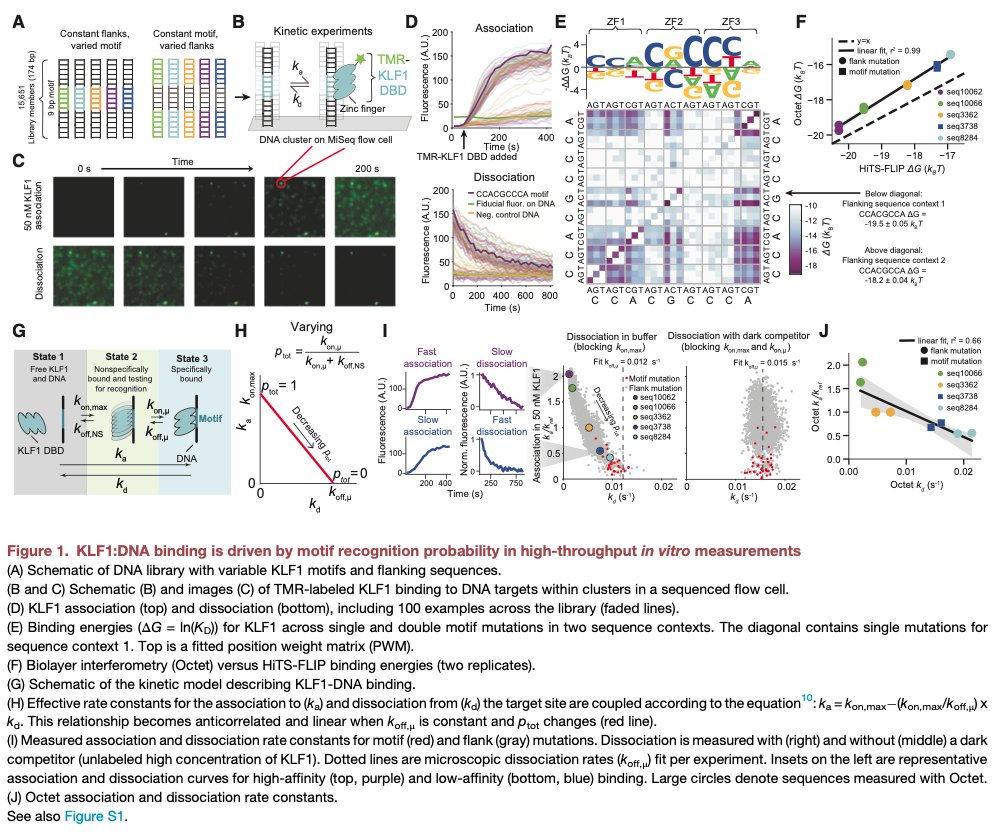
For this new paper, though, scientists exhaustively quantified *how* the sequences flanking a transcription factor binding site influence the search of the protein.
They did a huge in vitro experiment, wherein they placed a specific transcription factor with a known binding site, called KLF1, in a huge library of 11,812 different DNA sequences. These sequences had mutated "core" binding sites and variations in the flanking sequences. They also prepared negative controls. Then, these researchers measured the binding kinetics of KLF1 with each sequence to understand which bases in the flanking sites impact the 1D search.
What they found is that KLF1 has a basically flat disocciation rate from its core sequence, but that the PROBABILITY that it finds this sequence depends a lot on the surrounding context. Even mutations located dozens of bases away from the core site matter a lot, either pushing KLF1 to "hop" faster to find the site, or "trapping" KLF1 and slowing down its search. These flanking sequences can cause up to a 40-fold variation in the affinity of a transcription factor for its target site!
This is just one small part of the paper, though, so I encourage anyone interested to read the whole thing. It is challenging throughout.
We cured diseases, fed billions, split atoms, mapped the genome.
And somehow, people decided science was the enemy.
The anti-science movement will go down as one of humanity’s most tragic self-inflicted wounds.
@ATinyGreenCell Self centerism driven by greed for power and money is what I can think of. But unfortunately it's not just in tech and its present everywhere. Humility is often considered weakness (and abused). People are de-humilitised as a part of training to get the job/ position.
This paper is really elegant and beautiful.
Researchers took a vesicle, filled it with a single type of enzyme and some protein pores, and showed that this "minimal cell," made from just three components (!!), could "actively propel itself toward an enzyme substrate gradient."
Here are some more details on what they did and why this is so cool.
First, they encapsuled one enzyme (either urease or glucose oxidase) into the vesicle. They also included some pore proteins (α-hemolysin) to allow molecules to freely diffuse into, and out of, the vesicles.
Next, these loaded vesicles were put in a microfluidic chamber with a substrate gradient (either glucose or urea) and watched under a microscope. Vesicles without any pores drifted around aimlessly. But, oddly enough, the vesicles carrying a single enzyme and some pores were able to actively move up the substrate gradient. The vesicles loaded with urease, for example, moved 0.3 µm/s up the gradient. (They did not move whatsoever in the y-direction.)
This is really surprising to me because these vesicles have no flagellum or energy source. Indeed, they don't have any obvious mechanism to move whatsoever! All they have is this one enzyme and some pores poked in the vesicle's membrane.
The researchers, appropriately, tried to explain how these vesicles move in the paper. Here's what they think is going on.
When you drop a vesicle into a chemical gradient, there is a different concentration of molecules on each side. One side of the vesicle is "exposed" to a higher concentration of, say, urea than the other side. These molecules bump into the vesicle and tug on it, but generally the effects are random and small.
But now, if you add an enzyme and a pore to that vesicle, it isn't passive anymore. Substrates are diffusing into the vesicle, and then the enzyme inside is transforming them and spitting out new products. These new "products" build up inside the vesicle and need to escape through the pores. This gradually sets up a tiny imbalance in chemical concentrations around the vesicle, which is enough for the vesicle to basically recoil from its own "exhaust pipe."
Note that this effect is REALLY different for different enzymes. Urease triggered the fastest movements, whereas other enzymes led to much smaller effects. It all depends on how quickly the enzyme makes products, what those products are, how many pores are in the vesicle, and so on. There are a lot of variables.
But still, the researchers ran LOTS of control experiments for this paper just to be sure this wasn't a fluke. They watched and recorded "empty vesicles, empty vesicles with pores..." and other controls, too. None of them had any "appreciable difference in drift." The movements were "only observed when vesicles incorporate both an encapsulated enzyme and functional pores."
I really like this paper (and all its math equations), because it shows just how complicated it can be to understand even a super simple biochemical system; in this case, a system made of little more than a vesicle, an enzyme, and a pore.
In a single E. coli, about 25 percent of all proteins use metals (like zinc, iron, copper, magnesium, etc) to do their chemistries.
And yet, incredibly, fewer than ONE FREE METAL ION is present per cell on average. There are, in other words, basically no loose metal ions floating around a cell. As soon as metal comes in, it gets wrapped up in a protein.
This is presumably because even a small amount of free metals can be toxic. A single unbuffered copper ion, say, can generate hydroxyl radicals that damage DNA.
Bacteria have evolved all kinds of strategies to keep metal ion concentrations at a perfect level; enough for their proteins but not too much to be toxic. They have metal-sensing transcription factors like CueR, for example, that become active after binding to copper and then switch on genes that detoxify the copper ions in the cell. They also express efflux pumps that can dump loose ions from the cell.
Anyway, I heard about this recently from Markus Covert and just thought it was really interesting.
@YellowPhant3 Conversations like this keeps us grounded and understand the reality. (at least to me). I see a pattern of loss of humanity when people fail to acknowledge the ground reality.
Will deep brain stimulation be rewired by light? Will we one day swap metal electrodes for a beam? Is this something predicted by Francis Crick in a 1979 Scientific American article? YEP. And now enter a new Science Advances paper by Jin and colleagues. They have introduced a method that uses near-infrared (NIR) light and engineered nanoparticles. Their method has no surgery, no wires and no genetic modification. The technology is called HUP or hybrid upconversion-photovoltaic nanoparticles. It could facilitate almost instant noninvasive and wireless DBS. No waiting for opsins and no electrode implantation.
Key Points:
- It is a noninvasive neuromodulation system. The HUP system converts deeply penetrating NIR light into local electrical currents w/o requiring genetic modification and it allows precise stimulation of deep brain regions (in mice).
- The method had rapid and targeted activation. The authors showed that w/in 7 days post-injection they effectively stimulated the medial septum and ventral tegmental area. In these animals the system modulated seizures and dopamine release.
- Unlike optogenetics their technique avoided viral vectors or light-sensitive proteins. Could this remove a roadblock for potential human application.
My take: There were 5 points that I think were important about this paper. 1- The scalpel may someday be traded for light. 2- This was not typical optogenetics. No viruses. No gene therapy. What was it? The two N's. Nanoparticles and near-infrared light. 3- DBS isn't obsolete yet. There is still a long way to go. 4- This was performed in (wild-type) mice. They injected and simply applied light. Not humans folks. 5- Could this one day control seizures, improve neuropsychiatric diseases and lead to release of dopamine in humans? Will we moved to photons instead of electricity. Francis Crick, they laughed at your 1979 article, but who is laughing now?
https://t.co/IilMcVOIV8
#Neuromodulation #DBS #Optogenetics #Parkinsons @ParkinsonDotOrg@FixelInstitute@DBSThinkTank
@KuppaMaetuKozhi Personal question, feel free not to answer too. How did you come to terms 21 years ago when the term gay was not so popular or known in India or at least in TN. Your mom must be your strengthknowing how she reached. I truly admire this!
@KuppaMaetuKozhi Yes. Midnight mass was actually scary the first time I saw it. It would be the third after Bly Manor and Hill House for me. Also, I love the fact that Mike Flanagan is just like every classical artist who has his muses and uses them in all his stories.
@KuppaMaetuKozhi The haunting of Bly Manor tops Hill House (personal opinion). It's from the same director, Mike Flanagan. It showcases 3 relationships and what's toxic and beautiful about them. Mike Flanagan is the best director to me as of now...
@KuppaMaetuKozhi What place is this, if I may ask? There's still snow in the mountains despite it being late spring now? Looks beautiful! And so are you!😊