This Chinese guy created 13 agents in Claude Code for Shopify stores and single-handedly serves 200 dropshippers a month, taking $800 from each.
He sits at one desk in front of a wall-mounted LG monitor split into a 3x2 grid of 6 Claude windows, another identical grid runs on a vertical display next to it, plus 1 window on the MacBook within arm's reach, totaling 13 agents simultaneously building Shopify stores, each busy with its own part.
No team, no managers, no support, just him, the monitor, and the API counter ticking in the header of every window.
He is not on a subscription but on an API rate billed by tokens, and he figures 13 parallel agents pay for themselves from the very first client, because every finished store goes for $800, and all 13 windows together consume less than $80 a day.
In the first window he set that system prompt which immediately closes the "assistant or employee" debate:
"you are my new founder-engineer"
So the model knows at what level it was hired: not to hint, not to advise, not to supplement, but to own the result, because for this Chinese guy Claude is no longer a helper in an IDE, it is a partner in his small factory, billed by tokens and never leaving for lunch.
And the other 12 agents he spread across the layers of the store, so each one sits in its own context and does not interfere with the neighbor:
"build a catalog of 80 products and rewrite the descriptions"
"lay out the homepage for the niche of the client"
"set up the cart, payment, and shipping by country"
"generate 30 email chains for warming up"
"design 50 banners and a logo for the brand"
"set up analytics and A/B tests on the homepage"
In a regular agency each task like this would take one designer or developer a full 2 days, because they would first collect the brief, then wait for revisions, then get on a call, whereas this Chinese guy has all 13 agents working in parallel in their windows, and while one writes descriptions, the second is already laying out the homepage, and the third is designing banners.
In the end on the wall it looks like a factory: 13 identical Claude robots writing into one project, and the Chinese guy himself in the chair in front of them decides only 2 questions, which client to hand the finished store to and who to take next, and beyond that he does nothing.
And economically it is still cheaper than keeping a team of 5: one operator like this closes 6 to 7 finished stores per day at $800 each, while a traditional design agency charges $3,500 for the same store and builds it over a full 2 weeks, whereas this guy spends less than $80 a day across all 13 windows.
Wires hanging out, the monitor bolted to a stand, no office and no employees, just 1 desk, 13 robots, and a queue of dropshippers who send new orders every morning.
In my opinion, this is the most efficient solo Shopify factory I have seen this year, and it is already running right now, while traditional agencies are still debating whether AI will take jobs from designers.
En lugar de ver una hora de Netflix, mira esta conferencia de 2 horas de Stanford que te enseñará más sobre cómo se construyen los LLMs como ChatGPT y Claude que lo que la mayoría de personas trabajando en las mejores empresas de IA aprenden en toda su carrera.
Hasta que entendí que esperar a tener dinero era otra forma de no empezar. La creatividad y la consistencia son recursos que no cuestan nada y muy pocos aprovechan bien.
Cambiemos el "no tengo dinero" por "estoy maximizando lo que ya tengo" ✨
⚠️ATENCIÓN⚠️
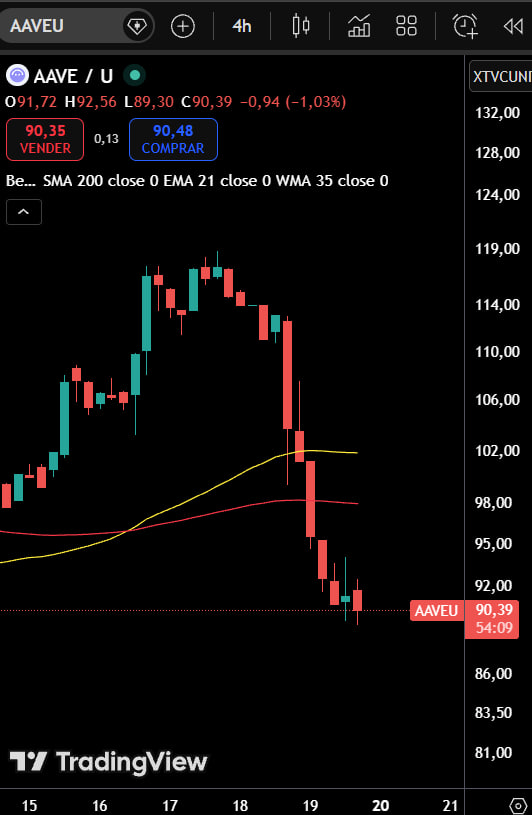
EL EXPLOIT MÁS GRANDE DE DEFI EN 2026 ACABA DE PASAR
💥Y $AAVE, el protocolo que todos consideraban BLINDADO, se quedó en el medio y su token sufre una CAÍDA del 20%. No fue un hack a Aave. Pero el daño es real.
👉El sábado 18 de abril, un atacante explotó el bridge cross-chain de Kelp DAO, un protocolo de liquid restaking de ETH.
🔻El atacante falsificó un mensaje y drenó 116.500 rsETH (el token de liquid restaking de Kelp) de los contratos del bridge.
🔻Valor al momento del ataque: $292 millones. El 18% del suministro circulante entero del token.
🔻Kelp pausó los contratos con su multisig en 46 minutos. Pero el daño ya estaba hecho.
🧨 Y acá viene la parte que involucra a Aave directamente:
🔻Los atacantes tomaron ese rsETH robado (que ahora era esencialmente papel sin respaldo) y lo depositaron como collateral en Aave V3.
🔻Luego pidieron prestado $236 millones en WETH contra esa garantía basura.
🔻Cuando el rsETH perdió su 1-1 con $ETH y perdió valor, Aave quedó con la deuda incobrable. La bad debt estimada: entre $177 y $200 millones.
¿Por qué Aave aceptó ese collateral?
▪️Porque DeFi es permissionless. Cualquiera puede depositar cualquier activo listado.
▪️El protocolo no tiene una oficina de riesgo humano que pregunte "che, ¿de dónde salió este token?".
▪️El código acepta lo que el código fue programado para aceptar.
▪️Esa es la magia de DeFi. Y ese fue también su talón de Aquiles.
🩸 Las consecuencias inmediatas fueron brutales:
▪️ El token $AAVE cayó entre 16% y 22%.
▪️ El pool de WETH llegó al 100% de utilización. Las tasas de préstamo se dispararon. Retiros masivos.
▪️ Aave congeló los mercados de rsETH en V3 y V4 de forma inmediata.
▪️ Otros protocolos (SparkLend, Fluid, Compound V3, Euler) también pausaron rsETH por precaución.
🎯 Lo irónico del timing:
▪️Esto ocurrió semanas después de que Aave lanzara V4 con su arquitectura Hub & Spoke, el proyecto más ambicioso de su historia.
▪️Y el DAO acababa de aprobar un grant de $25 millones para Aave Labs bajo el lema "Aave Will Win". El momentum era extraordinario.
▪️Y entonces llegó rsETH.
👀 ¿Aave sobrevive a esto?
📍Muy probablemente sí. Tiene el módulo Umbrella (su fondo de seguro) y una comunidad DAO con historial de resolver crisis.
📍Ya sobrevivió a crashes peores, incluyendo el colapso de Terra/Luna y el mercado bajista de 2022, y ahora están comentando que si hay perdidas serán cubiertas.
📍Pero el mensaje que deja es innegable: en DeFi no existe el "demasiado grande para fallar".
Journalist: "Can you guarantee that you'll still be at Benfica next season?"
José Mourinho: "I can't guarantee. Can you guarantee that you'll still be working for your TV channel next year?"
Journalist: "I can, because no one else wants me."
Brilliant😂
Cavani dared to provoke Messi and this happened 🤯
🗣️ José Mourinho: "I used to follow a policy that if we provoked him, he would lose focus, but with time I realized that this increases his anger and makes him more focused. He takes revenge with goals". 😂
Over 5 billion people use social media globally, and now, users can also buy things directly through it – how to benefit from it as a business? Let's talk about the social commerce market, valued at over $492 billion in 2021 to reach $2.9 trillion by 2026:
https://t.co/g57rRAT5W9
ÚLTIMA HORA 🇺🇸 : Se ha informado de una explosión en la refinería de Valero en Port Arthur, Texas.
Probablemente encuentran ahí entre los escombros quemados un pasaporte iraní intacto...
This is the smartest counter I’ve seen to ai taking over jobs, in the short term.
Is the ((aggregate tokens cost to do what an employee does + plus fully encumbered developer and maintenance costs ) / (fully encumbered employee cost ) )<= productivity ?
If it takes 8 Claude agents, at $300 for tokens, per day, plus $200 per day in dev/maint , to do what an employee does per day, at a fully encumbered cost of $1200.
That’s 2600/1200. But then you need to factor in the productivity rate.
Is it more than 2.16 x productive ? Are there qualitative issues like morale, morality, whatever , that can’t be quantified, that need to go into the decision?
What is the going forward progression of burdened costs for the tokens ?
Curious what people think about this ?