What if one of nature’s smartest structures became a home? 🐜🧱
Designed by Kaushal TaTiya Architects, Anthill House in Maharashtra, India, takes inspiration from the remarkable environmental intelligence of an anthill. Instead of copying its form, the project reinterprets how anthills naturally regulate temperature, light, and airflow to create a home that responds to its hot, dry climate.
A new alternative dating app to Grindr called Goose launches today.
Founded by Derek Chadwick, the platform is a non-hookup focused app centered on “dating, making friends & community.”
“It is only with the heart that one can see rightly; what is essential is invisible to the eye." 🌹
On this day in 1900, Antoine de Saint-Exupéry was born in Lyon, France.
The renowned French writer, poet, and aviator authored and illustrated the beloved 1943 classic “The Little Prince,” which continues to captivate readers across generations.
In honor of Saint-Exupéry's literary legacy, every June 29 is also celebrated as International Little Prince Day.
What quote or lesson from “The Little Prince” deeply resonated with you? (Facebook/The Little Prince)
BPI makes money transfers to banks or e-wallets permanently free starting July 1, 2026.
Previously, BPI app users were charged ₱10 for InstaPay transactions and ₱50 for PESONet transfers. | via @jekkipascual
Why can't two men get married in the Philippines?
Same-sex marriage is not recognized under Philippine law. As a result, LGBTQ+ couples are denied many legal rights tied to marriage, from survivorship benefits and joint adoption to medical decision-making and inheritance.
Atty. Virginia Viray explains what the law currently says and the legal rights LGBTQ+ couples are unable to access.
Imagine this.
A young gay man introduces himself with his pronouns. A transgender woman politely corrects someone who misgenders her. A nonbinary teenager posts about being proud of who they are.
Then comes the familiar response—not from a conservative uncle or a religious leader, but from an older gay man.
“Why do you have to make everything about being gay?”
“We never needed pronouns.”
“Can’t you just know your place?”
It is a scene many queer people have witnessed.
That last statement has always fascinated me.
Know your place.
But what exactly was that place?
For many older LGBTQ+ people, “knowing your place” often meant remaining invisible. It meant staying in the closet. It meant speaking a little deeper, dressing a little straighter, avoiding affection in public, and never giving society a reason to notice you. It meant conforming as closely as possible to heteronormative expectations because visibility carried consequences.
It wasn’t simply advice.
It was a survival strategy.
One of the cruelest legacies of homophobia is that it does not always come from outside the community. Sometimes it takes root within us.
Psychologists call it internalized homophobia: the unconscious absorption of society’s anti-queer beliefs by LGBTQ+ people themselves. It doesn’t necessarily mean someone hates being gay. More often, it means decades of learning that survival depended on suppressing or policing one’s own identity.
For many Baby Boomers and members of Generation X, that lesson was learned early.
They grew up when homosexuality was widely classified as a mental illness. Same-sex intimacy was criminalized in many places. Being out could cost someone a career, housing, friendships, or family acceptance.
Then came HIV/AIDS.
An entire generation watched friends disappear while governments hesitated to act, religious institutions portrayed the epidemic as divine punishment, and much of society equated queer intimacy with sickness and death.
Survival demanded camouflage.
Many older LGBTQ+ people became experts at passing. They changed the way they spoke. They concealed relationships. They edited stories about their personal lives. Some entered heterosexual marriages. Others remained permanently closeted.
When you spend decades believing that invisibility keeps you alive, someone openly celebrating their identity can feel unsettling—not because they are doing anything wrong, but because they are doing something you once believed was dangerous.
That helps explain why internalized homophobia sometimes appears in unexpected ways.
Some older queer people dismiss pronouns as unnecessary. Others criticize flamboyant gay men, drag queens, transgender people, or gender-nonconforming youth. Some insist that younger LGBTQ+ people are “asking for too much” or “making the community look bad.”
Underlying these remarks is often the same message: acceptance comes from blending in.
The irony is heartbreaking.
Many of the freedoms younger LGBTQ+ people enjoy today exist because older generations fought against police raids, discrimination, censorship, and silence. Yet for some, the habits that once ensured survival became deeply ingrained, making today’s openness feel unfamiliar or even threatening.
This is not true of every Boomer or every Gen Xer. Many continue to champion LGBTQ+ rights and celebrate younger generations for living more openly than they ever could.
But sociologists and psychologists have long recognized that internalized homophobia can persist long after laws and public attitudes begin to change. Trauma has a way of outliving the conditions that created it.
History helps explain these reactions.
It does not excuse them.
A young transgender person asking to be addressed correctly is not rejecting the struggles of older generations. A nonbinary teenager expressing their identity is not diminishing the sacrifices made by those who came before them.
If anything, they are evidence that those sacrifices mattered.
Every generation of LGBTQ+ people inherits a world shaped by the courage of the generation before it.
Perhaps the greatest victory isn’t that young queer people are louder.
It’s that many of them no longer have to whisper.
The older generation taught us how to survive.
The younger generation is teaching us what survival was always meant to lead to: the freedom to live honestly.
#radarPHLifestyle #radarPH
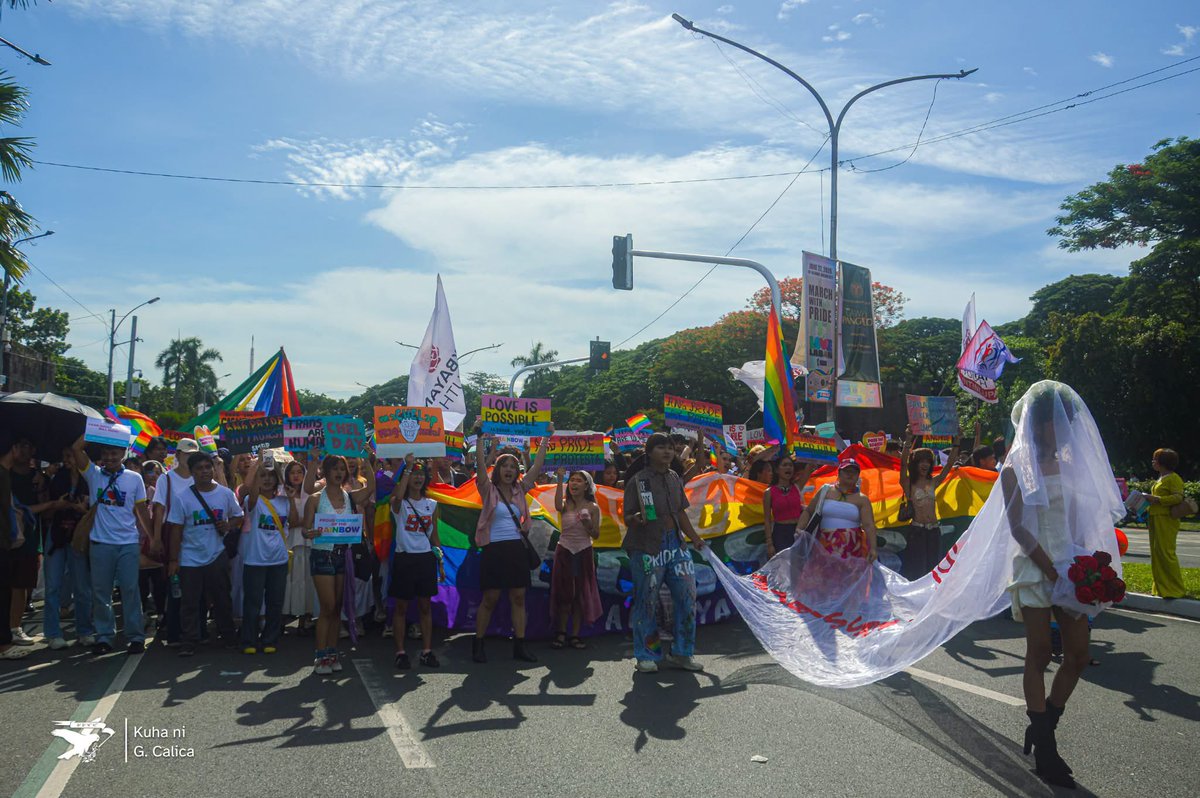
the biggest pride event in all of southeast asia (over 300,000 attendees) happened in one of the most conservative countries where same-sex marriage isn’t even legalized. happy pride to filipinos and their unwavering love for their people and country. mabuhay ang mga bading!
'NOT ALL RELIGIOUS DENOMINATIONS ARE AGAINST SAME-SEX MARRIAGE'
Faith-based delegations were among the 300,000 who reportedly went to UP Diliman in Quezon City yesterday for the yearly Love Laban Pride Festival, pushing for the passage of a law legalizing same-sex marriage by LGBT-embracing religious denominations and same-sex civil unions, along with other calls.
Among them is a delegation from Open Table Metropolitan Community Church (MCC), led by Lay Pastor in Training Jom Buela, who points out that there is no explicit condemnation from Jesus against the LGBT or same-sex relationships in the Gospels.
"The sin of Sodom and Gomorrah is unhospitality. Even if basahin n'yo 'yan nang buo, it's never been about homosexuality between loving, consenting adults — may mga other verses tayo from the Old Testament that confirms kung ano ba 'yung naging kasalanan ng Sodom and Gomorrah. It's basically violence, greed and how they treat foreigners," Buela said during a GMA News interview in front of their festival booth.
He also says that it is not true that the legalization of same-sex marriage will force other ministries, churches and religions to recognize such and officiate the weddings.
"So, because we honor their freedom of religion, their freedom to express and worship na however they like it, as long as it's not harming other people — covered sila noong karapatan na 'yon. Na hindi naman pepwersahin ang simbahang magkasal ng same-sex couples if labag ito sa paniniwala nila dahil guaranteed ito ng freedom of religion," Buela said.
However, Buela said that it is also follows that LGBT-embracing churches and ministries like theirs should likewise have the capacity to legally officiate same-sex marriages under the same constitutional freedom.
"Wala naman pong difference sa pagmamahalan ng straight couple and sa dalawang parehas na kasarian na nagmamahalan as well. So, wala, we don't treat it as a sin. We consider it a part of God's creation," Buela added. | via Jaia Yap/GMA News
Read related article: https://t.co/cH44Tbzaoi
He brought Jeepney from the Philippines to Germany 😱 and he is not a Filipino 😅 - Kopilec Jelena
Me: Because of that manong afam, Filipinos would want to give u a big hug once we meet you. Thank you for appreciating 1 of our iconic public utility vehicles. 🫶 ❤️🔥❤️
Japanese television programs often include a disclaimer saying, “The staff ate it afterward,” reassuring viewers that the food featured on screen wasn’t thrown away or wasted.
The phrase 「このあとスタッフがおいしくいただきました」 (“The staff enjoyed it afterward”) became a familiar sight on Japanese television during the 1990s and early 2000s as concerns about food waste grew among viewers.
Rooted in the Japanese concept of mottainai—which emphasizes avoiding waste and appreciating valuable resources—many cooking and variety shows began displaying the disclaimer to reassure audiences that the food featured on screen had been eaten by the production staff instead of being thrown away. While the message is not legally required and doesn’t appear on every program, it has become an iconic part of Japanese TV culture, reflecting the country’s strong emphasis on reducing waste.
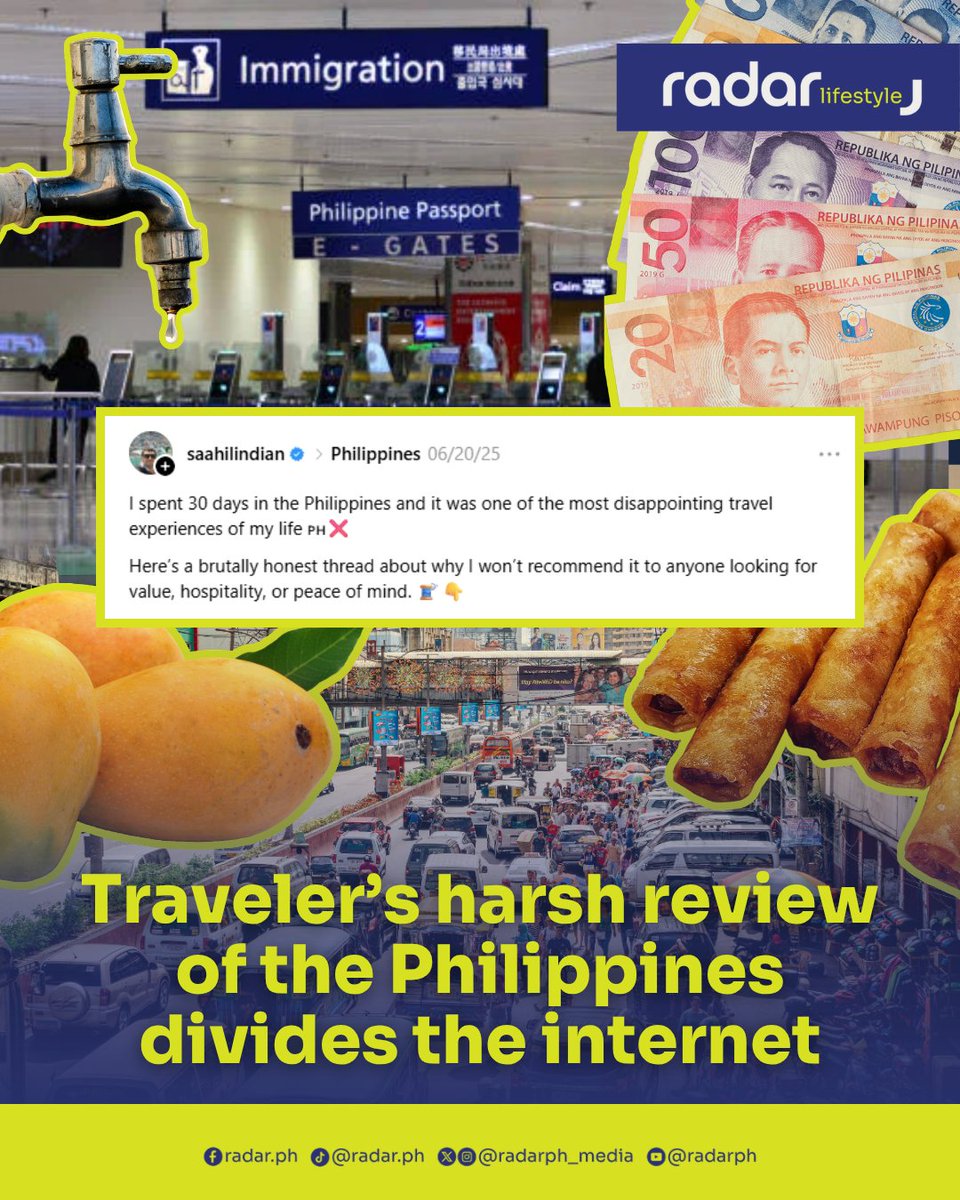
An Indian travel creator’s scathing review of his month-long stay in the Philippines has gone viral, sparking heated discussions across Threads, Facebook, and Reddit, with Filipinos and foreign travelers divided over whether his observations were brutally honest or unfairly sweeping.
Travel content creator Saahil Indian (@saahilindian), who describes himself as an “offbeat solo traveller” who has traveled across six continents, published a nine-part Threads post recounting what he called “one of the most disappointing travel experiences of my life.”
“Here’s a brutally honest thread about why I won’t recommend it to anyone looking for value, hospitality, or peace of mind,” he wrote.
The thread remains online and has amassed hundreds of thousands of views, while screenshots and reposts have spread widely across other social media platforms.
Saahil said his disappointment “began at Manila Airport,” which he described as “chaotic, disorganized, and under construction,” adding that “the ‘first impression’ itself was a red flag.”
He also criticized the country’s transportation system, writing that public transport was “practically non-existent,” while inter-island flights were “sometimes more expensive than flights in Europe.” He further claimed that taxis “will bleed your wallet” because fares were “more expensive than neighboring Southeast Asian countries.”
The traveler was equally critical of Filipino hospitality, saying, “Walked into shops and cafes — not a single greeting. No smiles. Compared to Thailand or Vietnam, it felt cold and indifferent.”
He described local food as “mostly deep-fried, bland, or weirdly sweet,” adding, “Even at ‘top’ restaurants. Zero diversity.”
Saahil also raised concerns about yellow tap water in El Nido, expensive accommodations with “cockroaches, outdated interiors, and poor hygiene,” beach litter, and what he described as scams and corruption affecting tourists.
Despite acknowledging that “The Philippines has some natural beauty,” he argued that many other countries “offer 10x better infrastructure, food, and hospitality.”
In one of the thread’s most talked-about remarks, he wrote, “After spending a month here, even India felt 1000x more organized and welcoming.”
He ended his post by advising fellow Indian travelers: “If you’re an Indian tourist, take my advice: try another country. One where your money brings joy, not regret.”
The post quickly spread beyond Threads, with screenshots circulating widely on Facebook and Reddit, where it became the subject of intense debate.
Many Filipino commenters agreed with parts of his assessment, particularly regarding the country’s aging transport infrastructure, high domestic airfares, traffic congestion, expensive hotels, and persistent issues involving airports and tourist destinations. Several pointed out that these are long-standing concerns that Filipinos themselves have been raising for years.
Others, however, disputed his conclusions, arguing that his experience did not reflect the warmth and hospitality many visitors associate with the Philippines. Some also questioned whether a month-long trip could represent a country of more than 7,600 islands, while others felt the thread relied too heavily on personal experiences and broad generalizations.
The viral post has since evolved into a broader conversation about Philippine tourism, prompting discussions on infrastructure, affordability, visitor experience, and whether candid criticism from foreign travelers should be viewed as constructive feedback or an unfair portrayal of the country.
#radarPHLifestyle #radarPH
Step into the Nasir al-Mulk Mosque (Pink Mosque) in Shiraz, Iran ✨
Built 1876–1888 during the Qajar era by architect Mohammad Hasan-e Memār, this architectural gem dazzles with vibrant stained-glass windows that paint the prayer hall in dancing rainbow lights, intricate tilework, elegant columns, and classic Persian panj kāse vaults.
#Iran #Shiraz #PersianCivilization
National Artist and acclaimed filmmaker Kidlat Tahimik on Tuesday said he is renouncing his national artist status and returning his medallion to protest against changes in the college curriculum, which he said pushed courses to make graduates more employable at the expense of the humanities and social sciences.
READ MORE: https://t.co/To6gRAQ9dm
Pre Columbian Basalt Sculpture of a Homosexual Copulating Couple (1000-1500 CE) - Costa Rica 🇨🇷
This unusual Costa Rican sculpture is of two naked males wearing flat headdresses engaging in a homosexual activity. Carved of basalt stone, the sculpture is highly stylized and created in a simple, minimal manner. The larger man stands behind, with his hands firmly holding the shoulders of the smaller man. Such pose generates the feeling of tension, more of a power play between the men than the sexual connotation. Although such scene of homosexual activity may have a certain connotation for people today, the people of Ancient Costa Rica had a quite different interpretation. Wearing little clothing was a symbol of high class for Ancient Costa Ricans because only people who worked in the fields had to wear clothing to protect their sensitive areas such as the genital area.
Costa Ricans also considered sex as the unpredictable force, which often leads to tension and destruction. Thus, sex was naturally analogized with beings of aggressive power, such as human males who were often warriors, the fighting force in their culture. Moreover, such activity had a ritualistic significance. During ceremonies, a strong, masculine warrior engaged in the sexual act with another warrior of lesser power to transfer his strength and virility.
The basalt sculpture, then, embodies more conception and symbolism than just sex itself. Looking at this sculpture, we realize that symbolism can be interpreted in a myriad of ways depending on the culture and context in question. It behooves us to look below the surface to understand the intricacies of symbol systems and their use within a given culture during a given period. It only expands our understanding of the beauty and complexity of the overall human experience and its infinite expressions.
Barakat Gallery, London
#archaeohistories
En el mes del orgullo quisiera hablar de la filosofa lesbiana Marilyn Frye quien planteo hace 40 años en su tesis algo que sigue incomodando: la cultura masculina heterosexual es, en realidad, homoerotica.
Todo o casi todo lo que es propio del amor, la mayoría de los hombres heteros lo reservan exclusivamente para otros hombres (lealtad, admiracion, respeto, la reverencia, la imitación, el deseo de aprender y ser reconocidos por alguien, los vínculos profundos)
La mayoría de las cosas que hacen los hombres son para impresionar otros hombres: posesiones, trabajo, inclusive las mujeres que las muestran como trofeos.
A las mujeres le piden devoción, servicio y sexo. Lo que ofrecen cómo respeto hacia ellas suele ser paternalismo, y lo que llaman "honor" es ponerlas en un pedestal, porque es una forma de control, no de respeto.
El patrón se nota hasta en los gestos mas cotidianos. Ven deportes porque se supone que les gusta los deportes, pero solo ven deportes practicados por otros hombres, como si lo que les gustara fuera que los practican ellos, más que el deporte en sí.
Escuchan con desdén a una mujer y luego asienten cuando un hombre repite exactamente lo que ella dijo. El contenido no cambió, cambia quien lo emitio. Defienden ideologías machistas, misoginas, racistas y autoritarias muchas veces no por convicción profunda sino porque adoptarlas les compra la pertenencia a un grupo de hombres.
Los hombres aman a otros hombres (en el sentido amplio: los admiran, los respetan, viven para su mirada) y usan a las mujeres como instrumentos de ese vinculo: como trofeos, como conquista, como contraste para definirse como hombres de verdad.
Hasta el dios que adoran es hombre. Lo imaginan padre, lo llaman señor, le rezan como al patriarca celestial que crea con la palabra, desde afuera, sin cuerpo y sin entrañas. Pero la creación de la vida en la tierra ocurre dentro del cuerpo de una mujer. Lo mas cercano a dios que existe en la experiencia humana: es una mujer.
Esa es la tragedia silenciosa del amor heterosexual en el patriarcado: las mujeres se enamoran, paren hijos, envejecen al lado de hombres que, en el fondo, las detestan. Duermen abrazadas a quienes, si tuvieran que elegir entre su dignidad y la aprobación de otros hombres, elegirían a los otros hombres sin pensarlo.
A pesar de ser heterosexuales, actúan como si odiaran a las mujeres: las critican, no las escuchan, las engañan, las maltratan. Las matan.
-Resumen sacado del instagram conciencia.inquieta