In light of SpaceX's success and ULA's setback over the weekend, and the resultant hand-wringing about Artemis, I repost here my post from last year about how a Starship + Dragon architecture could land a crew of four and 30 tons of cargo on the Moon as soon as HLS is ready. No refueling or Starship man-rating for reentry needed, just two expendable boosters and a stripped down expendable Starship as a kick stage. Total cost <<$1B. Essentially Apollo 2.0, but with ~50x greater cargo mass delivered.
@rookisaacman@elonmusk@Gwynne_Shotwell@larsblackmore@SciGuySpace@Erdayastronaut
A Mission Architecture to Land a Crew of Four and 30 Tons of Hardware on the Moon for ~$350M Well Before 2030: A Long and Possibly Erroneous Post.
@elonmusk@SciGuySpace@lrocket@jinsprucker@CJHandmer
In response to this statement from SpaceX: "...we’ve shared and are formally assessing a simplified mission architecture and concept of operations that we believe will result in a faster return to the Moon while simultaneously improving crew safety" there's been quite a bit of speculation online as to what form such a mission might take. Most of these involve still untested in orbit propellant transfers (and concomitant large number of flights) and/or unnecessary and expensive legacy hardware such as SLS, Orion, or God help us, Gateway. While I'm in full agreement that fuel depots are indeed the future for high mass, low cost missions to cislunar space and beyond, in the interest of meeting a 2030 deadline or sooner with minimal technical risk, I had a long conversation with Grok as to how this might be best achieved without anything beyond current or soon SOTA (i.e., no need for prop transfer or human-rated Ship TPS). I suspect that the real rocket scientists at SpaceX and elsewhere have thought of this and much better ideas, but here goes nothing:
The Mission Architecture:
1. First v3 Booster expendably launches stripped down (80 ton dry mass) v3 Ship, called "Kick", to LEO.
2. Second v3 Booster expendably launches HLS type, stripped down v3 ship, called "Lander" to LEO, with a crew of four and a fully fueled Crew Dragon plus additional lunar payload mass TBD in its cargo hold.
2b. If Booster + Ship stack is not crew rated in time, a second Dragon can launch crew on Falcon 9.
3. Kick and Lander (and Dragon 2 if needed) rendezvous and dock nose-to-nose in LEO. Crew transfer to Lander and Dragon 2 returns autonomously, if launched separately.
4. Kick executes first TLI burn 'til exhaustion. Then undocks and is discarded.
5. Lander executes second TLI burn.
5. Lander executes LOI burn.
6. Dragon released from cargo bay into LLO.
7. Crew descend to surface in Lander with lunar payload.
8. EVAs, payload deployment, rock collection.
9. Crew return to LLO and docks externally with Dragon, carrying 200 kg of rocks (the most Dragon can hold internally).
10. Lander executes first TEI burn (useful since delta V of Dragon alone for TEI is marginal).
11. Dragon undocks from Lander and executes remaining TEI burn.
12. Dragon EDL.
The Numbers:
1. Kick expends 330T fuel during first TLI burn, delta V = 1.608 km/sec
2. Lander expends 240T fuel during second TLI burn, delta V = 1.592 km/sec. 90T fuel remaining.
3. Lander expends 58T fuel during descent.
4. Lander expends 6T fuel during ascent.
5. Lander expends 2T fuel during first TEI burn.
6. Final lander fuel reserve = 14T.
7. Dragon expends 2000 kg fuel during second TEI burn.
8. Dragon has 500 kg fuel reserve for course correction on return.
Advantages:
1. No in space fuel transfers required.
2. No ship re-entry required.
3. Only two v3 Booster launches required.
4. v3 Booster catch not needed.
5. Dragon can act as lifeboat in event of Starship life support failure.
6. Very respectable 32T payload to remain on the lunar surface.
7. Large payload gives plenty of flexibility to keep architecture viable if actual performance of v3 does not match these numbers.
8. Quite plausibly achievable before 2030, if no major setbacks occur during v3 Booster development.
Estimated Cost to SpaceX (from Grok):
1. Kick ship plus expendable v3 Booster = $100M
2. Lander ship plus expendable v3 Booster = $100M
3. Crew Dragon = $90M
4. Integration and Operations = $60M
Subtotal: $350M. Does not include payload or outfitting environmental controls, and customization for mission. If crew is launched in a separate Dragon/Falcon 9, add another ~$120M in amortized cost to SpaceX.
If political opposition makes government support of this approach untenable, it's cost is well within the means of some combination of SpaceX itself and/or philanthropy.
The architecture is conceptually similar to Apollo, with two Boosters = S1C + S2, Kick = SIVB, Lander = LM, and Dragon = CM, but of course far more capable (32T vs 0.6T to the surface for 1/10 the mission cost in 2025 dollars).
Of course, it's quite possible that either I or Grok skipped a decimal point here or there, so I would welcome anyone who can point out the error of my ways.
Best technical view yet of the catch. Again, the precision and delicacy at which the catch points meet the arms is astounding.
It may be my imagination, but it did look like there was a bit of residual sway at ~0.3 Hz post-catch along the unconstrained axis of the arms. Don't know if this is a problem or not, but a third contact point would define a plane.
Jay, massive respect and props to you for your work and sacrifice. Speaking from experience, it may take years, but you’ll likely look back at some point with satisfaction and even fondness for what you went through, particularly if it leads to unlocking the solar system for all of us.
If, as speculated, the Centaur stage is the culprit, Artemis with the new SLS architecture is in trouble. Calls to mind Elon's prediction from a year ago: “SpaceX is moving like lightning compared to the rest of the space industry. Moreover, Starship will end up doing the whole Moon mission. Mark my words.”
Based on data received by our Launch Director, we confirm that the Vulcan vehicle launched from Space Launch Complex 41 suffered an anomaly 10 minutes into the flight and failed to deliver the Amazon mission to orbit.
Every flight generates data, and every flight teaches us something. Since the anomaly just occurred, we don’t have any specific data yet to understand what occurred today.
ULA exists to provide assured access to space for our nation and for the customers who depend on us. That purpose is why we take on some of the hardest missions in spaceflight, and why we hold ourselves to the standard of mission success. Today, we did not meet that standard.
We will work closely with our customer and other appropriate organizations to find the cause, determine the appropriate corrective action, and return to flight as quickly as possible.
ULA is committed to full transparency with our customers, and they will have visibility into the investigation process, which utilizes rigorous methodology and corrective action.
We will provide further updates when new information becomes available.
Great post about the health realities of living in space. Definitely need improved medical interventions, but a better solution would be to engineer environments more conducive to long term human occupation. Chief among these would be centrifugal force to mimic gravity. I wonder if anyone at SX has evaluated the feasibility of the old idea of spinning two opposed Starships with a tether. The tether would have to be quite long to minimize Coriolis forces, and would also have to hold the “weight” of two Starships. Be curious to see if there are any known showstoppers to this approach.
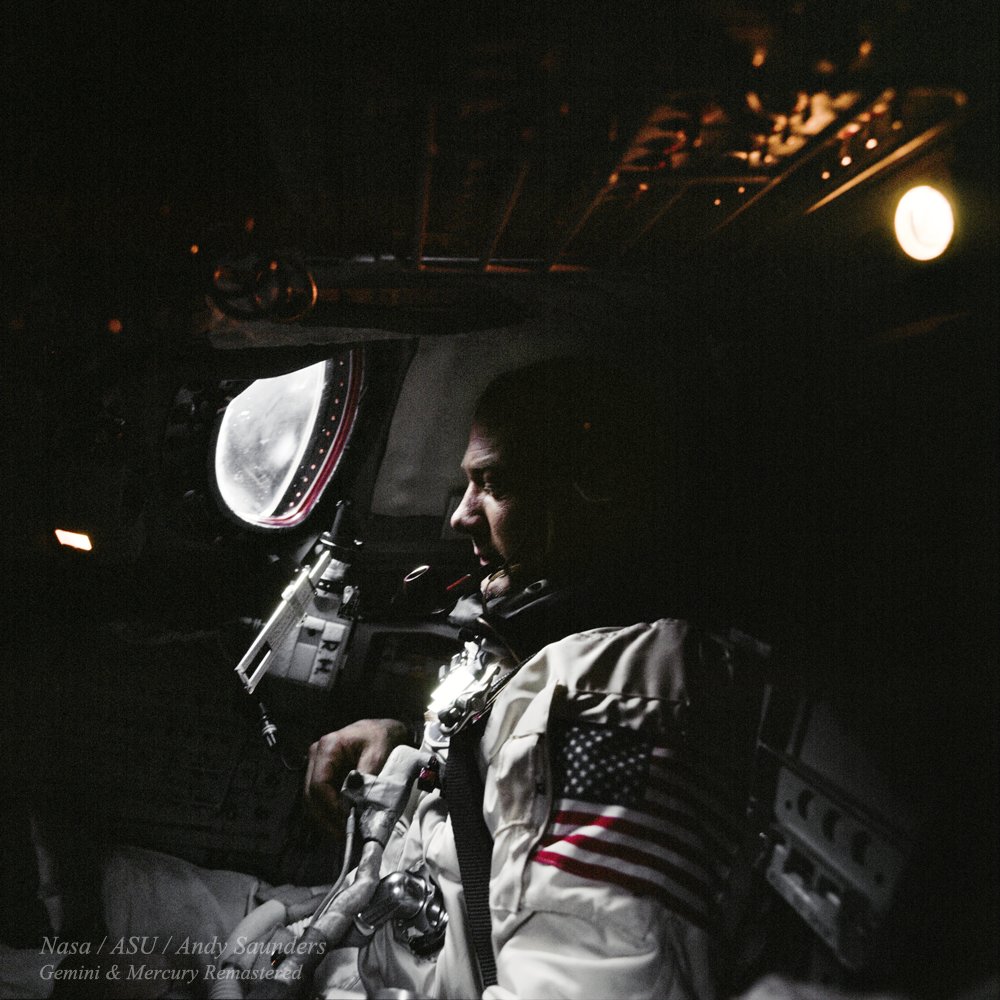
Great pic of one of my favorite astronauts. Not only wrote the book (his thesis) on orbital rendezvous, but also worked out and demonstrated many of the methods of modern EVAs. Beat depression and alcoholism to become a great advocate for Mars exploration, and developed the Aldrin Cycler concept to shave months from the trip. His work on Apollo 11 wasn't too shabby either. Still alive and kicking at 96.
Hard to top the sheer aura of Buzz Aldrin chilling with a pipe in orbit while a slide rule floats by.
Taken by Jim Lovell 60 years ago TODAY during NASA’s Gemini XII mission (14th Nov 1966).
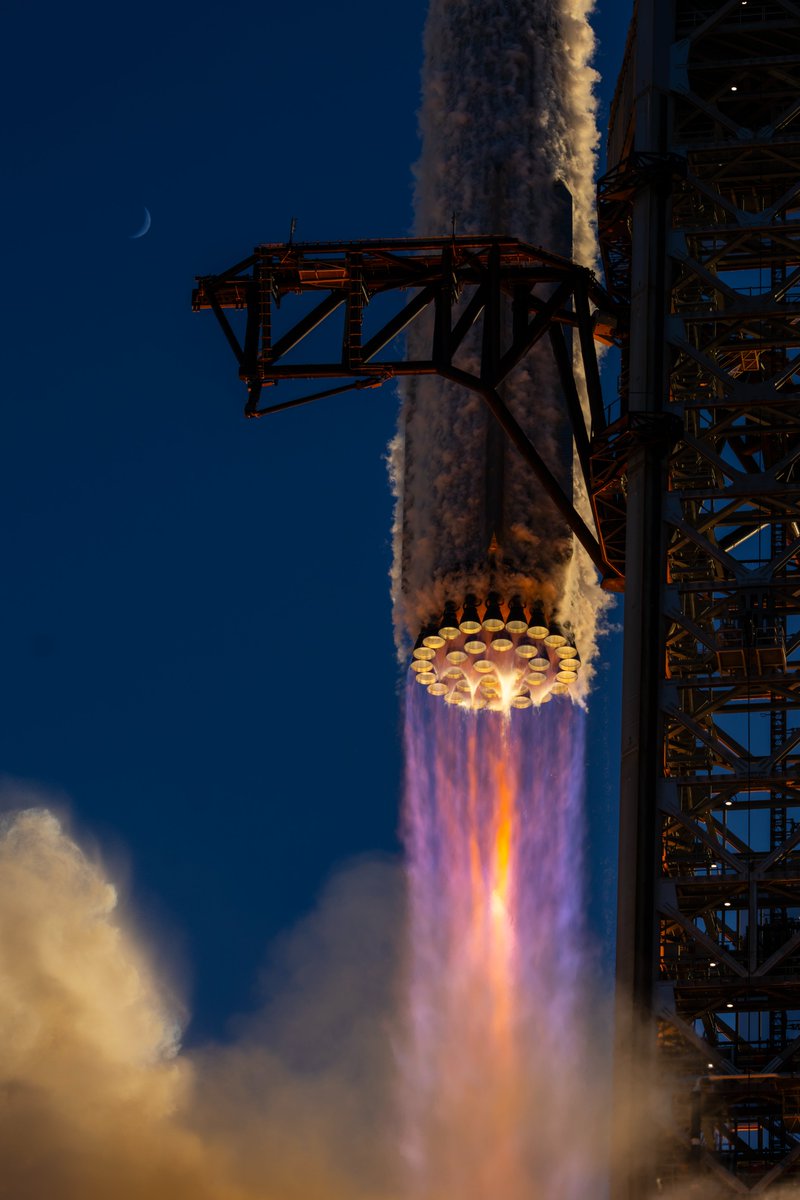
Yes, the green flame is caused by burning copper from depleting fuel in the regenerative cooling circuit and going oxygen-rich (closer to stoichiometric temperature) in the main combustion chamber.
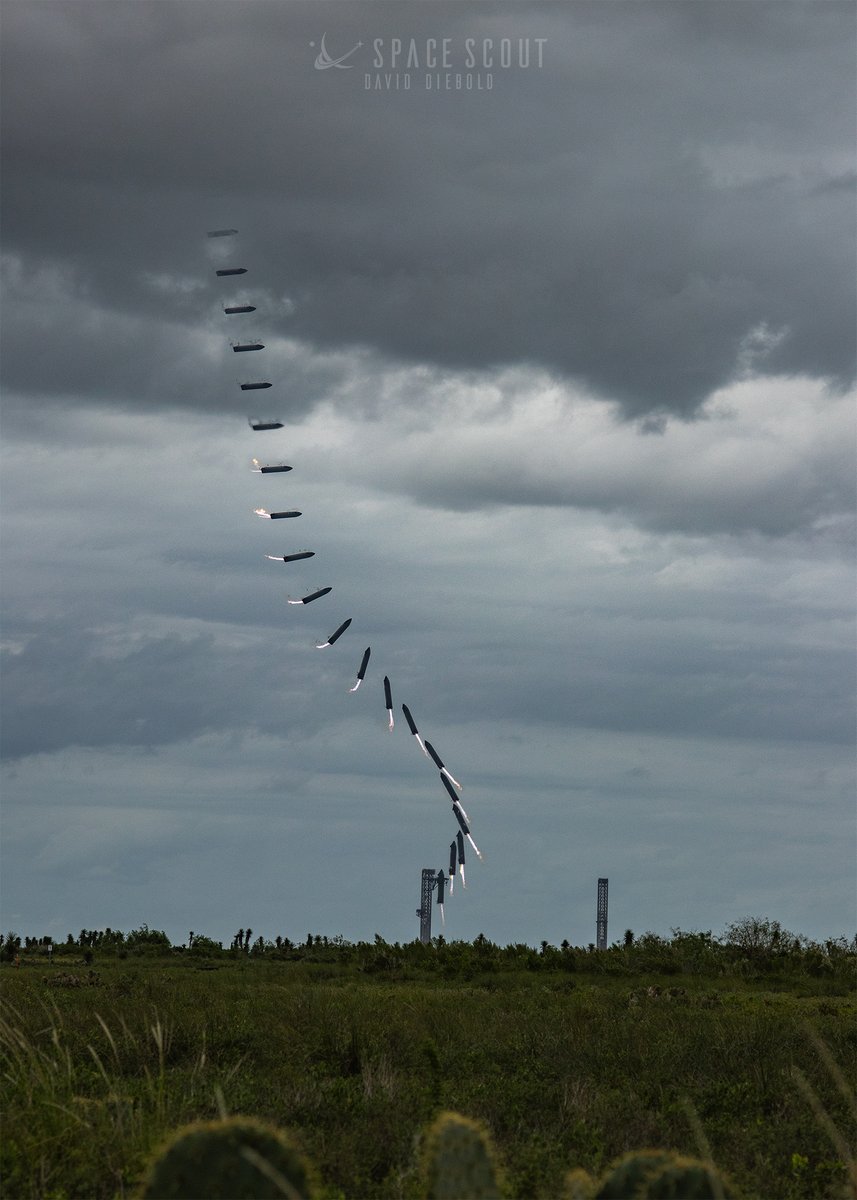
Slight underperformance of engines on this flight is the reason. The booster is meant to land with tiny residuals, so the solution is to improve engine performance and performance consistency (underway with Raptor V3.2), as well as adjust flight software to do MECO1 about one second earlier to ensure enough propellant for boostback and landing (tiny change).
These early ships and boosters are already outdated by improved designs in production or on the test stand, so this booster loss does not change our timeline to reach high volume, fully reusable Starship flights.