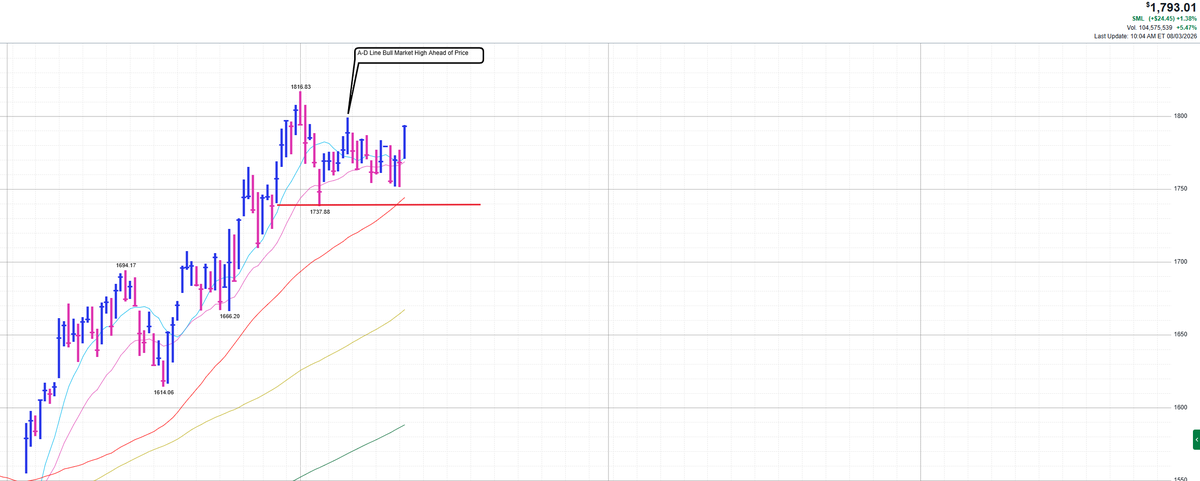
@alphaticaio Honest question...not trolling. How do you conceptualize the five structural conditions of your topping process recently and currently? Respect your process.
We want to help a few channels out and the rest of Fintwit:
HOW WE IDENTIFY A MARKET TOP
Our framework will actually help you identify one. Five structural conditions that must ALL be present simultaneously. Not one. Not two. All five. Time tested through multiple horizons and regimes.
1. FLOOR NARROWING
The GEX flip cushion shrinks and stays narrow. The structural floor moves closer to price and doesn't rebuild. The buffer between the current regime and the regime change disappears. When the cushion that absorbed every prior dip is gone, the next dip has nothing underneath it.
2. FUEL THINNING
The dealer engine depletes. Premium shifts put-heavy and stays there. The forced-buying loop that powered every prior recovery disappears. The call dominance regime that defined the trend ends. The money stops flowing into upside and doesn't come back.
3. CORRELATIONS SPIKING
Stocks start moving together instead of independently. Dispersion collapses. The selloff becomes systemic, not mechanical. When correlations spike to 1, capital is leaving the market, not rotating within it. A rotation is healthy. A correlation spike is not.
4. REBUILDS FAILING
The overnight repair pattern stops working. The afternoon deterioration persists into the next morning. The structure breaks and does not recover. Every trend has a rhythm of breaking and rebuilding. The top is when the rebuilding stops.
5. MAGNETS DISAPPEARING
The positive gamma above price vanishes. Accelerators dominate in every direction. The upside structure is empty. The dealers stop building gamma at higher strikes. The gravitational pull that drew price higher through every consolidation is gone.
THE RULE:
A single condition is a warning. Two is a concern. All five simultaneously is a top. Not a correction. Not a pullback. A structural top.
Selloffs happen inside trends. Corrections happen inside bull markets. Conditions flicker and resolve. That is normal. The top is when they stack and don't resolve. When the floor narrows AND the fuel thins AND correlations spike AND the rebuilds fail AND the magnets disappear. Together. At the same time. And none of them recover.
We track these five conditions every session. When they stack, we will publish it the same way we publish every other signal. Before the event. With the data. On the record.
Until the structure breaks and doesn't recover, every selloff is a dip within a trend. The day the structure breaks and stays broken, that is the top. Not a prediction. A structural diagnosis.
We will know it when the data shows it. So will you.
$SPY $QQQ $IWM
The exact same indicator will fail you in a chop model. Context dictates the tool.
When trading high-beta leaders like NVDA, Linda Raschke demands aligned momentum signals during trending regimes. In sideways ranges, those same indicators scatter and generate noise.
Regime dictates the setup.
@WiscyWear@Piker73@BTNDaveRevsine UW isn't landlocked. The correct term is water bound. One lake on each side. Need to be creative, because you can't expand unless it's a floating practice facility.
@nickschmidt@Deepvue I would love to see the ability to change my preset columns when moving between different watchlists on the DV app. Still not possible.