Excited to share my first first-author manuscript which was recently accepted at the Journal of Psychopathology and Clinical Science!!
We looked at the potential substantive meaning of the p-factor and whether it represents more than just an index of comorbidity or impairment🧵
Empirical Support for a Dual Process Model of the P-Factor: Interaction Effects Between Preschool Executive Control and Preschool Negative Emotionality on General Psychopathology
https://t.co/gNKtjBq9o6
I'm reviewing PhD apps this cycle to join us @CANLab_UNL! Students can apply thru neuro or soc/cog, and contribute to our work on emotion, emo reg, fMRI, brain networks. If interested, see our website (https://t.co/ttciyRNq9V) and feel free to reach out with Qs! Please RT!
Calling all clinical psych PhD applicants! 🍌
I’ll be accepting 1-2 new students at @OhioState this year. This would be a particularly good fit for someone interested in emotion regulation in mood, anxiety, & personality disorders and who likes stats 📈
I’m reviewing applications for PhD students to join me at @UMNPsych in 2025!
Apply if interested in the intersection of clinical and personality science, HiTOP, and using intensive longitudinal methods to study patterns of everyday behavior that maintain psychopathology.
Info:
📢New preprint. We collected continuous passive smartphone and wrist-worn actigraphy data for 1-year in individuals w/ serious mental illness to try to predict their negative emotional states w/ @JustinBakerMD, Boyu Rea and team https://t.co/JXzpccukxk 1/n
🚨New preprint!
How do disinhibited people behave in daily life? How does disinhibition affect social interactions? A thread🧵1/n
https://t.co/uYN1i4Rdyg
Hellooooo new pre-print!
We used integrative data techniques to synthesize 3 meta-analyses and ask the question...
Can cognitive functions be integrated into the HiTOP model?
Our results say YES! This is super exciting.
@LaurenLaifer @vjrphd wait am i missing something? how is faculty (not postdocs) publishing 2.43 articles a year (not necessarily as first author) not far off from 13 first-author papers in a span of 2.5 years? it looks like faculty members at top university’s are publishing only 6 in that timeframe
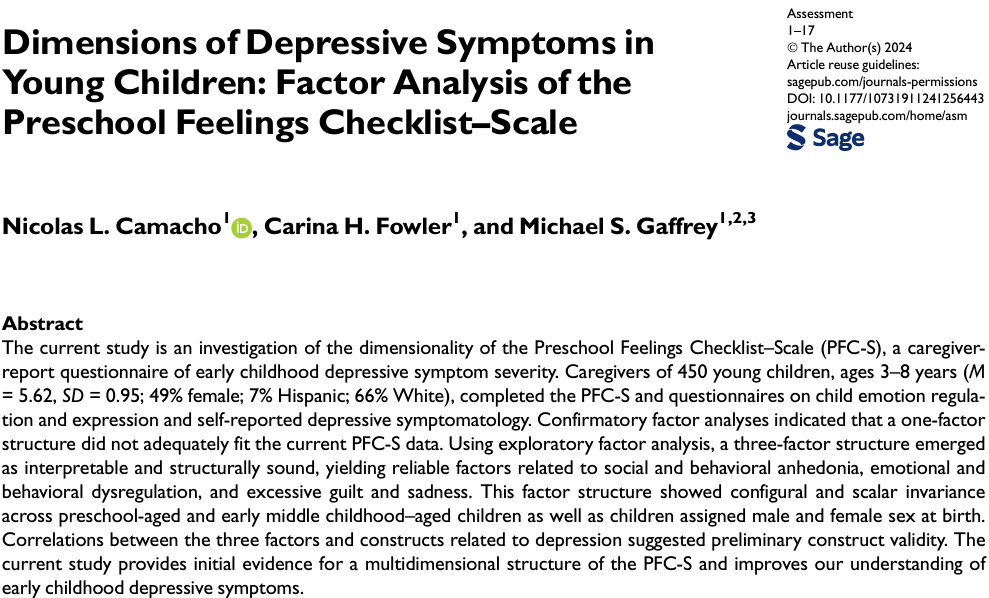
🌟NEW PAPER ALERT🌟
In my ✨1st first-author paper✨ published at Assessment, we explored the factor structure of a measure of depressive symptoms in young children, identifying age & sex invariant factors related to anhedonia, emotion & behavior dysregulation, and guilt-sadness
First PhD project is out now! We explored the pressure not to feel bad from romantic partners. Findings show people report (sometimes very minor) pressure about 50% of the time, linked to negative emotions, emo suppression and conflict.
Read more here:
https://t.co/4DP2UUlqYB
Our poster “Is Our Research Inclusive? Experiences in Psychological Research for Participants Identifying as Transgender and Gender Diverse” was accepted! Can’t wait to showcase the results of my dissertation!
🚨New lab paper!
Approaches to Modeling Interpersonal Complementarity in Intensive Longitudinal Data
led by (twitterless) Will Woods
It's for a special issue edited by @EmorieBeck and @mijkenijk on matching theory to models in psych
1/4
open link: https://t.co/iWrTLxh2KC
Emotion regulation is like other skills: it takes practice.
After 2 weeks of daily journaling to reframe unpleasant events, depression dropped, life satisfaction rose, and the benefits lasted at least a month.
The best way to improve at managing emotions is to do it more often.
Good news! Our work developing a transdiagnostic, empirical model of mental health problems after TBI has just been accepted in the Journal of Neurotrauma following peer review.
Link to accepted preprint after revisions: https://t.co/5wK0ZCJ2vd
More to come :)
New preprint🚨
We examined the links between parents’ mental health and youth’s functional emotion regulation networks and their longitudinal connection to youth psychopathology. https://t.co/KBhMrf3sNl
I don’t hear the loudest voices discussing problems in adolescents focusing on what I take to be the biggest shift: a change in kids having less externalizing problems (eg acting out, getting in trouble) and more internalizing problems (anxiety, low self-esteem, avoidance.)