Humanoids excel in free space but struggle with real-world contact. Meet SceneBot 🤖 the first unified RL framework for ALL free-space locomotion, terrain traversal and object interaction!
By conditioning on per-link contact labels, it masters complex, interaction-rich tasks like carrying a box upstairs. Code & data open-sourcing soon! 📦 🪜
Paper: https://t.co/aHLo5pPZQr
Website: https://t.co/SRUsbC6Y9b
With @JayHe748646@KehanWen170077@leggedrobotics , we push humanoid mobility to next frontier.
Achieved by a generalist contact planner + a generalist tracker + a generalized neural mapping, warmstarted from few human data.
Website: https://t.co/Y7cu3D4K4I
Promo Video 👇
How can we represent whole-body interaction for humanoid robots—compactly enough for low-frequency planning, yet richly enough to preserve high-frequency feedback control?
Introducing FIBER! 🤖
FIBER learns a unified latent interface between high-level planning and whole-body control, enabling a humanoid to acquire diverse interaction behaviors from heterogeneous experts through a pretrained, frozen Behavior Foundation Model (BFM).
With a single planner and BFM, we demonstrate heavy-door pushing, box carrying, object grasping, controllable navigation, and more!
🌍 Website & Live Demo: https://t.co/h14roShdvb
📄 Paper: https://t.co/QBjYNLCzEW
A thread on the ideas behind FIBER 🧵👇
We found a way to scale humanoid control that reduces GPU-hours by more than 1000×.
Across 129,514 motions, SuperMimic surpasses the state of the art (128 GPUs, 7 days) with 1 GPU in 3 hours.
Project: https://t.co/6gc9WKm9qY
Demo: https://t.co/OHRvx5ogQY
Your navigation model already found the goal. It just doesn't know when to stop.
Introducing StopWatch, a navigation agent that grounds the goal explicitly before every action. It sets a new state of the art on six object-goal navigation benchmarks.
Watch the flower vase episode below. Both agents reach the goal. StopWatch stops there. LightNav-0 turns away and keeps going.
Code, models and data are open source 👉 https://t.co/wgKRL7U8eF
Work done at Amazon FAR w/ @yunshengtian@QiuYuhengQiu@pabbeel@peterxichen@GuanyaShi@simonforrest
🧵 [1/n]
Wrist cameras give robots close-up views, but only where the hand happens to be.
What if the policy could decide where to look?
Introducing FoveaVLA: a VLA that replaces the wrist camera with learned foveation actions.
FoveaVLA predicts where it will need to look next, then crops that region from the full-resolution external image. The full view gives context; the foveal crop gives close-up detail.
With one external camera and no wrist camera, FoveaVLA reaches 70.8% success on 48 real-world trials, vs. 52.1% for π0.5 with a wrist camera.
• No additional demonstrations
• No camera calibration
• No wrist camera
Paper, code, and models are all open 🧵
What to remember in the past to act—spatial, temporal or motion details?
We often assume what’s useful, but that’s hard to know in advance.
Meet IMPRINT 🧠: retain rich memory first, then learn to use it for control. Compact latents keep inference fast as history grows. 🧵 1/10
Humanoid fighting looks easy. Humanoid catching is hard.
You have ~1 second to perceive, predict, and move your whole body to act.
Meet Reflex: our framework for catching human-thrown boxes on a @UnitreeRobotics G1 using onboard RGB-D.
Thread 👇
Perceptive Humanoid Parkour (PHP) is now OPEN-SOURCE! 🔥
Try training your own parkour robot! 🤖
🔗 Project: https://t.co/Jeb6bSmF6v
💻 Code: https://t.co/YWB2rdHYj4
🎮 Try it in your browser: https://t.co/QT7OAul37y
🤖 For parallel-jaw grippers, high-level plans can already be executed with mature primitives such as grasping. What about dexterous hands?
Introducing GOTT (General Object Trajectory Tracking): object trajectories to dexterous execution with a reusable cross-embodiment contact primitive.
The same primitive supports diverse real-world tasks including sweeping, pouring, whiteboard erasing, and hammering.
With one checkpoint, GOTT reaches 90-96% grasp-and-lift success across multiple objects on three real-world arm-hand platforms.
Check videos 👇
Practice makes perfect. A truly agentic robot shouldn’t just know what to do. It should also figure out how to get better.
What if a robot could watch a demonstration, figure out what it needs to practice, and learn how to get better through practice?
Introducing RPG: Guided Self-Improvement for Embodied Agents, a real-to-sim-to-real pipeline that turns real-world demonstrations into targeted practice.
RPG reconstructs practice tasks from demonstrations, uses demo videos to guide skill improvement, and continually updates a shared skill system from failures.
On real robots, RPG achieves 30/30 successes across 3 tasks. In simulation, it reaches 95.0% success across 22 manipulation tasks after 15 rounds of self-improvement.
Demo → Reconstruct → Guided Practice → Self-Improve → Go Real
Excited to introduce QF3: Fast Flow RL with Filtered Q-Gradients!
Train humanoids from scratch, fine-tune VLAs, even fine-tune image models... all with one simple off-policy update ✨
Can a humanoid learn robust whole-body loco-manipulation directly from a human? No robot, no teleop, no retargeting.
Meet Workhorse 🐴: our G1 topples and climbs a suitcase, catches a thrown box, and sorts boxes with hands and a kick. Fully autonomous.
More videos at https://t.co/HrxCv199F7
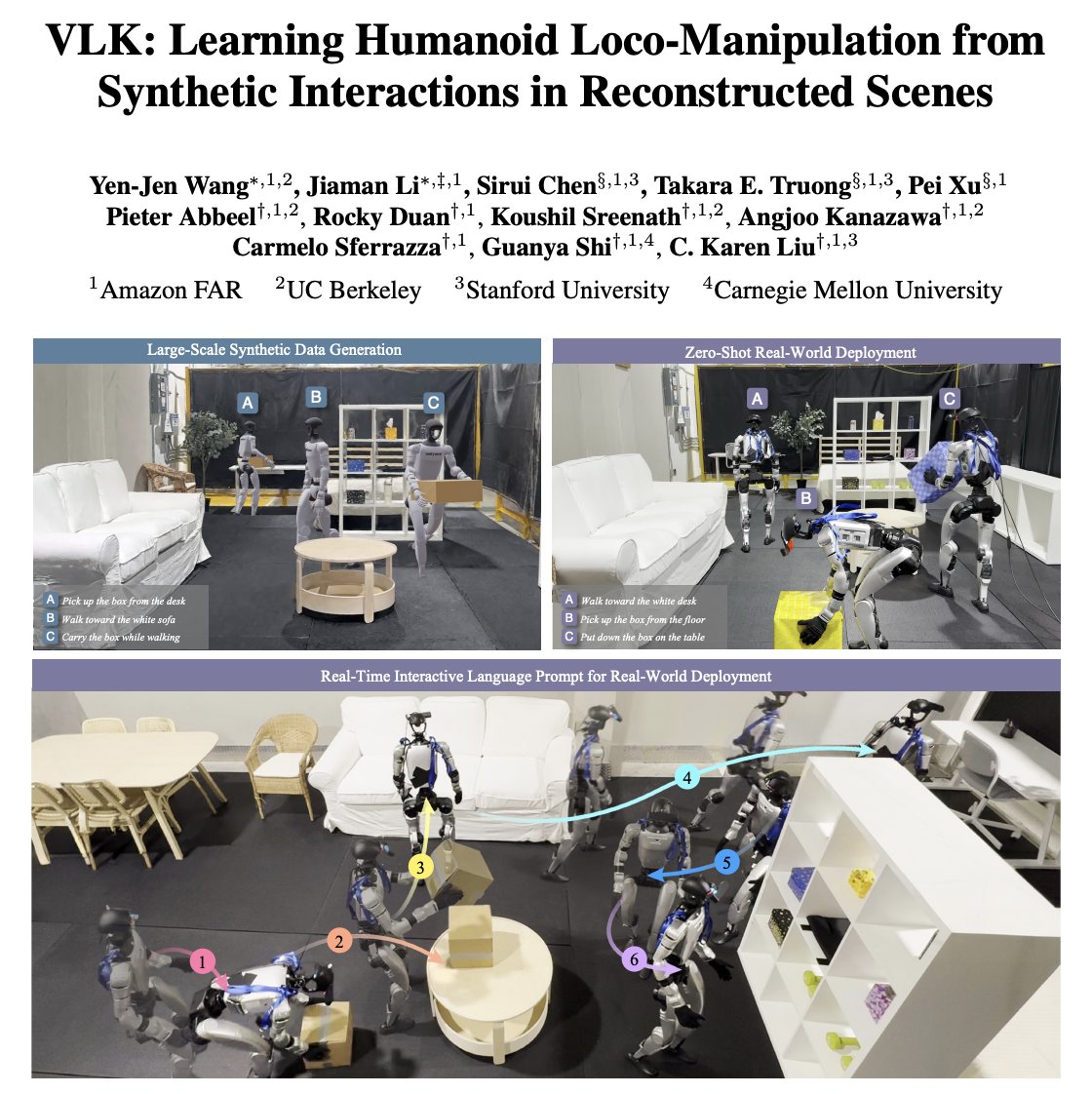
A real Unitree G1 navigated rooms and carried boxes on language commands. It never saw a single real-world demonstration.
The model that generated its navigation training data learned from G1 motions in BONES-SEED.
BONES data in Research #03
Researchers affiliated with Amazon FAR (@AmazonScience), @UCBerkeley, @Stanford and @CarnegieMellon developed VLK, accepted at CoRL 2026.
Instead of collecting expensive teleoperation data, they generated it: a navigation model trained on G1 motions from BONES-SEED synthesized new trajectories in reconstructed 3D scenes (the object-interaction model was trained on OMOMO sequences retargeted to G1). The team paired the generated movements with rendered camera views and language instructions to train the policy.
Then came the real robot: a Unitree G1 navigating to targets, picking up boxes and carrying them, without real-world fine-tuning
Congratulations to @wangyenjen, @jiaman01, @eric_srchen, @TakaraTruong, Pei Xu, @pabbeel, @rocky_duan, @KoushilSreenath, @akanazawa, @carlo_sferrazza, @GuanyaShi and C. Karen Liu!
Paper: https://t.co/T4KbqyhJwh
BONES Research Network gives researchers access to open human motion data:
https://t.co/g9eYsPDYON
#BonesResearchNetwork #BonesSeed #HumanoidRobotics #PhysicalAI
Teleoperation is usually used to control robots. We present DITTO-X, a framework that works both ways:
🖐️➡️🤖 In forward teleoperation, you can control diverse dexterous hands with force and haptic feedback.
🤖➡️🖐️ In reverse teleoperation, the robot moves your hand to match its own state while an autonomous policy runs, so you can intervene fluently whenever it goes wrong.
Why does this matter? Taking over a dexterous hand mid-task is hard. Any mismatch between your hand pose and the robot state can cause an unstable grasp and make the robot drop the object. With reverse teleoperation, every takeover starts from the robot's own state, and these smooth interventions become DAgger data that make our policy more robust each round.
Find more information at:
🌐 https://t.co/pUunM8u15L
📄 https://t.co/tVBEuJ8Z3I
co-led with @jbps_2001.
Humans generalize from rich interaction experience. We bring this to humanoid loco-manipulation through scalable real-to-sim-to-real.
Introducing PRISM, we expand 4 real videos into 256 counterfactual variants, recover robot-object trajectories, and train one policy that generalizes across diverse objects, scales, and spatial layouts.
CoRL’26 🚀 Website for details 👉 https://t.co/DUf2DIrvai
Work done at Amazon FAR w/ @zhenkirito123@pabbeel@rocky_duan@JitendraMalikCV@carlo_sferrazza@ckarenliu@GuanyaShi@akanazawa
Can a robot design a tool from scratch? Introducing HOT: Robot Tool Design from Scratch via Behavior-Aware Hierarchical Optimization.
Check out our project page for more details, videos, and code! 👇
https://t.co/1YLAThub0W
What can GPT-6 Astra do on a humanoid when the contact gets hard?
Give it the right interaction kernel.
Led by @yk20wang, our team presents KPI: A Promptable Kernel for Physical Interaction on Humanoids.
With our agentic system, Astra completes long-horizon, contact-rich tasks zero-shot—no task demos or task-specific training.
1/6
What can Astra do when given a humanoid embodiment?
We built HomeBody to find out. Controlled by GPT Astra, it carries out long-horizon tasks in a previously unseen kitchen—from tidying up across the room to retrieving remembered objects from ambiguous requests—without environment-specific training data or additional policy learning.
Here's how we did it 👀: https://t.co/FFGS2F7VtI
Incredibly excited to return to ETH Zurich as Assistant Professor of Robotics and Artificial Intelligence next summer. I'll be recruiting PhD students to build a new lab on general-purpose embodied intelligence for humanoid robots and dexterous manipulation. Details coming soon!
Introducing Real-Time EXPO-FT – Fast and Reliable RL for Real-Time VLA Policies!
Real-Time EXPO-FT unlocks π0.5 on challenging dynamic tasks, such as balancing a ball on a plate and striking a ball into the goal
(1/6)