In my last two posts, I emphasized the enormous gains in material wealth and life expectancy that humanity has experienced over the past couple of centuries.
But those improvements are nothing compared with the monumental gains in what I call moral autonomy and self-determination. Two centuries ago, in 1826, the vast majority of people were far less free and far less able to shape their own futures or their communities’ futures.
Let me start with labor. One striking feature of economic history is that, for most of the human past, much labor has not been free but coerced through violence, ranging from the worst forms of chattel slavery to serfdom, peonage, and feudal tenancy. In 1826, for example, around 30% of workers worldwide were subject to some form of violent coercion and to legal limits on the work they may do (this is different from, and more restrictive than, economic limits, such as being a landless laborer with little choice of employer). If you are born in 1826, you stand a strong chance of being born to an enslaved mother in the Americas or to a serf in Russia. Today, the ILO computes that fewer than 1% of workers are coerced in this way.
Let me continue with gender. If you are a woman in 1826, your freedom to choose a husband, an education, an occupation, how many children to have, and to own property is severely limited nearly everywhere. If you are an enslaved or coerced woman, you face a very high chance of sexual assault during your lifetime. Free women suffer these attacks too, with next to no recourse.
Let me move to religion and ideology. If you belong to the “wrong” religion, denomination, or ideology, or if you simply love someone you “should not love,” you risk severe punishment. Even in the U.S., Massachusetts still has an established church and will keep it until 1833 (the First Amendment applied only to the federal government until Everson v. Board of Education, 330 U.S. 1 (1947)). In the U.K., we are three years away from the Roman Catholic Relief Act of 1829 and forty-five years away from the abolition of religious tests at Oxford and Cambridge.
In education and culture, 88% of people are illiterate, and fewer than 2% hold the equivalent of a high school degree. For most, the great works of art and literature play no part in daily life, beyond perhaps a religious image or text seen in the local temple.
Finally, almost nobody outside a small elite participates in political life. In 1826, only the U.S. can be called a democracy, and that stretches the word. With very few exceptions, only white adult men can vote, and even among them, several states, such as Virginia, restrict the franchise to about 50% of white adult males. Some Swiss cantons (but not all!) do better, and Norway, then in union with Sweden, has a relatively broad franchise for men. The United Kingdom (before the 1832 reform), France, and the Netherlands have very restricted franchises. And that is pretty much it. Nothing resembling democracy or the rule of law exists in all of Asia and Africa, most of the Americas, and the rest of Europe. In nearly all the world, you could be arrested at the whim of your ruler, and there was little you could do about it.
I do not want to paint too rosy a picture of 2026. Workers are still coerced. Gender inequalities remain large. In many parts of the world, you still cannot think what you want to think or choose your own romantic life. Democracy has badly backslid over the last two decades. And I am increasingly forced to remind people that due process is the twin sister of liberty.
But if I ask you, behind a veil of ignorance, whether you want to live in 1826 or 2026 (that is, you do not know whether you will be born a king or an enslaved woman, only that the probabilities match the proportions in the global population), you would be crazy to pick 1826. Your life will be short. You will probably be very poor. You will be illiterate, told what to do for a living, who to pray to, and whom to marry, and no one will give a penny for your input into the running of your community. And, you can be arrested at will.
And this absence of moral autonomy and self-determination is worth ten, one hundred, or even one thousand times more than all the extra income that modern economic growth has given you.
My post on life spans:
https://t.co/YyUEQyI7QV
My post on prosperity:
https://t.co/fMk9kLWOqi
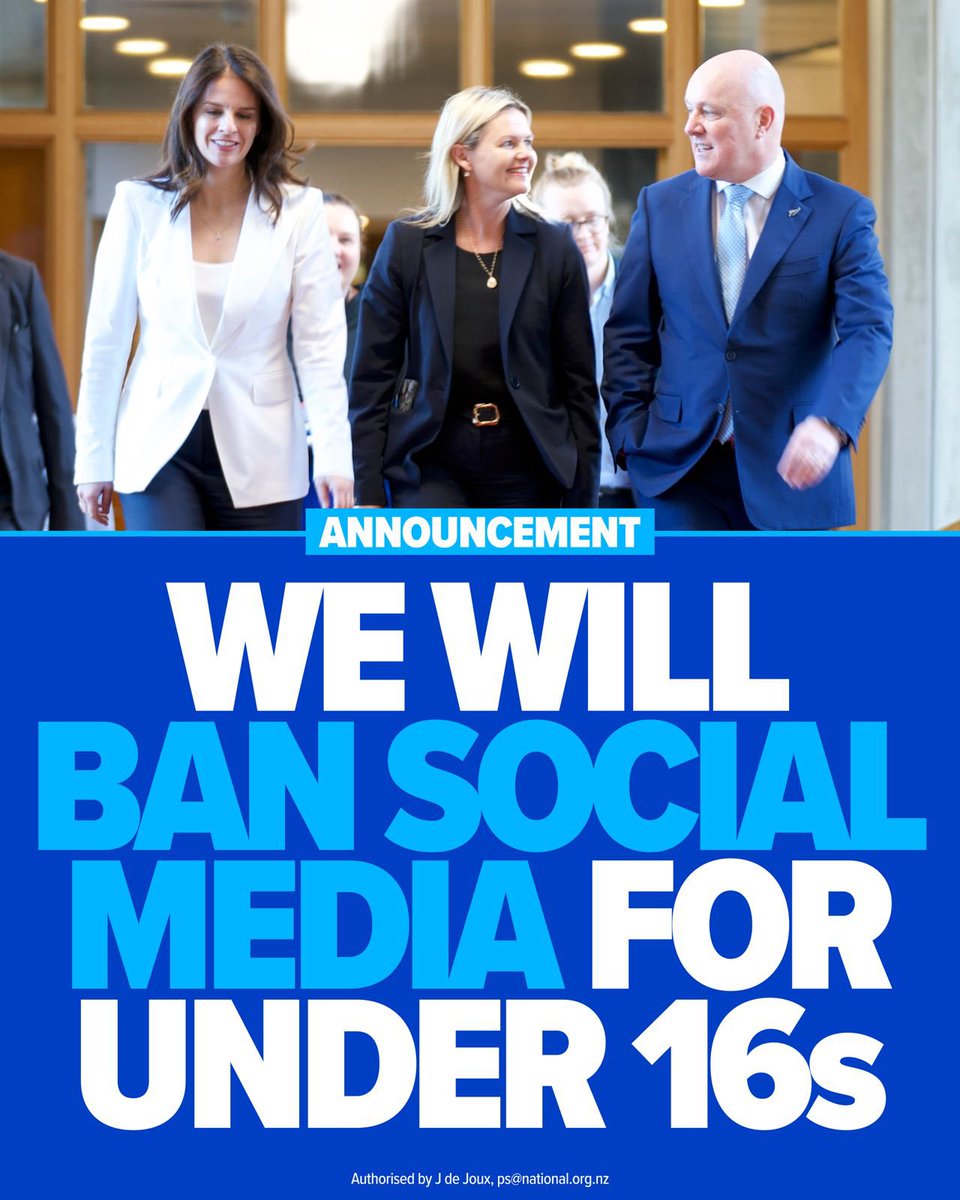
The social media ban is stupid, unworkable policy and I sincerely hope the Labour Party doesn't succumb to its worst impulses and support it.
https://t.co/utyYRIMAB8
I want to flesh out the basis for my argument that we shouldn't retaliate against US tariffs.
Start by thinking of it as a cost-benefit analysis. The cost - higher prices for Canadian consumers and a weaker Canadian economy as a result - is pretty clear, and I don't think anyone is arguing that cost doesn't exist. We can spread it around through redistribution, but someone in this country has to bear the cost.
So the question is: what exactly is the benefit, and why is it larger than the cost? The benefit must be that retaliating will change US behavior in some way that we like: repealing Section 338 tariffs, lowering Section 232 tariffs, agreeing to stop the 51st state nonsense, etc. I have not seen anyone actually make the theory of the case for how this is going to work. Just saying "game theory" doesn't cut it. (And the idea that Trump is a rational actor to whom you can apply game theory at all is ludicrous).
Yes, I know the midterms are coming up. So what? Even if the Democrats take both houses of Congress, and even if they pass legislation to repeal Trump's tariff authorities, he can always veto that legislation. The probability that the Democrats will have a veto-proof majority is zero.
Concretely, if you support retaliation, you need to make explicit and justify your assumptions about the probability that retaliating will affect some margin we care about. For example, why is the probability that Trump will reverse S338 increasing in the intensity of our retaliation?
You also need to account for the fact that, instead of convincing Trump to do what we want, retaliating may instead cause him to escalate, which would cause more damage to our economy. (He announced that he's going to do exactly that in January.) That possibility has to be factored into the cost as well. And again, make your assumptions explicit: Why is the probability that retaliating will cause Trump to treat us better greater than the probability that it will make him treat us worse?
The bottom line is that I have yet to see anyone make a convincing argument that the expected benefit from retaliating exceeds the expected cost. And I think Mark Carney should have to make that argument if he's going to retaliate. What are the expected goals of the retaliation package? On what timeline should progress toward these goals be measured? If no progress materializes after X number of years, how do we proceed? Do we just keep retaliating forever, even if the US keeps its current course? Surely there is no rational basis for doing that.
Many people point out that Canadians strongly support retaliation, and that we have the stomach to tolerate any economic pain retaliation might cause. I agree that's true. But that pain is still for naught if it doesn't accomplish anything. Resolve alone doesn't yield outcomes. I agree that Canadians can tolerate a protracted trade war. That's not what matters. What matters is the likelihood that such a situation going to end with outcomes we want to achieve. Again, lay out the theory of the case.
@stephenfgordon makes an interesting and compelling argument, namely that by the revealed preference theorem, strong support for retaliation implies that the value people assign to sticking it to Trump is greater than the cost, even if that value is purely subjective. That is far and away the best pro-retaliation argument I've seen so far.
However, I don't think the job of a policymaker is to simply enact the policies that his or her constituents claim to prefer. Surveys show that strong majorities are in favor of economically stupid ideas like price controls, internally inconsistent fiscal policies (e.g. cutting taxes while increasing spending), and so on.
Doing things just because people support them is folly. Policymakers should care only about the outcomes their policies lead to - and how people eventually judge those outcomes - not the content of those policies per se. And, on balance, my assessment is that retaliating is not likely to lead to better outcomes.
This option doesn't break the internet.
But it also means a lot of families would lose choices that they value dearly.
My kids had the run of the city on the bus network, from a young age, because they had a supercomputer with a map in their pocket.
@GORMTHEOLD25 Im sorry but Trump would 100% be for the Stormcloaks as they want their land and values to be what they have always been before Imperialism. Correct me if im wrong but im pretty sure he would be Ulfric
@neekosette@RenamedPM@caffeineworship Being a politician and winning votes requires sincerely believing that they are going for growth, that the social media bill is good, and that there is no connection/contradiction across those two.
Stanford's bill will, in the limit, require ISPs to block all NZ access to international platforms that do not wish to comply with the new regulatory regime.
You may wish to get a multi-year subscription to a good VPN early.
@RenamedPM@neekosette@caffeineworship Going for Growth by sending out a giant decel vibe saying that National will lean into and ride populist anti-tech stuff.
@RenamedPM@neekosette@caffeineworship It achieves its goal of signaling solidarity with panicked parents over Evil Big Tech.
Of course, tech can take the 'NZ is committed to asinine decel policies' signal and act on it too, in less obvious ways when deciding which countries warrant investment.
Fun fact: Meta’s massive data center in Los Lunas uses 215 acre feet of water per year. About enough for 800 homes. Sounds crazy right?
For alfalfa alone (there are other much more profitable crops not included), in the middle and lower Rio Grande Valley, the estimated use per year is 85,000-125,000 acre feet.
Data centers aren’t the problem
Talk about an academic finding that replicates that our K through PhD system has encouraged people to actively ignore. We are replicating mistake after mistake that were conclusively shown by the close of the 20th century, precisely because of massive educational failure. And, of course, the people who advocate for policies that inevitably raise costs don't know they don't know that it's a harder problem to solve than it should be.
@MHMSutherland After several playthroughs, reasonably sure that Ulfric is a Thalmor asset aimed at both weakening the Empire and providing pretext for invasion. Like say 70% sure.
And 15% chance that that's just what they want us to think.
Remaining odds on something else entirely.
National has released a paper signalling its intentions for National Direction to come under the new planning framework.
The section on competitive urban land markets is very good.
https://t.co/VPdRdNH3sG
Canadian journalists should talk to @IlyaSomin rather than talk to premier Ford. The reason is that Ilya is actually useful. He is the attorney who helped bring forth the case at the Supreme Court that struck down the previous round of tariffs. And, again, he points out that the 338 tariffs are illegal and will likely be struck down again.
@frost_seo I doubt it would be Meta that would not be in compliance. But restrictions against being the local ad buyer for a non-compliant platform is the natural reading of that section of the legislation's explanatory notes, yes.
My simple explanation: Jonathan Haidt convinced the anglosphere that a minor but real problem is an enormous problem. Because the problem triggers 'protect the children' responses to what are perceived as new threats, rational thinking gets turned off in favour of policies that 'send a message' about solidarity with kids over 'Big Company'.
There may well also be ancillary lobbying from those that might provide tech measures addressing the problem.
And there are definitely large and very high-stakes fights between platforms and operating systems about who should be liable for any of it.
But it's mostly just a moral panic.
This does not back parents who prefer to use the readily available tools to manage their children's social media use.
And imposes substantial risks to freedom of speech by making it much harder to set a reliably anonymous social media account.