Job openings surged for pro/business services. Hard to say immediately if its AI-driven, that will require more time. Also unsurprising that actual hires weren't up - it takes time to fill those specialized roles. overall, positive news.
56% of planned U.S. data centers are in states highly exposed to natural disasters.
@raylehmann and @kristianstout wrote in the @TB_Times about why Florida's AI infrastructure bet depends as much on flood pumps and substations as on servers. 🔗 ⬇️
When users choose Google even where rivals are equally accessible, what does that reveal about foreclosure?
ICLE, among other Law & Econ scholars, filed an amicus brief urging the D.C. Circuit to ground its Section 2 analysis in counterfactual effects, not query coverage. 🔗 ⬇️
Primarily, the $60,000 report suggests Oregon tax policy and constitutional limits create significant legal hurdles for the proposed charge on empty storefronts. https://t.co/PvozircsDl
Don't be fooled by the headlines from Oregon’s latest revenue forecast.
Oregon's May revenue forecast is up.
But, revenues are up only because of tax increases and budget gimmicks. Strip these out and the underlying fiscal picture is actually $23 million worse than projected in the previous forecast.
The core issue? A war in the Middle East has spiked oil prices, sending Portland gas to $5.40/gallon. This external shock has flipped the sign on the state’s job growth forecast from plus to minus.
In just three months, the 2026 employment forecast dramatically flipped from a 0.6% gain to a 0.6% decline—a staggering swing of 30,000 fewer jobs.
Compounding the instability, Oregon's revenue increasingly relies on volatile capital gains over more stable wage income, setting the state up for a severe financial swing when markets inevitably correct.
The Portland area is bearing the brunt: Washington County's vital semiconductor sector is facing a brutal 12-13% job collapse, primarily due to "significant layoffs" at Intel. Additionally, Multnomah County continues its population exodus, having lost over 21,000 residents since 2020, exacerbating the dreaded "urban doom loop."
If oil prices stay high, Oregon could be among the first states hit by a recession. And forget housing relief—the Fed is holding rate cuts until at least mid-2027. Time to build that rainy day fund, Oregon, because the clouds are not going away soon.
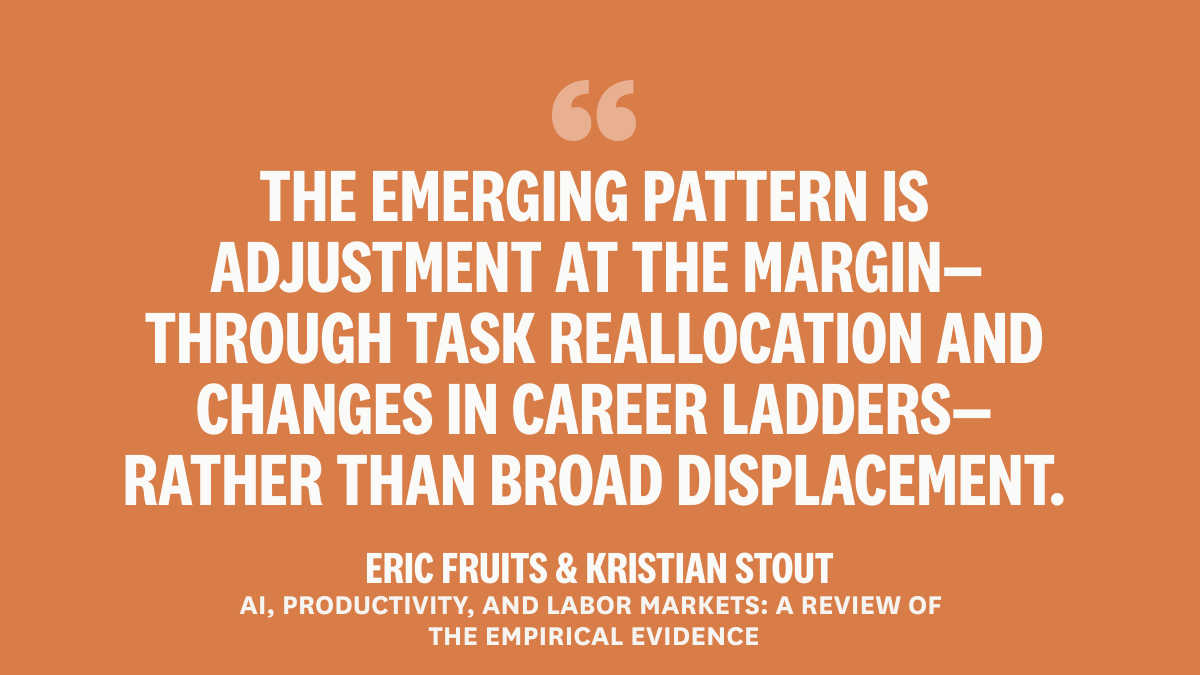
Gov. Newsom introduced an EO on AI-driven job displacement this week. ICYMI: an empirical review by @ericfruits and @kristianstout found that regulatory approaches premised on widespread displacement find little support in the data.
Full analysis below ⬇️
“Yes” is a formal affirmative.
Then things get weird.
“Yep/yup” is either informal affirmative or informal ambivalent.
- “Mountain Dew is a delicious beverage” - “Yup” - informal affirmative.
- “Boss needs you to wipe down the employee toilet.” - “Yup” - informal ambivalent.
Then there’s “Hell yeah” - “Let’s drink some 40s and do donuts in the snow covered parking lot” - “Hell yeah”
As eric notes - the actual evidence adduced to date shows at worst a mixed result, but really its more of a reshuffling with a positive aid for low skill workers. Long term, it looks like it will follow other economic disruptions and produce far more labor gains that losses.