Can AI ace law exams?
Last year, OpenAI announced GPT-4 got 90th percentile on the bar.
Here we (a) refute 90th percentile claim; (b) replicate/extend recent work on GPT capabilities; (c) discuss implications for law profession.
Now open, AI&Law: https://t.co/fX4cwr15gn
1/
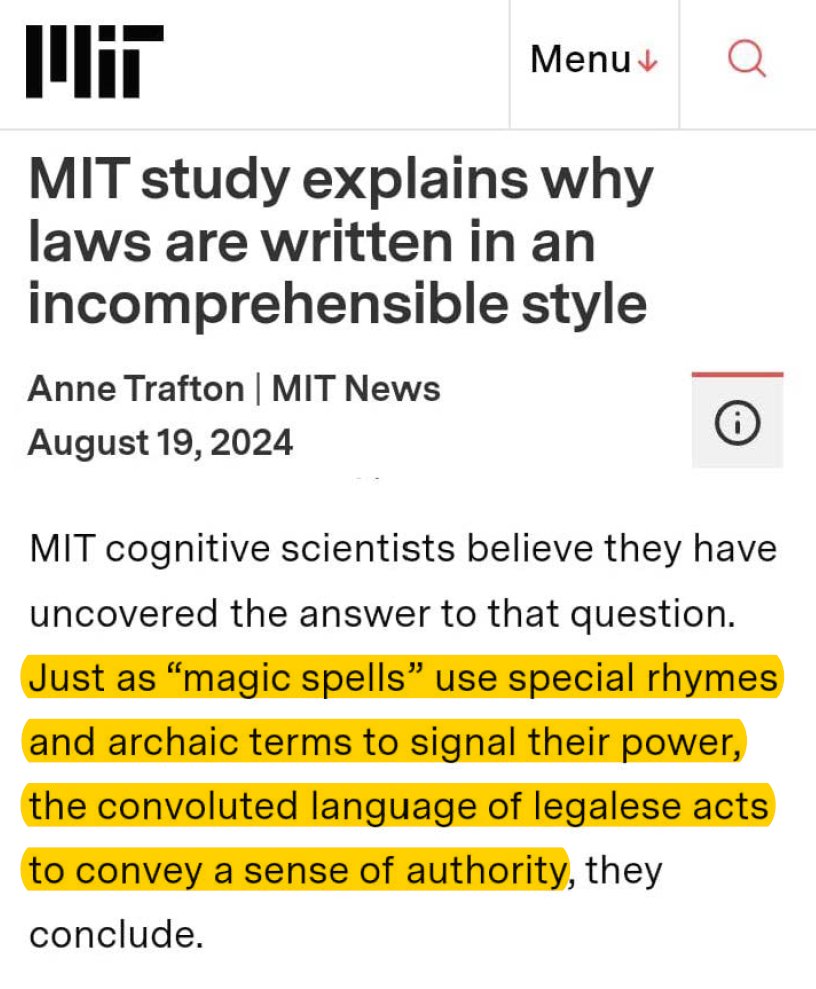
MIT researchers found that legal language is intentionally complex, not for clarity, but to create a false sense of authority. Even lawyers prefer plain English. https://t.co/r7fxU6PTab
David did a “scientist interview” with me his freshman year, and I immediately recruited him to help with our law in the brain project. So happy to see him advancing in his academic career! ✨
Congrats to the 4 MIT students who have been named 2025 Rhodes Scholars - esp David Oluigbo in @ev_fedorenko lab, who plans to apply AI to complex medical problems and systemic healthcare challenges. 🙌 https://t.co/SUX4jMrjVC
Out now in Cognitive Science: We investigate how people think judges should handle immoral laws. Should judges follow the law no matter what, or can exceptions be made for (grossly) immoral laws? We surveyed 167 laypeople and 141 participants with legal training to find out.
[Please retweet!] My paper, 'Cognitive Representations of Social Relationships and their Developmental Origins" has been accepted at Behavioral and Brain Sciences! I'm thrilled to be able to engage with people's commentary! Please consider writing one! https://t.co/Hk3p5FPPdq
Many AI governance stakeholders agree that certain laws or regulations should apply only to “frontier models.” But what is a “frontier model”? LawAI’s latest working paper discusses some of the most important legal considerations for efforts to define that term: https://t.co/JI2WUYYJ7J
Our philosophy-informed LLM papers now out in TACL! See the improved paper or thread linked below for more on “bibliotechnism”, the referential ability of ngram models, what it means to say LLMs (or humans) have beliefs, beachgoing bardolaters, and more.
https://t.co/nrtn29379W
Very humbled to be in such amazing company on this list... Congrats to everyone recognized!
So, so grateful for the support from my mentors and collaborators.
Excited to have been named one of @techreview's 35 under 35!
I am happy that, these days, language & human cognition are topics that the world cares deeply about (thanks to recent developments in AI). Not only are these topics impactful, they are also fun to study!
🚨New preprint!🚨 My first first-author project with @RouseTurner@natvelali@cocosci_lab
How do people evaluate idle collaborators who don’t help out during group tasks?
TL;DR: Sometimes it’s okay not to help with the dishes 🧵👇
Link: https://t.co/9igIEOfHo8
Now out in Cognition!
➰"Ambivalence by Design: A Computational Account of Loopholes"➰
by Qian, Bridgers, Parece, @MayaTaliaferro, and me
https://t.co/MQdbvFUDje
MIT study explains why laws are written in an incomprehensible style. The convoluted “legalese” used in legal documents conveys a special sense of authority, and even non-lawyers have learned to wield it. https://t.co/0iC03nYR0A
Why are legal documents so impenetrable? Just as “magic spells” use special rhymes and archaic terms to signal their power, the convoluted language of legalese conveys a sense of authority, cognitive scientists have found. https://t.co/HFAk9RTRba
New study: nonlawyer lawmakers "wrote in a more convoluted manner" perhaps to sound more "authoritative". So we maybe we can simplify laws without sacrificing content.
@PNASNews article by @UChicagoLaw's @ericgrimani, and profs at @UniMelb & @MIT
https://t.co/0BvnZQd03c