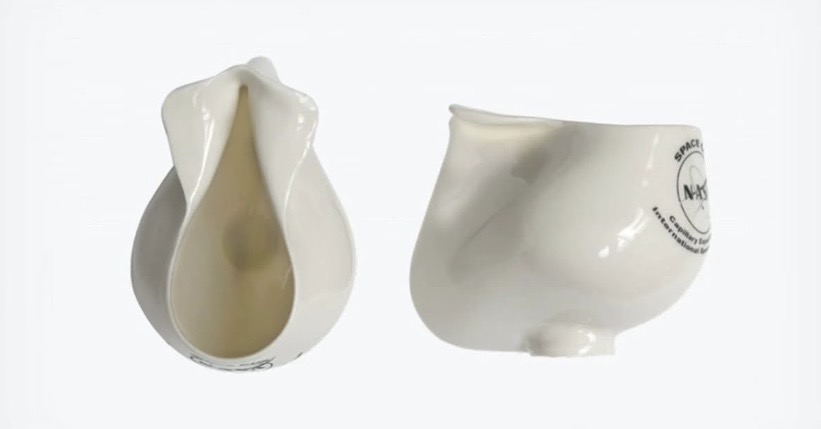
NASA created a coffee cup engineered to prevent spills in the weightless environment of space.
NASA developed the Capillary Beverage Cup to solve a challenge unique to spaceflight. In microgravity, liquids do not settle at the bottom of a cup because gravity is largely absent. Instead, they cling to surfaces and gather into floating droplets, making a traditional mug impractical.
For decades, astronauts drank coffee and other beverages from sealed plastic pouches fitted with straws. Although effective, those containers prevented researchers from observing how liquids naturally behave in weightlessness.
In the early 2000s, a NASA team led by Mark Weislogel began designing an open cup that used surface tension and capillary action instead of gravity to move liquid. The finished Capillary Beverage Cup was successfully tested aboard the International Space Station in 2015.
Its distinctive teardrop-shaped design and narrow channel naturally direct liquid toward the rim, allowing astronauts to drink from an open cup without pumps or straws. Beyond making a cup of coffee feel more familiar, the technology has important engineering applications. Research into capillary flow is helping improve fuel storage systems, water recycling technology, and life-support equipment for future missions to the Moon and Mars, where controlling liquids in low-gravity environments remains a major challenge.
@Mrsenhorbob@edu_costa_mg@oengenheiroleo tá dizendo que assumiu que eu sou gado petista simplesmente porque eu constatei que o PM é um jegue? tá agindo exatamente como os caras que tu critica então. burro e maniqueísta.
@Pirat_Nation Steam Deck has been out for almost half a decade, was the uncontested best portable PC for most of this time despite the existence of more powerful options and the "bigger number better" people still didn't learn that whining about numbers is pointless.