@nateparrott able to let 20 yr domain knowledge CEO iterate on UI graphics for soccer field by sharing a HTML from our repo.
need the handoff of chat context from his Claude Design chat back into repo / Claude Code to be smoother
Difficult to overstate the shortcomings of even "modern" sports analytics relative to current AI/ML, pure math, stats, and computing capabilities.
Spatiotemporal tracking data that conceptualizes the field/pitch/court/rink as a 3-D coordinate plane and conceptualizes the players+ball as a network/graph are under a decade away from proving that many human-observed "principles" of how you're supposed to play soccer, basketball, hockey, etc. are simply laughably wrong.
@lennysan@jennywen@AnthropicAI@figma@Dropbox@Square@Shopify I believe “systems designers who ship” will lead this transition rather than continuing to service engineers.
Claude Code is the executer now. folks who solve problems systemically and visually will lead regardless of the role label
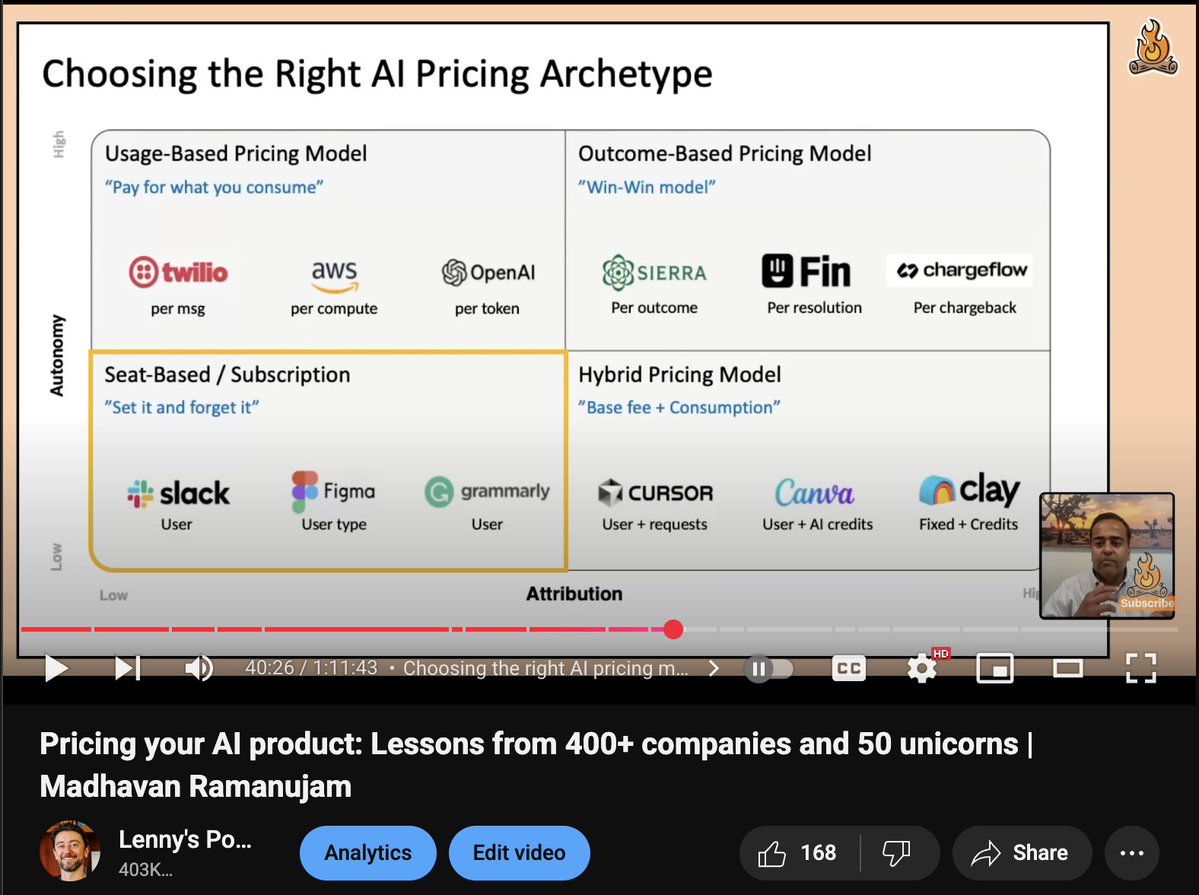
Maybe the most important slide from my chat @MadhavanSF
A 2x2 for determining your ideal pricing model:
"There's attribution and autonomy.
The bottom left, that is the quadrant where your attribution is low, and your autonomy is low. In that situation, the best pricing archetype is seat-based or a subscription model, because you're not able to attribute a lot of value to what you bring.
The bottom right quadrant, those are companies that can prove more attribution, and show what they actually bring to the table. But they're still not in a fully autonomous mode, there are still humans in the loop. A hybrid pricing model is the best option for them.
If you look at the top left quadrant, those are products that are very autonomous, but are not strong on attribution. These tend to be mostly backend or infrastructure kind of products. In that situation, you need to be on a pay-for-what-you-consume model.
The quadrant that you really want to be in is the top right one. That's the outcome-based pricing model. This is where you have great autonomy and great attribution. You are not only charging for work delivered, but you're charging for work delivered that was delivered by AI with no humans in the loop.
If you want to win in AI, figure out a way to get to that quadrant because that's a magic quadrant.
🚀Run interactive evals in the LangSmith Playground📊
You can now create datasets inline and add examples to existing datasets without leaving the Playground. This update makes building a dataset to evaluate LLM calls much easier, especially for non-developers.
Try it out in LangSmith today 👉https://t.co/Al4CQjEikC
If you're building AI agents, come to Langchain's Interrupt conference May 13-14 in SF! You'll learn best practices from AI experts at Langchain and @AndrewYNg , @adamdangelo, @amasad
Tickets just dropped for Interrupt: The AI Agent Conference by LangChain 🚀 🌒
Join us this May 13-14 in San Francisco for Interrupt, LangChain’s first-ever conference — a space for anyone building or shaping the future of AI agents.
Learn more: https://t.co/vl9uNssvlK
5/ The full color of the picture is revealed when we bring disparate data together at the same space-time position through LWMs in order to understand, reason, and act in 3D / 4D.
You know about LLMs, but Large World Models (LWMs) & spatial intelligence will be key to solving BIG challenges in climate change and human health. Here’s why 🧵👇
9/ LWMs and spatial intelligence can provide clarity, helping us with informed decisions & actions across physical systems such as humans, the planet, animals, and the built environment.
This clarity will unlock solutions to some of the world’s most complex challenges. 🧑🏿🤝🧑🏻🌎