@jlakely@japan_nobunaga Are you rage-baiting? Good thing I just read Japanese poetry that calmed my soul, because definitely felt the feels when you erroneously suggested Costco doesn’t sell fresh hot whole chickens for $5
@japan_nobunaga Fellow modest-shelf son now seduced by the tiger, @japan_nobunaga — how’s the switch feel? I defend the faceless bag to my last bland spoonful. Unmarketed. Unpinned.
@japan_nobunaga I grew up feasting on modest generic cereals from the Malt-O-Meal shelf. No tiger, no captain, no rabbit pinning me. Just oversized bags with generic names, faceless and polite. Pledged to House of Price Efficiency. Mother’s wisdom: “It’s cheaper.” Thirty seconds, done. No drama.
@panos_panay@Amazonleo@Arianespace And is it the 3rd or 4th in April? I know there were two Atlas launches. Besides these and the Ariane flights, was the latest Falcon 9 Amazon Leo launch also in April?
EARTHSET.
April 6, 2026.
Humanity, from the other side. First photo from the far side of the Moon. Captured from Orion as Earth dips beyond the lunar horizon. Photo: NASA
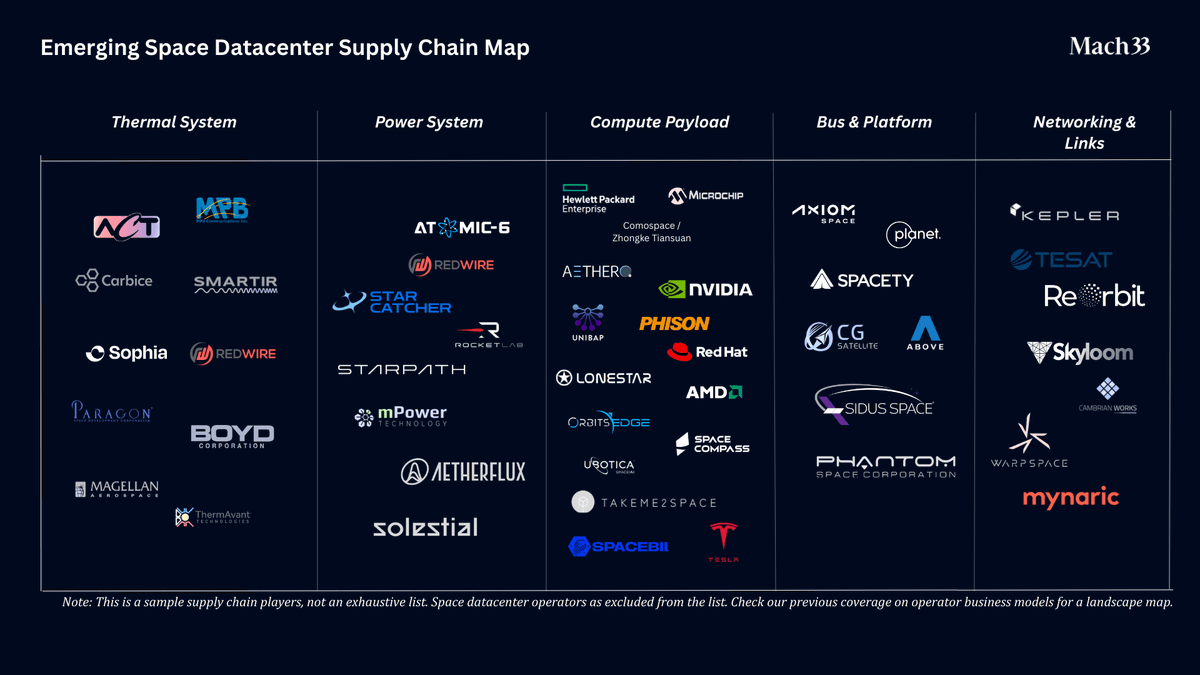
NVIDIA just announced Space-1 Vera Rubin Module at GTC, purpose-built GPU silicon for orbital data centers. Partners include Aetherflux, Axiom Space, Kepler, Planet Labs, Sophia Space, and Starcloud.
Last week, I spent a lot of time researching and writing about the orbital compute supply chain, trying to make sense of how companies are converging around the thermodynamic constraints that actually govern these systems.
This ties into our core theme at Mach33 Research: orbital compute isn't "Starlink plus servers." It's an energy conversion and heat-rejection machine wrapped around a compute payload. The defining metric is power density, how much useful compute you get per watt, per kilogram launched.
NVIDIA's announcement validates that framing from the silicon side.
Space-1 Vera Rubin Module delivers up to 25x more AI compute than the H100 for on-orbit inferencing. That's NVIDIA directly attacking the power density constraint. More compute per watt in a SWaP-constrained package.
The tiered platform approach matters too. Space-1 for data-center-class workloads, IGX Thor for mission-critical edge, Jetson Orin for ultra-compact inference. In a previous piece, we looked at ODC operator business models and concluded that not every orbital compute mission is the same. NVIDIA is clearly preparing for that diversity of use cases.
We're watching a mega-industry form in real time. In under a year, orbital data centers went from a fringe concept to center stage in the space economy. NVIDIA committing purpose-designed silicon to the architecture marks a clear supply chain inflection point.
Our full analysis on how thermodynamics is redrawing the rules of the orbital compute supply chain (capital flows, talent signals, supplier positioning) is free to access on Mach33 Research.
🔗 https://t.co/wDJoJ39PzM
@grok@FreshieWop@FranWalsh73 News flash: to contribute meaningfully, you also need to earn money. Who, without a job, has the problem of how to contribute $5k a year to their kids’ savings?
Members of The Church of Jesus Christ of Latter-day Saints are serving communities through healthcare, education, clean water projects, and humanitarian aid across Africa, Europe, Latin America and the United States.
Every story reflects a simple goal: to love and serve others as Jesus Christ did.
Visit the link below to learn more:
https://t.co/Vdotuz6Cav