Andrew Yang support breakdown by race from the Emerson National Poll:
20.6% Latino
26.4% White
28.0% Black
21.0% Asian
3.9% Mixed
https://t.co/ZdObEls1M7 https://t.co/ZdObEls1M7
A British biologist looked at 200,000 years of human history and found that the entire reason humans broke out of poverty was not intelligence, not language, not even agriculture, but one mechanism so simple a 6-year-old could explain it.
His name is Matt Ridley.
He is a zoologist by training, an evolutionary biologist by career, and in 2010 he wrote a book called The Rational Optimist that quietly argued the most important fact about human progress had been hiding in plain sight for the entire history of economics.
Naval Ravikant has been telling people to read everything Ridley has ever written for the last 15 years. The reason is the argument inside this one book.
For 200,000 years, anatomically modern humans walked around with the same brain you have right now. Same skull size. Same neural architecture. Same raw capacity for language, planning, and abstract thought.
For roughly 190,000 of those years, almost nothing happened. Generation after generation lived and died inside the same Stone Age toolkit their great-great-grandparents had used. Then somewhere around 50,000 years ago, the line on the chart of human progress started to tick upward. Then it bent. Then it exploded.
The question Ridley spent years on was the only question that mattered. What changed.
It was not the brain. The brain had been the same for 190,000 years. It was not language, which had existed long before the takeoff. It was not even agriculture, which arrived only 10,000 years ago and was actually preceded by the upward bend, not the cause of it.
What changed was that humans started trading with strangers.
This sounds too small to be the answer. Ridley argues that it is the answer to almost everything. The moment one human exchanged a useful object with another human from a different group, something happened that no other species on earth had ever done.
Two ideas that had developed in isolation came into contact. The flint knapper learned what the spear maker had figured out. The fisherman from the coast learned what the hunter from the forest had figured out. The two pieces of knowledge fused into something neither side could have produced alone.
Ridley calls this ideas having sex. The phrase sounds frivolous and it is meant to. The point is that ideas, like genes, get better when they combine with other ideas from different lineages.
An idea sitting inside one head, no matter how brilliant the head, eventually hits a ceiling. The same idea exposed to ten thousand other ideas does something genes do under sexual reproduction. It mixes. It recombines. It produces offspring nobody planned.
The cleanest proof of this argument is the most uncomfortable case study in the book. Tasmania.
Around 10,000 years ago, rising sea levels cut Tasmania off from mainland Australia. A population of roughly 4,000 humans was now isolated on an island, with no possibility of contact with the rest of humanity. They had the same brains. The same language. The same starting toolkit as their cousins 150 kilometers north. The natural experiment was now running.
What happened next is something no economist or geneticist had ever predicted.
The mainland Australians kept inventing. Boomerangs. Spear-throwers. Fishing nets. Bone needles for sewing fitted clothes. Watercraft with paddles. Their technology compounded slowly across the centuries.
The Tasmanians went the other way. They did not just fail to invent the new tools their cousins were developing. They started losing the tools they already had. Fishing was abandoned within a few thousand years. Bone tools disappeared. Fitted clothing disappeared. They forgot how to make fire from scratch and started carrying lit firebrands from camp to camp instead, relighting their fires from a neighbor's whenever their own went out.
By the time European explorers arrived in the 17th century, the Tasmanians had the simplest toolkit of any human society ever recorded. Their material culture had gone backward for 8,000 years.
The archaeologist Rhys Jones called it a slow strangulation of the mind.
Joseph Henrich at Harvard later proved with formal mathematical models that there was nothing wrong with Tasmanian brains. There was something wrong with their network. A toolkit requires a critical mass of people exchanging skills to maintain itself.
The act of teaching a skill is imperfect. Every generation loses a small percentage of what the last generation knew. If your population is large enough and trading widely enough, those losses get caught and corrected by someone else who still remembers.
If your population shrinks below a certain threshold and stops mixing with outsiders, the small losses compound until entire technologies disappear.
This is the part that should haunt anyone reading this in 2026.
Intelligence is not a property of the individual brain. Intelligence is a property of the network the brain is connected to. A genius in isolation will produce less than a mediocre thinker inside a dense exchange of other mediocre thinkers.
The thing your ancestors needed in order to break out of 190,000 years of stagnation was not better brains. It was better connections between brains they already had.
The implication for any individual is direct and uncomfortable. If you are smart and isolated, you will be outproduced by people half as smart who are connected.
The most successful people in any field are almost never the smartest people in it. They are the ones positioned at the intersection of the most idea flows. They are reading more authors than their competitors. They are talking to more people from more disciplines. They are in the rooms where ideas from different lineages bump into each other.
Ridley ends the book on the line that sounds optimistic but is actually a warning its this "The future will be invented by people who connect ideas, not by people who guard them."
I just finished teaching the first lecture of the course “Geoeconomics Uncovered: Theory Meets Evidence” at Oxford, so I decided to post the slide deck:
https://t.co/8lcVCInfi4
This was a 90-minute, big-picture lecture: what is geoeconomics, why does it matter, and what can economists do in this field?
It draws on several plenary talks I have given over the past year, so you may have seen some of these slides before. But I have many new followers, and some are clearer than before.
During the rest of the week, I will post more of these slide decks. The next one will be on the history of the field.
PS: Oxford is such a lovely place. Unfortunately, a country that gave us Newton, Darwin, and Turing cannot keep escalators running at Heathrow.
I follow with concern the war in #Ukraine, which is experiencing a sharp intensification in these days. I wish to express my closeness to all those suffering due to recent attacks carried out even against civilians. War does not solve problems but worsens them. It does not create security but multiplies suffering and hatred. Where missiles and drones fall, hopes also fall; homes and places of prayer are destroyed, and innocent lives are broken. I entrust all peoples wounded by war to the protection of the Virgin Mary, Queen of #Peace.
Steve Jobs walked into a room full of MBA students and asked how many were going into consulting.
Hands went up.
He said their careers would be “like a picture of a banana.”
“You might get a very accurate picture. But you never really taste it.”
He spent 60 minutes explaining what actually builds careers:
"Without owning something over an extended period of time, where one has a chance to take responsibility for one's recommendations, where one has to see one's recommendations through all action stages and accumulate scar tissue for the mistakes and pick oneself up off the ground and dust oneself off, one learns a fraction of what one can."
He continues:
"Coming in and making recommendations and not owning the results, not owning the implementation, I think is a fraction of the value and a fraction of the opportunity to learn and get better."
"You do get a broad cut at companies, but it's very thin."
Then the line that made the room go silent:
"It's like a picture of a banana. You might get a very accurate picture, but it's only two dimensional. Without the experience of actually doing it, you never get three dimensional."
"So you might have a lot of pictures on your walls. You can show it off to your friends. You can say, look, I've worked in bananas, I've worked in peaches, I've worked in grapes."
"But you never really taste it."
The room applauded.
This was 1992. Jobs had been fired from Apple seven years earlier. He was running NeXT. He had scar tissue.
An MIT student asked him: where would Apple be if you hadn't left?
Jobs paused.
"I've obviously thought about this a lot. I think everybody lost. I think I lost. I think Apple lost. I think customers lost."
"And having said all that, so what? You go on. It's not as bad as a lot of things. Not as bad as losing your arm."
That's Steve Jobs. Getting fired from the company he built, comparing it to losing a limb, and shrugging.
He spent the rest of the talk explaining what he learned about building companies.
On competitive advantage:
"Hardware churns every 18 months. It's pretty impossible to get a sustainable competitive advantage from hardware. If you're lucky, you can make something one and a half or two times as good as your competitor. And it only lasts for six months."
"But software seems to take a lot longer for people to catch up with."
"I watched Microsoft take eight or nine years to catch up with the Mac, and it's arguable whether they've even caught up."
On technology windows:
"You can use the concept of technology windows opening and then eventually closing."
"Enough technology from fairly diverse places comes together and makes something that's a quantum leap forward possible. And a window opens up."
"It usually takes around five years to create a commercial product that takes advantage of that technical window opening up."
"And then it seems to take about another five years to really exploit it in the marketplace."
He gave examples from his own life:
Apple II lasted 15 years. DOS lasted 15 years. Mac was eight years old at the time and would easily last another five.
"These things are hard. They don't last because it's convenient, or even because it's economic. They last because this is hard stuff to do."
On management:
"I've never believed in the theory that if we're on the same management team and a decision has to be made, and I decide in a way that you don't like, and I say, come on, buy into the decision."
"Because what happens is, sooner or later, you're paying somebody to do what they think is right, but then you're trying to get them to do what they think isn't right. And sooner or later, it outs."
His approach:
"The best way is to get everybody in a room and talk it through until you agree."
Then this:
"We don't pay people to do things. That's easy, to find people to do things."
"What's harder is to find people to tell you what should be done. That's what we look for."
"So we pay people a lot of money, and we expect them to tell us what to do. And when that's your attitude, you shouldn't run off and do things if people don't all feel good about them."
A student asked: what's the most important thing you learned at Apple that you're doing at NeXT?
Jobs thought for a moment.
"I now take a longer-term view on people."
"When I see something not being done right, my first reaction isn't to go fix it. It's to say, we're building a team here. And we're going to do great stuff for the next decade, not just the next year."
"So what do I need to do to help so that the person that's screwing up learns, versus how do I fix the problem?"
"And that's painful sometimes. And I still have that first instinct to go fix the problem."
"But taking a longer-term view on people is probably the biggest thing that's changed."
On not knowing your own competitive advantage:
"A lot of times you don't know what your competitive advantage is when you launch a new product."
"When we did the Macintosh, we never anticipated desktop publishing. Sounds funny, because that turned out to be the Mac's compelling advantage."
"We anticipated bitmap displays and laser printers. But we never thought about PageMaker, that whole industry really coming down to the desktop."
"But we were smart enough to see it start to happen nine to twelve months later. And we changed our entire marketing and business strategy to focus on desktop publishing."
"And it became the Trojan horse that eventually got the Mac into corporate America."
The same thing happened at NeXT.
They built software to help developers create apps faster. Their target customers were Lotus, Adobe, WordPerfect.
Then big companies started showing up and saying: "You don't understand what you've got. The same software that allows Lotus to create their apps faster is letting us build our in-house apps five to ten times faster."
"And you dummies don't even know it."
Jobs admitted: "It took them about three months before we finally heard it."
On hiring:
"It seems like all the good people I really want to hire, it takes me a year to hire them. It's always been that way, even at Apple."
"I usually meet somebody that is really good. And you can't get them. And then you go try to find other people. And nobody measures up."
"When you meet somebody that good, you always compare them to this one person. And you know you're going to be settling for second best if you compromise."
"And I've always found it best not to compromise, and just keep chipping away."
His VP of Marketing took a year and a half to hire.
"And they're all worth it."
This talk is Steve Jobs at his most unfiltered. A founder with scar tissue explaining what he learned the hard way.
This 60 minute MIT lecture will teach you more about building companies than every startup book you've read combined.
Bookmark & give it an hour, no matter what.
“Somebody shorted the oil markets today by hundreds of millions of dollars exactly 20 minutes before Trump made his announcement that everything was going to be great. And if you see that once, it could be a coincidence. But that’s happened at least three times, if not more, since the war began. That’s a pattern.”
“And what that suggests is that there’s rampant corruption and insider self-dealing going on with the president’s up and down
predictions of what’s going to happen tomorrow in the negotiations and in the markets. And I’m sure that that’s being investigated. We can’t prove it, but it seems like the corruption that we’re seeing in our government, maybe not the President, but people who are in the know and the markets, is having a priority over the actual negotiations to end the war. And that’s a crazy thing that our system has never seen before.”
The ‘enrollment cliff’ is coming. The 18 year old population is expected to drop 15% between now and 2029. Expect many school closings and program downsizing. In some states, the casualties will be brutal.
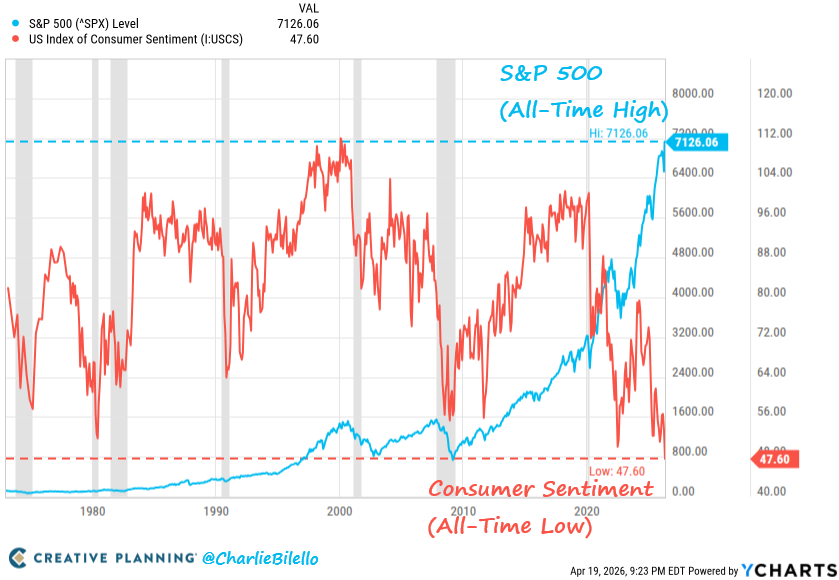
The S&P 500 is at an all-time high while Consumer Sentiment is at an all-time low.
We've never seen a gap this wide between Wall Street and Main Street.
Si murieras mañana, nadie podría acceder a tus:
- Cuentas bancarias
- Carteras de criptomonedas
- Almacenamiento en la nube
- Administrador de contraseñas
Tu vida digital muere contigo.
Aquí tienes la configuración de 30 minutos que evita esto ↓↓↓
Step 3: Set auto-delete (in case you want to keep some history)
If you don't want to turn tracking fully off, at least set auto-delete.
Go to: https://t.co/SsI3dVLQDL → Auto-delete → Set to 3 months
This means Google can only store the last 3 months. Everything older gets deleted automatically.
Do this for Web & App Activity, Location History, and YouTube History.
Step 2: Stop Google from collecting new data
Go to: https://t.co/W8qY3NVWk6
Scroll to "History Settings." You'll see three switches:
→ Web & App Activity → Turn OFF
→ Location History → Turn OFF
→ YouTube History → Turn OFF
Turn off all three. This stops the bleeding.
Here's how to take it back. Start here.
Step 1: See everything Google has on you
Go to: https://t.co/kw1CAQdmGT
Click "Delete" → "All time" → confirm.
This wipes your entire activity history. Searches, YouTube, voice recordings — all of it. Gone.
The former director of AI at Tesla stood up at Y Combinator's AI Startup School in June 2025 and said something that made half the room of young developers realize they had been preparing for the wrong future.
His name is Andrej Karpathy, and he is one of the only people alive who has been in the room for all three of the paradigm shifts that built modern AI. He was a founding member of OpenAI. He led the Autopilot team at Tesla. He designed and taught the first deep learning class at Stanford, which grew from 150 students in 2015 to 750 by 2017 and then escaped onto the internet where millions of people have watched it since.
When he said something had fundamentally changed, the people in that room had every reason to listen.
Here is the framework he walked through, and why it is the clearest map anyone has drawn of what just happened to software.
He said there have now been three distinct eras of programming, and they are not replacements of each other. They are layers on top of each other, each one eating into the work that used to require the one below it.
Software 1.0 is what almost everyone still means when they say code.
A human being sits down, writes explicit step-by-step instructions in Python or C or JavaScript, and the computer does exactly what those instructions say. For seventy years, this was the only kind of software there was.
Software 2.0 is the shift Karpathy himself named in a 2017 essay.
He watched it happen in real time at Tesla. The team stopped writing explicit rules for how the car should recognize a stop sign and started showing a neural network millions of examples until it figured the pattern out on its own. The code was no longer the instructions. The code was the dataset and the network architecture, and the actual logic lived in the weights that came out of training. He wrote at the time that Software 2.0 was eating Software 1.0 one function at a time, and inside Tesla, he was watching hand-coded computer vision logic get deleted and replaced by learned weights week after week.
Software 3.0 is the one that just arrived, and it is the one almost nobody has the right framework for yet.
He said the line carefully. "The hottest new programming language is English." Not a metaphor. A literal statement about how software is now being built. You no longer need to write Python to produce behavior. You write a prompt in plain language, and a large language model executes the intent. The prompt is the program. The English is the source code.
And the thing that makes this more than a productivity improvement is what he said next. Software 3.0 is eating Software 1.0 and Software 2.0 at the same time. Every traditional rule-based function that used to require a team of engineers can now be replaced by a prompt and a model call. Every narrow machine learning model that used to require millions of labeled examples can be replaced by a large model that was already trained on a significant fraction of the internet. The entire stack is being compressed upward into natural language.
The implication he drew from this is the one that matters most for anyone trying to figure out what to build next. He said we are living through the single biggest expansion of accessibility in the history of computing. For seventy years, programming required learning a formal language that fewer than one percent of humans could ever become fluent in. In the span of about three years, the barrier has collapsed. The only language you need to program a computer now is the one you already speak.
He used a phrase for this that sounded almost silly until you realize what it actually means. Vibe coding. The act of describing the program you want in loose natural language and letting the model handle the syntax, the structure, the boilerplate, and the integration. You do not need to know Swift to describe the iOS app you want to build. You describe the vibe, and the LLM handles the rest.
But he was careful not to oversell it. He said LLMs are what he calls people spirits. Stochastic simulations of human reasoning with an emergent psychology and a set of very specific weaknesses that every builder now has to design around. They have jagged intelligence, meaning they can do astonishingly hard things and then fail at something a child could handle. They have anterograde amnesia, meaning they cannot form new long-term memory the way a human coworker would. They hallucinate. They get confused. They need supervision.
Which means the job of a developer is not disappearing. It is changing shape. The best developers in the Software 3.0 era are not the ones who write the most code. They are the ones who can think in systems, design the right prompts, build the validation layers that catch the model when it drifts, and orchestrate an entire pipeline of specialized AI agents the way a conductor handles an orchestra.
The specific line he kept coming back to is the one I keep thinking about. We are no longer just writing code. We are managing behavior.
The people who will build the important things in the next decade are not the ones with the cleanest syntax.
They are the ones who figured out, earlier than everyone else, that when English becomes a programming language, the bottleneck is no longer how well you can speak to the compiler. The bottleneck is how clearly you can think about what you actually want the machine to do.
And that has always been the real skill. It is just that for seventy years, we had the luxury of hiding it behind the syntax.
Whatever you do, do not let your parents transfer their house into your name.
Instead, do what the wealthy do.
If your parents are retiring and they tell you they want to sign the deed of the house over to you, maybe they bought the house for next to nothing back in the eighties and now it is worth $800,000, do not do it.
If they transfer it to you while they are alive, you will take their original tax basis. This means that when you eventually sell, you will have to pay capital gains tax on the entire increase in value since they bought it. The taxman does not care that it was a gift.
Here is what the wealthiest families do instead:
Step 1: Set up a revocable living trust and place the home inside it.
It keeps your parents in full control while they are alive, but sets up a smooth, private transfer later.
Step 2: Your parents should name you as the beneficiary of the trust. That way, when they pass away, the house automatically moves to you with no court involvement and no probate.
Step 3: When you inherit the house through the trust, you get a stepped-up basis. That means you only pay capital gains tax on any increase in value that occurs after they passed away, not on the huge appreciation since the 1980s.
That single move can save you over $120,000 in taxes.
That is how you pass inheritance to your children without losing a dollar to the system.
If you want to stop the government from taking a cut of your family’s hard-earned assets, follow these steps.
Stubb: Ukraine is killing 30–35k Russians a month; Russia can’t replace losses. About 95% of kills are by drones.
Ukraine is retaking ground and in March launched more drones/missiles at Russia than vice versa. This isn’t charity anymore — the West needs Ukraine’s know-how.
1/
To avoid repeating the mistakes it made in Iraq in the 1990s, the United States “should offer Iran a path to diplomatic and economic normalization in exchange for compliance with a clear set of demands,” argue @DanielChardell and @HelfontSamuel.
https://t.co/Xp9Yuyn9yc
Elon Musk says universal income may be the answer to AI-driven unemployment. He has proposed a “universal high income,” arguing that government payments could offset large-scale job losses caused by AI and robotics. https://t.co/yx50KPl9Bf
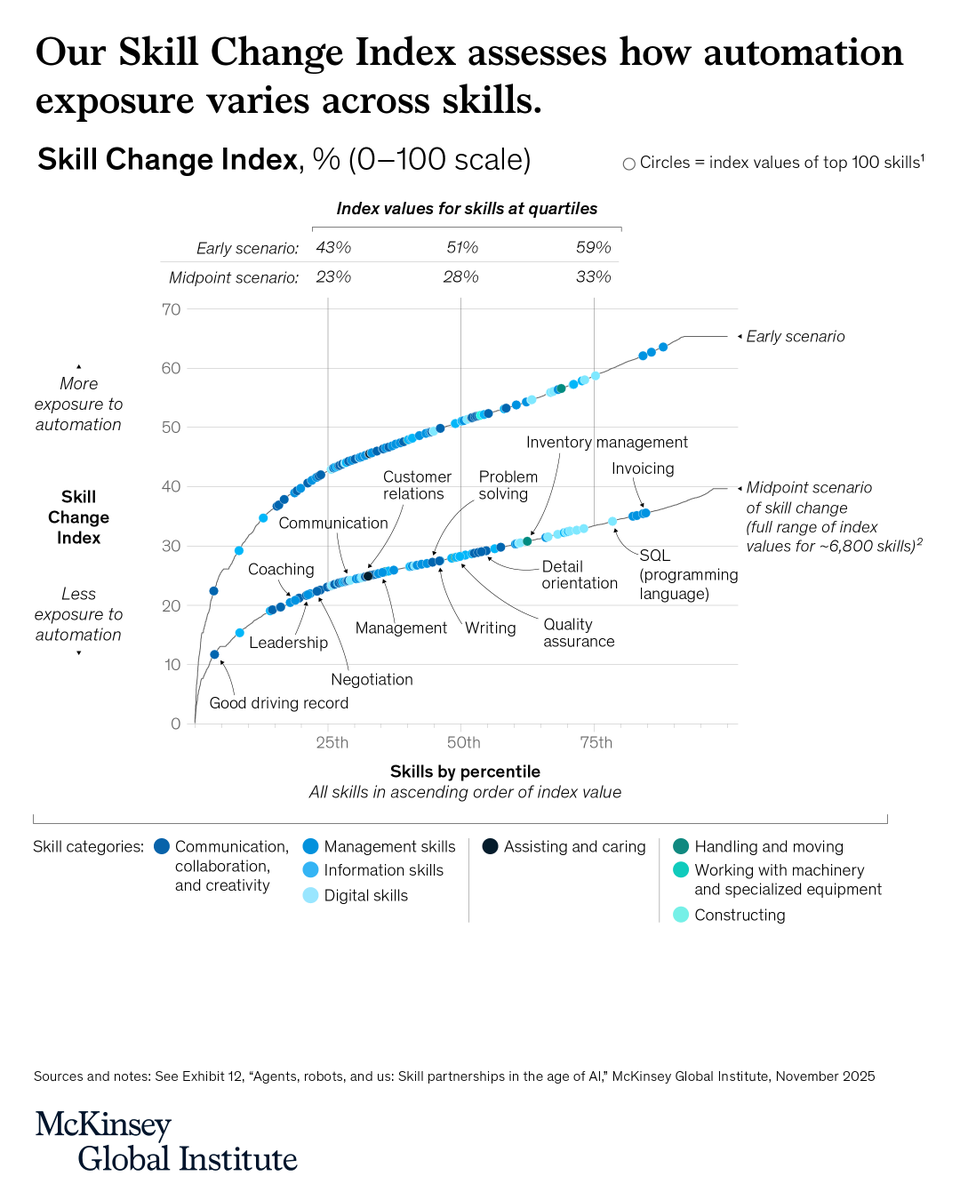
AI won’t make most human skills obsolete, but it will change how they’re used.
Negotiation, problem solving, and leadership will matter more than ever as people work alongside agents and robots.
Our new Skill Change Index shows which skills will be most, and least, exposed to automation in the next five years: https://t.co/fRXfHF1k56
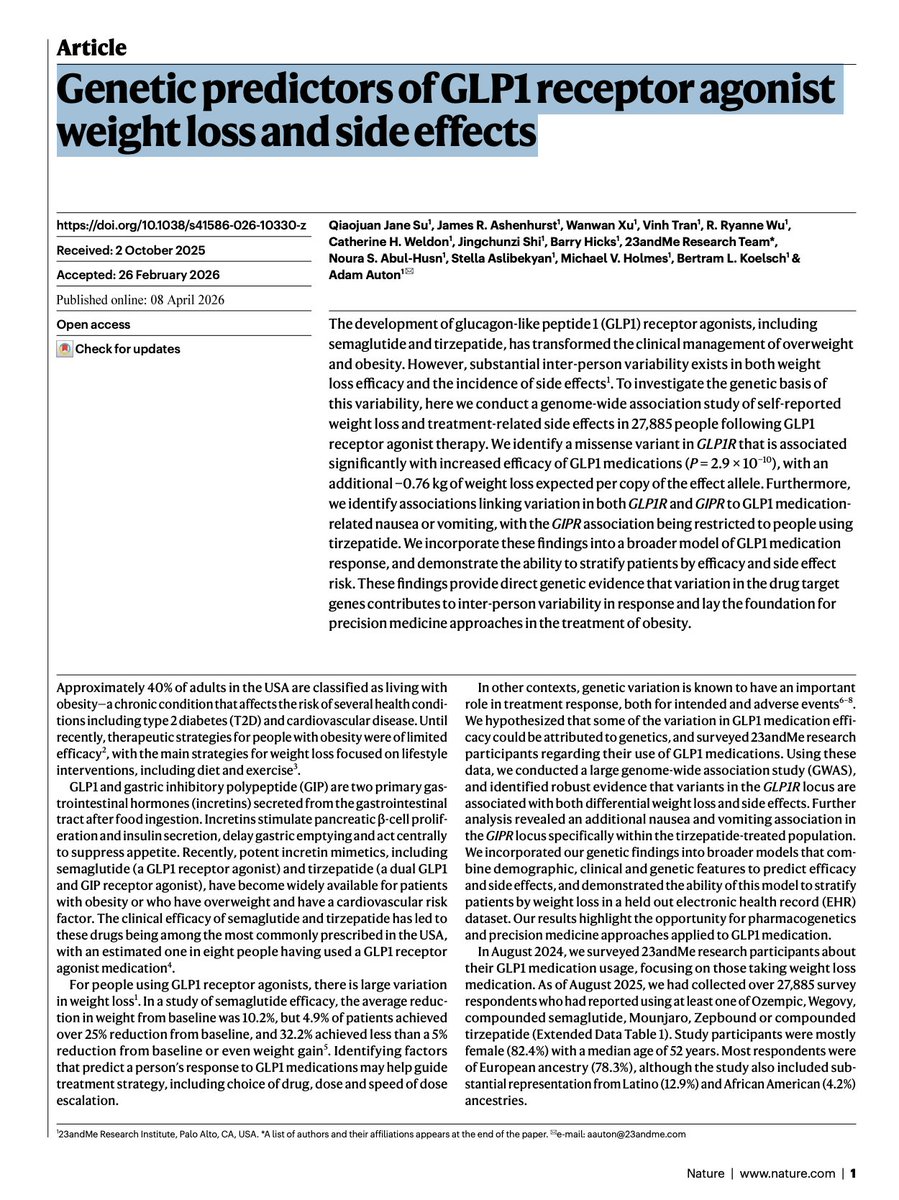
A massive Nature study of 27,885 GLP-1 users just dropped some major news about Ozempic and tirzepatide.
Your DNA determines how much weight you lose and how bad the side effects hit.
1 in 3 people see minimal results, and now we know why: (1/9)
Markets are delusional
we’ve already lost:
- ~30% of fertilizers
- ~20% of LNG
- ~14% of oil
- ~30% of helium
Any one of these on its own would be enough to trigger a crisis. Together, they form a systemic shock that risks pulling the global economy into a serious recession.
Because these aren’t isolated commodities.... they sit at the core of entire production chains:
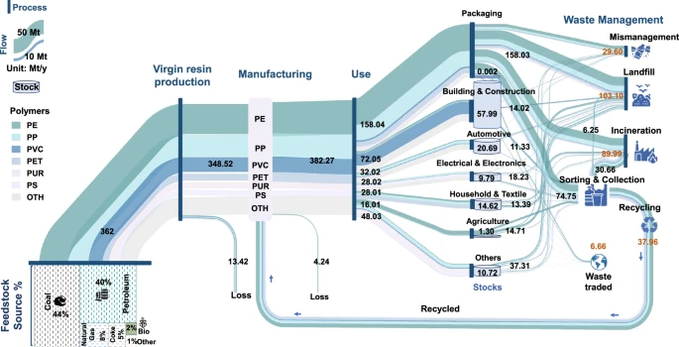
Petrochemicals -> fertilizer -> food production
Petrochemicals -> mining (copper, uranium, nickel)
Petrochemicals -> plastics -> cars, electronics
Petrochemicals -> drugs, rubber, textiles
Helium -> semiconductors / AI chips
Gas -> power generation
Diesel -> transportation
So this isn’t just an energy problem... it’s a full-spectrum supply shock hitting food, industry, tech, transportation and power at the same time. Without flows from Hormuz, the system doesn’t just slow down, it starts to break.
And there is no policy tool that can replace missing physical supply.