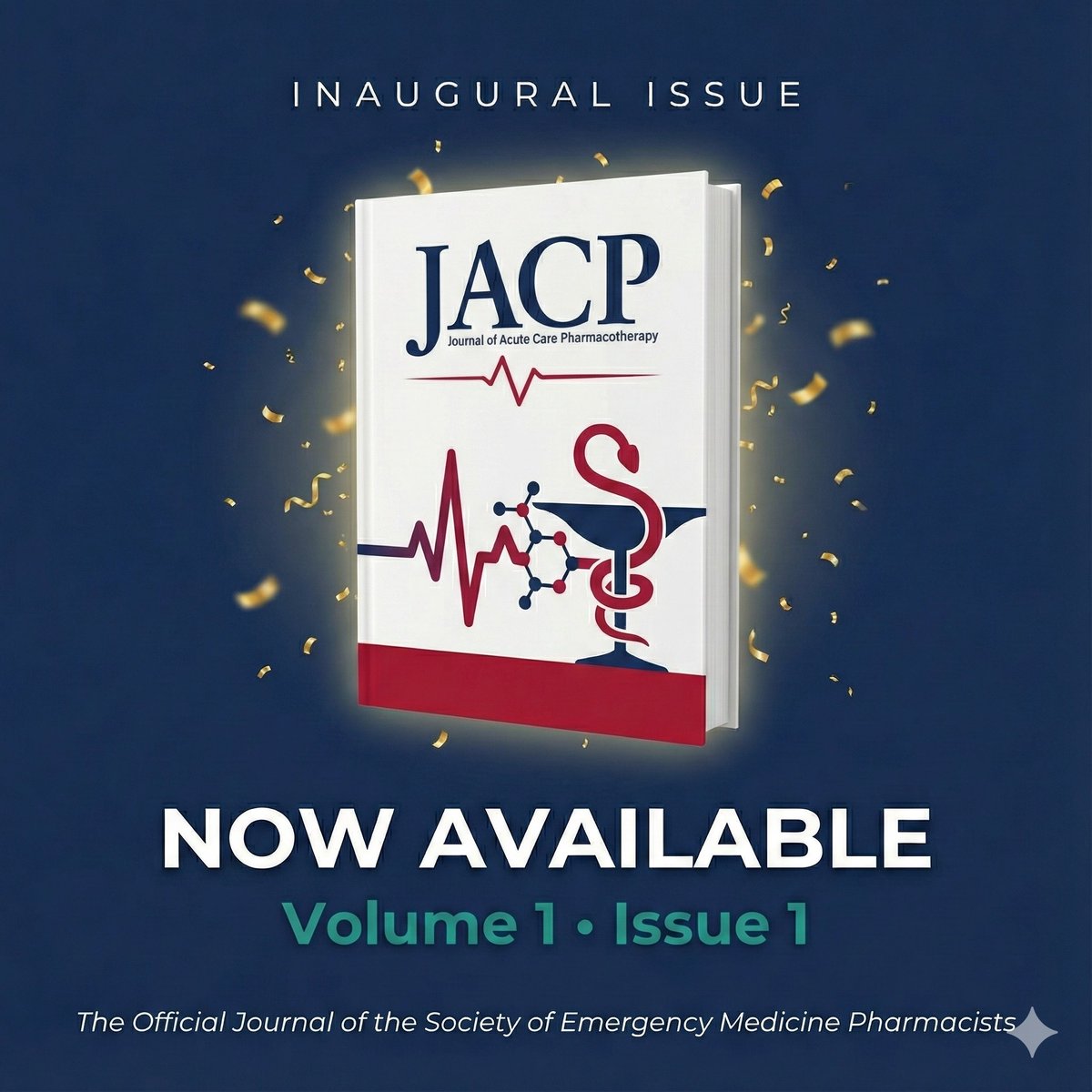
The inaugural issue of JACP is live!
The official journal of the @empharmacists covering EM, critical care, ID, tox, pediatrics, prehospital & more.
Read Issue 1: https://t.co/TNP8s19Gfy
Submit your research: https://t.co/qB95AVa61A
Publish with us and advance acute care pharmacy. #JACP #SEMP
Stop the press! Our latest guideline: when to use dialysis for ethylene glycol poisoning. Perhaps our best paper yet. Hundreds of articles included, thousands of hours of work. https://t.co/FF7MK2UU65
@SC_PharmD Looks like the administration technique is important to decrease the drug retention in the ETT. In vitro study but still interesting (simulating neonates) https://t.co/aHpUwcJEfs
@SC_PharmD Would go IO as much as possible. ET absorption is unpredictable and even if the recommandation is to use at least 2-3x the usual dose (in the adult world), serum concentration will not be enough and you might even need to use 10x the dose https://t.co/LuyZVYra6X (dog study)
🚨Check our first group publication! 🚨
Staying InformED: Top emergency medicine pharmacotherapy articles of 2020 https://t.co/xebTeuOEcU
Highlights:
🔷TXA
🔷Ketamine vs. etomidate
🔷Stroke
🔷All things EM ID!
#TwitteRx@DEZ_EM_Pharm@MeganARech@bfaine1
@dpraterems @ChillaPharmD@CircAHA The problem with "low-dose" atropine is that the dose inducing bradycardia is rarely defined in the recommendations. The dose seems to be less than or equal to 0.002 mg/kg equivalent to 0.5 mg for a 250kg patient. https://t.co/iEtS8Z0Y8w