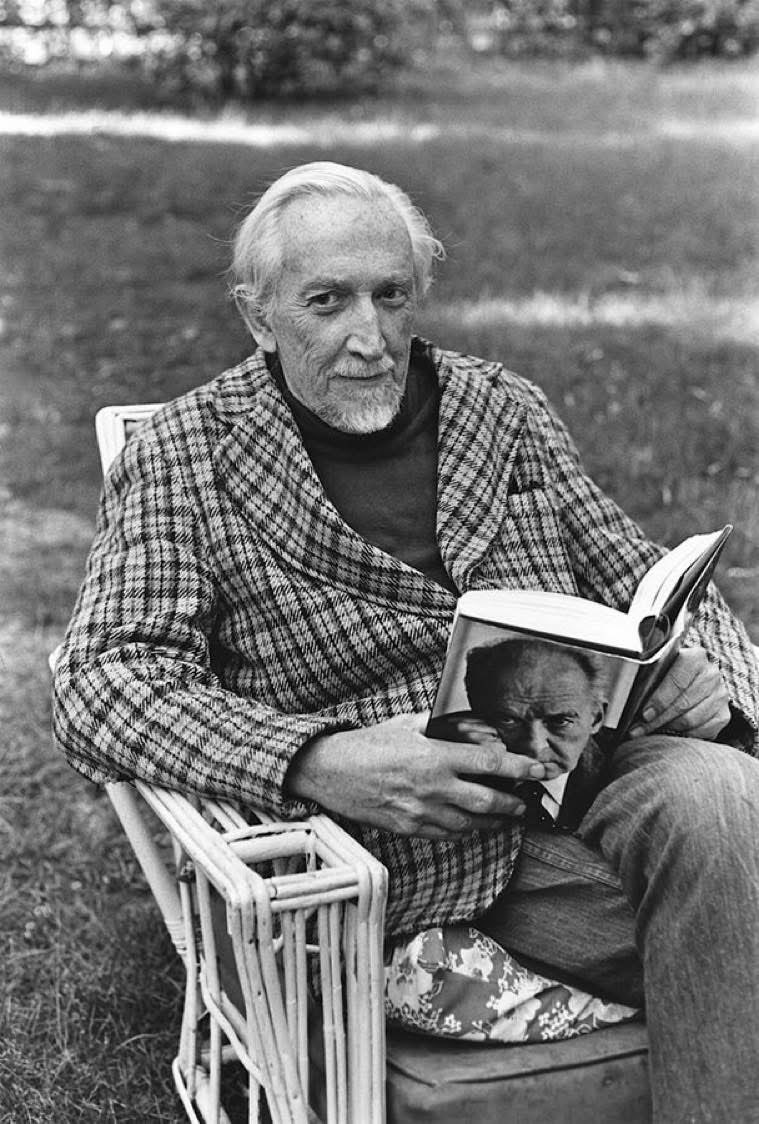
Graft! Incompetence! Civil war! Mutiny! A peasant insurrection! It's all here in this comic novel about life in the Late Roman Army. Finally, some realism! Fortuna at the Rudder, the Curious Adventures of Gaius Obsequens Dolo, from Catchall Books.
A single rogue Wikipedia editor falsely credited Muslims with thousands of scientific inventions, including funnels and sieves and the parabolic mirror (used in telescopes).
These false claims eventually made their way into academic literature, journalism, and culture.
It’s fashionable today to refer to a “Muslim Golden Age” of invention. But, as @cremieuxrecueil writes, this idea is founded on outright lies. Full story 👇
Holy F-ing shit. You simply have to listen to this.
THIS is an absolute bombshell!
This is EXACTLY the world we live in today. She nailed it.
Hannah Arend: They Don't Need You to Believe (1967)
A University of Michigan professor was just recorded teaching a class and the whole world got to see how crazy these professors really are.
A four year tuition at the university of Michigan will cost you over $600,000 after interest.
$600,000, for this.
Greta Thunberg is told about the latest Fridays for Future demo happening in Berlin – the climate protest she helped found. She bursts out in laughter. "Really? They're still doing that?"
Jokes on you climatetards. Left has moved on.
For a very simple reason: it's not a resources problem. It's an ideology problem.
The UN spent more than $7 billion over 13 years on its peacekeeping mission in Haiti. Thousands of troops, billions more in aid, NGOs on every street corner. When it left, the gangs moved in. Today they control the capital.
El Salvador, a country of 6 million people that was itself the murder capital of the world a few years ago, sends 2,000 soldiers and pays for most of it out of its own pocket. Within weeks, the leader of 400 Mawozo is writing to the UN Secretary-General, begging for "dialogue."
A fraction of the money. A fraction of the time. Real results.
The difference isn't technical. It's moral.
In the ideology that captured our institutions, taking out a gang leader is never "the solution." The solution is mediation, reintegration, "root causes," a ten-year disarmament program. The criminal is always a victim of the system. The real victim, the mother whose son was kidnapped, the village being extorted, becomes a line in a report.
Empathy for the executioner. Indifference for the victim.
It's the same software that broke the justice system, where people worry more about rehabilitating the repeat offender than about the safety of those riding the subway. The same one that broke schools, where nobody dares to demand anything anymore. The same one that tells young people having kids is a problem for the planet.
And it's the same structures, the same profiles, who ran Covid with absolute certainty and zero self-questioning.
What Elon exposed with USAID is exactly this: an ecosystem that lives off the problem, not off solving it. Haiti is the textbook case. Billions poured in after the 2010 earthquake, and the country is worse off than before. When your budget depends on the crisis, you have zero incentive for the crisis to end.
Bukele didn't invent anything. He's simply doing what every state did before this ideology took over: protect the innocent first.
Based.
Earlier today I wrote that school destroys critical thinking. Many of you asked for proof.
The proof is Marx.
Marxism is probably the most tested theory in human history. Tested on paper by the best economists in the world. Tested at full scale on hundreds of millions of people, across several continents, for more than a century. And it failed every single test.
A free mind, one that checks its ideas against reality, cannot remain Marxist. If so many people still are, it's not a problem of intelligence. It's a problem of method. They were never taught to verify.
Let's start from the beginning.
In 1867, Marx publishes Das Kapital. Everything rests on one idea: the value of a good comes from the amount of labor it contains. The boss's profit is therefore labor stolen from the worker.
Four years later, in 1871, Menger and Jevons independently show that this is wrong. Value doesn't come from labor. It comes from the usefulness the buyer sees in the good. An hour spent digging a useless hole creates zero value. That's the marginal revolution, and all of modern economics is built on it.
In 1896, Böhm-Bawerk shows that Marx's system contradicts itself: real prices don't match labor values, and Marx knew it. The foundation collapses.
In 1920, Mises asks the question that kills it: without private property, there are no market prices. Without prices, how does a central planner know what to produce, how much, and with which resources? Answer: he can't. Hayek finishes the job in 1945: economic knowledge is scattered across millions of minds, and no central bureau can ever gather it.
That's the theory. Now the predictions.
Marx predicted the revolution would break out in the most industrialized countries, England and Germany. It happened in Russia, an agrarian country. Wrong.
He predicted workers would grow poorer and poorer under capitalism. They grew richer than at any point in history. Wrong.
He predicted the State would wither away. Everywhere his ideas were applied, the State became total. Wrong.
Now the experiments.
USSR: forced collectivization, famine in Ukraine, millions dead, the Gulag.
China: Mao's Great Leap Forward. Between 15 and 45 million dead depending on the historian. The largest famine in human history, produced by a plan.
Cambodia: the Khmer Rouge killed roughly a quarter of their own population in four years.
Then there are the natural experiments. The most brutal ones, because they eliminate every excuse.
Korea. Same people, same language, same culture, same history. In 1945, the North was richer than the South. Today, income per person in the South is about 29 times higher than in the North. Only one variable changed: the system.
Germany. One people cut in two. One side had to build a wall. Not to keep people out. To keep them in.
Venezuela. The largest proven oil reserves on the planet. Nearly 8 million people fled the country. 21st-century socialism ended with Maduro captured last January.
Meanwhile, the other system, the one you were taught to hate, did this: in 1820, about three quarters of humanity lived in extreme poverty. Today, around 10%. And the biggest escape from poverty in history, China after 1978, happened at the exact moment the Communist Party brought markets back.
From Marx to Maduro, 150 years of data. All pointing the same way.
So how does anyone stay Marxist?
With the magic sentence: "that wasn't real communism."
Think about what that sentence means. A theory that fails every time it's tried, whose believers then declare that none of the attempts counted, is no longer a theory. It's a faith. Karl Popper saw it as early as 1945: Marxism survived its refutations by making itself irrefutable.
A mind trained to think for itself asks one question: how many failures does it take before you question the hypothesis? One, two, ten, forty?
That's exactly the question school never teaches you to ask.
Marx isn't taught as a hypothesis to test against the data. He's taught as a morality tale: there are oppressors and oppressed, and the right side is obvious. You learn the conclusion, never the method.
A four-year-old would ask: "Okay, but where did it work?" Fifteen years of schooling later, they've stopped asking.
A system that teaches you to obey has no interest in teaching you to verify. Because the day you start verifying is the day you start being free.
And that day, you stop being a Marxist.
In 1968, teenage Red Guards were beating their professors to death with clubs in Beijing courtyards.
Meanwhile, Jean-Paul Sartre sat in Paris calling Mao's Cultural Revolution a model of revolutionary democracy. The most celebrated intellectual in France looked at a country burning its own libraries and saw liberation. He sold the Maoist newspaper La Cause du Peuple on French street corners himself, holding it aloft like a sacrament.
Between 1966 and 1976, the Cultural Revolution killed between 500,000 and two million people. Schools shut down across the entire country. Students dragged teachers onto stages, hung placards around their necks, forced them to kneel on broken glass, then murdered them. The historian Bian Zhongyun, vice-principal of a girls' school in Beijing, died on August 5, 1966, beaten by her own students with nail-studded clubs.
Sartre swooned at this, calling it the people governing themselves. Why did a man this intelligent get it this wrong? Sartre believed knowledge served power, that truth was whatever the revolution required, that the individual existed to be dissolved into the collective will.
So when Mao abolished the distinction between teacher and student, between expert and mob, Sartre cheered. He had spent decades arguing that bourgeois reason was a class weapon. Here was a regime taking him at his word and clubbing the reasoners to death. This is what economic illiteracy gets you.
Mises had already explained the calculation problem in 1920. Hayek explained dispersed knowledge in 1945. Sartre had access to both and chose the dunce cap of the collective instead, then handed out its propaganda on the Rue de Rennes.
He died in 1980, mourned by 50,000 followers, never having retracted a word about Mao. The professors of Beijing got no such funeral, only a philosopher in Paris explaining that their murder was freedom.
🔴🫵🏻Le fait que des bac+5 votent pour Mélenchon alors qu’il dévoile un programme totalement aberrant, sidérant, mortifère et désastreux économiquement prouve à quel point, dans une grande partie de leur cursus, ils n’ont été abreuvés que d’idéologies, de sociologie militante, de conférences politiques universitaires, d’utopies et de slogans, sans jamais recevoir la moindre culture économique minimale.
Mais je ne suis pas surpris. J’ai croisé à plusieurs reprises, au cours de ma vie, des étudiants en master qui ne savaient même pas ce qu’était une assurance-vie, pour qui il était impossible de faire une déclaration d’impôts (et encore moins de la comprendre), ou qui étaient incapables de faire la différence entre un b��néfice et un chiffre d’affaires. Des gens qui sortent de cinq ou six ans d’études supérieures sans maîtriser des notions aussi basiques que le coût d’opportunité, l’effet des incitations, la différence entre richesse créée et richesse redistribuée, ou le fait qu’un déficit public permanent a un coût réel.
Quand on voit le programme de Mélenchon – nationalisations à tout-va, taxation confiscatoire du capital et des successions, réduction du temps de travail, retraite à 60 ans, contrôle des prix, explosion des dépenses publiques financée par la planche à billets ou par l’endettement – et qu’on constate que des diplômés y adhèrent sans broncher, on comprend que beaucoup n’ont jamais été confrontés à la réalité économique. Ils ont appris à analyser le monde en termes de « rapports de domination », de « justice sociale » et de « partage des richesses », mais rarement à se demander d’où viennent ces richesses et ce qui les fait disparaître.
Le résultat est là : des gens formés, cultivés sur le papier, mais économiquement analphabètes, prêts à voter pour des politiques qui ont déjà échoué partout où elles ont été essayées, parce que personne ne leur a jamais vraiment expliqué pourquoi.
#JLM2027 #7novembre
Le mensonge de l’ONU vient de s’effondrer en une semaine sur Haïti.
Pendant 30 ans, l’ONU et la « communauté internationale » ont multiplié les résolutions, les missions (MINUSTAH, MSS, GSF), les rapports, les expertises et les mandats limités.
Résultat : les gangs contrôlent 80-90 % de Port-au-Prince, des milliers de morts par an, plus d’un million de déplacés, un État fantôme. La Force de Suppression des Gangs, autorisée par le Conseil de sécurité, a mis plus d’un an à déployer environ 1 500 hommes avec un impact dérisoire. Les gangs ont même réussi à tendre une embuscade à des techniciens salvadoriens sous mandat ONU.
Bukele arrive. En une dizaine de jours, il déploie plus de 2 000 soldats salvadoriens davantage que toute la force ONU, hors du carcan bureaucratique et des chaînes de commandement multilatérales. Pas de six mois de négociations, pas de rapports de 200 pages, pas de « respect des droits des gangs ». Juste des soldats, des blindés, des hélicoptères, et une volonté claire.
Et soudain, les gangs se cachent. Les habitants sortent dans la rue, crient, célèbrent. Le mot d’ordre est simple : « Se débloque le pays ». Les chefs de gangs appellent l’ONU pour « dialoguer » et demander la médiation. La panique s’installe chez ceux qui terrorisaient le pays depuis des années.
Ce n’est pas un miracle. C’est la démonstration que le problème n’a jamais été « trop complexe pour être résolu ». Le problème, c’était le dogme : que seule l’approche multilatérale molle, procédurale, obsédée par les « droits humains » des criminels, pouvait être l��gitime. Que la souveraineté, la force décisive et les résultats concrets étaient suspects.
Bukele a déjà prouvé chez lui qu’on pouvait casser les gangs. Il vient de le montrer en Haïti en une semaine, pendant que l’ONU en parlait depuis trois décennies. Les Haïtiens dans la rue l’ont compris plus vite que les experts de New York et de Genève.
La question n’est plus « comment faire ? ».
Elle est : combien de temps encore allons-nous prétendre que les processus internationaux qui perpétuent le chaos sont la seule solution possible ?
A bon entendeur.
"The constant reading of the bible in hundreds of thousands of humble families kept a basic floor of literacy under literature as a whole, and under the English language. The variety of styles of writing so admirably represented, the relative complexity of many of the ideas involved and the range of ethical levels to be found in that great compendium of ancient Hebrew culture demanded, in its reading and in its exposition to the children, a certain mental activity, and provided for the poorer classes the same sort of cultural groundwork that the study of Greek and Latin provided for the sons of the rich. A mind accustomed to the Old and New Testaments could easily admit Shakespeare and the entire range of Victorian writing: poetry, novels, historic and scientific essays, up to the saturation point of that particular intelligence. Today the English-speaking peoples have no such common basic classical education. The bottom level is the visual and aural culture of the movies, not a literary level at all. Above that appear all sorts of gradations of illiteracy, from those who, though they may have learned to read in school, are now barely able to spell out the captions in the pictures, to those who can take in, with the help of the photographs, a few simple sentences out of the daily tabloids, right through to the several millions of actively literate people who can read right through The Saturday Evening Post or The Reader’s Digest and understand every word of it. This is the literal truth. Every statistical survey that has recently been made of literacy in this country has produced the most staggering results. We have to face the fact that the number of Americans capable of reading a page of anything not aimed at the mentality of a child of twelve is not only on the decrease but probably rapidly on the decrease."
John Dos Passos
An over simplification but some truth here. Albert Jay Nock had the same idea - being able to read is not the same as being literate. Brings to mind Lincoln whose formal schooling lasted about six months, perhaps a year. He succinctly summed up his educational background in 1858, when he filled out a brief biographical sketch for the upcoming Dictionary of Congress: “Education defective,” it read. Primarily self-taught he read the Bible & Shakespeare avidly.
In an 1860 biography of candidate Lincoln, journalist William Dean Howells wrote that Mr. Lincoln was “a diligent student of Shakespeare, to know whom is a liberal education.” There's no denying this. Historian William E. Gienapp: "Lincoln’s gift for language was marvelous, even poetic, so much so that he is the only American president other than Thomas Jefferson whose writings can be considered literature.”
As for the King James Bible:
"The King James Bible came at the end of the Elizabethan age, between Shakespeare and Milton, when Englishmen were using words more passionately, richly, vigorously, wittily, and sublimely than ever before or since."
Dwight Macdonald
In this abbey in France, nuns have been restoring old books for over 70 years.
The Benedictine sisters of Maumont Abbey run a full workshop and their craft is bookbinding, gilding and restoration. Centuries-old books arrive damaged, torn and crumbling, and they restore them all by hand to last another hundred years.
[Citation Finkielkraut 🤩] Pourquoi adolescence et politique font mauvais ménage :
« L’adolescent, c’est l’être au regard clair, à la voix vibrante, au visage grave qui ne voit jamais que des scandales là où il y a des problèmes ou des dilemmes, et des lignes droites là où il y a des carrefours. (...) Que faire quand le devoir donne des ordres contradictoires ou surgit de plusieurs côtés à la fois ? L’adolescence fuit ce casse-tête éthique dans l'abstraction exaltante d’un univers de substitution où toute la souffrance des hommes résulte de la politique des méchants. Sortir de l’adolescence, c’est donc n’avoir plus besoin d’un salaud pour incarner la mauvaise part de l’Histoire : la gravité juvénile laisse place non certes à la frivolité ou à la maîtrise, mais à l’embarras et à la passion de comprendre. (...) Or il n’y a presque plus personne pour tendre aux jeunes une main secourable et les sortir du mélodrame. (...) Qu’il se tourne vers les “profs”, les artistes, les journalistes, les philosophes – l’adolescent contemporain ne rencontre, sauf exception, que lui-même, c’est-à-dire l’allergie à l’inextricable et l’extase des engagements binaires. »
Alain Finkielkraut, Les battements du monde (2003).