Your brain is built to forget almost everything that happens to you. It makes one exception, and you're looking at it.
Carole Peterson at Memorial University has spent over 25 years studying our earliest memories. She found that the first one most adults can recall comes from age 2.5, not 3.5 as the old textbooks said. The early memories that survive share three things: a strong feeling, a new experience, and a physical sensation. A wave, a dad's grip, and the weird feeling of riding a board check every box.
The mechanism lives in the amygdala. It's the brain's emotion sensor, sitting right next to the hippocampus, the part that files memories. When something big happens, the amygdala triggers a flood of stress hormones like cortisol. That's the signal to the hippocampus to file this one extra deep. James McGaugh at UC Irvine spent his career showing this works for happy moments too. The amygdala fires for pleasure the same way it fires for fear. What matters is how loud the feeling is.
Dads play a particular role here. Daniel Paquette, a developmental psychologist in Montreal, has spent 20 years researching what he calls the "activation relationship." Moms tend to be the safe base kids come back to. Dads tend to be the door to the outside world. They push kids into new and slightly scary situations, and stand right there as the safety net. Kids who grow up with this kind of dad end up more confident, less anxious, and more comfortable around strangers.
A 2017 review pulled together 16 studies covering 1,521 father-child pairs. Quality rough-and-tumble play, which means the wrestling and tossing and chasing kind, was linked to lower aggression, better emotion regulation, and stronger self-control. In rats, baby animals that don't get to play-fight grow up with an under-developed prefrontal cortex, which handles planning and impulse control.
Christina Bethell's 2019 study in JAMA Pediatrics took the long view. Her team at Johns Hopkins surveyed 6,188 Wisconsin adults about their positive childhood experiences. Adults reporting six or seven of those had 72 percent lower odds of adult depression than those reporting zero to two. The effect held even for people with serious childhood trauma. Good moments keep paying out for decades.
The original tweet is right. The moments that burn in are the ones with big feelings, new physical sensations, and an adult who is the bridge between safe and scary. Twenty years from now, the grip is what he'll remember.
Little rant about my experience as an artist and how I see AI bros' behavior
When I was a kid, I was called a gifted kid because I could draw, and it fascinated both classmates and Adults. I'm sure a lot of fellow artists had a similar experience, since it was quite rare to see irl especially before socials became so widespread. Some were envious, some simply curious, and some trying to befriend me to get free art even then.
Honestly I didn't mind the ego boost, but I noticed a repeated pattern of "I wish I could do that!" "you're so lucky you can draw" "you're so talented, unlike me", dismissing their own skills or insisting they couldn't do anything. Adults said something fun wasnt a real job, that I should think of getting a job like theirs instead.
Now in the era of AI 'art', those same persons who used to envy artists have an easy access to an illusion of talent and skill. They spit on the stolen work of every artist whose art has been fed into AI to flatter their fragile ego and look down on artists. They say artists will loose their jobs and get replaced, when they don't even understand why that's false or what it takes.
But the truth is they cope, they stay in the comfort of denial, saying THEY created the results AI give them. Saying prompting is a skill, because they want it to be one. They'd kill to do the same as artists, to have a passion, a talent, to captivate people and get praised for something they created with their own hands. To make money out of their passion.
But besides AI bros boosting each other's egos, no one will genuinely compliment AI 'art'. And if anyone did, upon learning it was AI they'll take it back because it has no value at all. It's stolen, empty, and made with no passion or love whatsoever (and probably a ton of mistakes up close too)
I just think it's sad because anyone can draw well. It just takes practice, but they're not even willing to try. Instead, they just hide behind insults and superior complex. Behind a false sense of achievement.
NO ARTIST will ever say "you have no skill, you suck" to someone genuinely trying to get into art. The art community is very welcoming, just pick up the pen and have fun with us!
Maybe this is controversial of me but if you see the scenes so clearly in your head but can’t get them into cohesive words that sound good, maybe you’re just not a writer lol
“To photograph people is to violate them, by seeing them as they never see themselves, by having knowledge of them that they can never have; it turns people into objects that can be symbolically possessed. "
― Susan Sontag, On Photography
Haftanın highlightları:
1- Ex patronun "ya biz seni mağdur etmezdik zaten aramızda böyle bi güven olmamasına üzüldüm" dediği olayda sorun çıktığı an beni aramak yerine benden habersiz drivedaki dosyalara erişmeye çalışması.
2- Tombili 👇🏻
Abi üzüntüden kalp krizi geçireceğiz artık. Lütfen yeter, durun artık. Dünya'nın en güzel coğrafyası ve insanı yaklaşık 4-5 bin kişilik bir aç gözlüler ordusu tarafından sömürülüyor
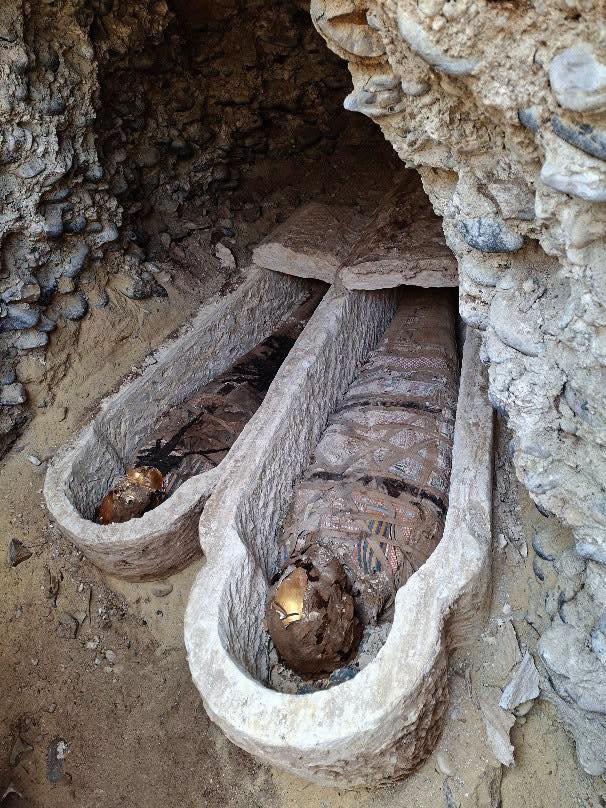
Archaeologists have made a stunning discovery inside a 1,600-year-old Egyptian mummy — a fragment of Homer's Iliad.
The papyrus was found tucked inside the gut of a mummy unearthed in Tomb 65 at Oxyrhynchus, an ancient city located 118 miles south of Cairo.
The excavation was carried out between November and December 2025 by a team including researchers from the University of Barcelona and the Institute of Ancient Near East Studies.
This marks the first time a Greek literary text has been found incorporated into the mummification process.
Previous discoveries at Oxyrhynchus had turned up Greek papyri used in burials, but their contents were always magical or ritualistic in nature.
The fragment found within the mummy belongs to Book II of the Iliad, a section known as the Catalogue of Ships, which lists the Greek forces that sailed to Troy.
The Iliad, composed around 800 BC, is widely considered the cornerstone of Western literature and centers on the Trojan War and the fate of the warrior Achilles.
Researchers are still unsure why this particular literary passage was chosen for the embalming ritual.
The funerary complex also yielded other remarkable finds, including mummies adorned with gold tongues and fingernails, heart scarabs, and amulets depicting gods such as Horus, Thoth, and Isis.
#archaeohistories
“I've seen women insist on cleaning everything in the house before they could sit down to write... and you know it's a funny thing about housecleaning... it never comes to an end. Perfect way to stop a woman. A woman must be careful to not allow over-responsibility (or over-respectabilty) to steal her necessary creative rests, riffs, and raptures. She simply must put her foot down and say no to half of what she believes she "should" be doing. Art is not meant to be created in stolen moments only.” - Dr. Clarissa Pinkola Estés
Mentally healthy people live in a permanent hallucination.
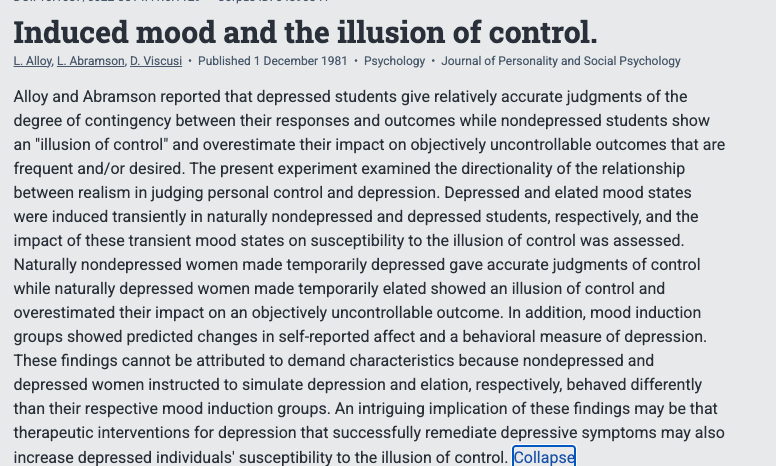
Lauren Alloy's landmark studies at Temple University shattered a comfortable assumption about mental health.
She gave participants a simple task: press a button and try to control when a light turns on.
Some had control, others didn't.
Depressed participants accurately identified when they had zero influence over the light. Mentally healthy participants believed they were controlling it even when the light operated on pure randomness.
The pattern repeated across dozens of experiments. Healthy people overestimated their test scores before getting results back. They predicted longer lifespans, better job prospects, and lower divorce risk than statistical reality supported. Meanwhile, mildly depressed individuals predicted outcomes that matched actual data with eerie precision.
Alloy called this "depressive realism" and it reveals something disturbing about human consciousness. What we label as mental wellness depends on systematic self deception. Your brain evolved to lie to you about your chances, your control, and your capabilities because accurate risk assessment would have killed your ancestors before they reproduced.
The optimism that gets you out of bed each morning is the same cognitive error that makes you buy lottery tickets.
But, the depressed participants who saw reality clearly became more depressed as a result of their accuracy. Knowing the truth about your limited control and uncertain future creates a feedback loop that spirals into paralysis.
Evolution faced a choice between accuracy and action. It chose action every time.
The people you admire for their mental strength are chemically incapable of seeing how bad the odds really are.
"Todo lo he hecho a sabiendas y no me arrepiento de nada. Ni de lo bueno ni de lo mano ni de los momentos felices ni de las tristezas. Al final, tengo el alma llena de paz y de tranquilidad".
Chavela Vargas
üreticinin çilesini görmediğimiz için çok hafife alıyoruz. geçen yaz iznik’te yaban mersini üreten bir grup kadınla tanıştım. inanılmaz ilham verici de bir hikayeleri var aslında. köyün yerlileri. ailelerinden miras kalınca kadınlara en sapa, yolu suyu olmayan araziler veriliyor.
This is my video that recently went viral. I cover the euthanasia situation in the Netherlands. For people under 30, it mostly targets autistic people (75%) and women (74%).