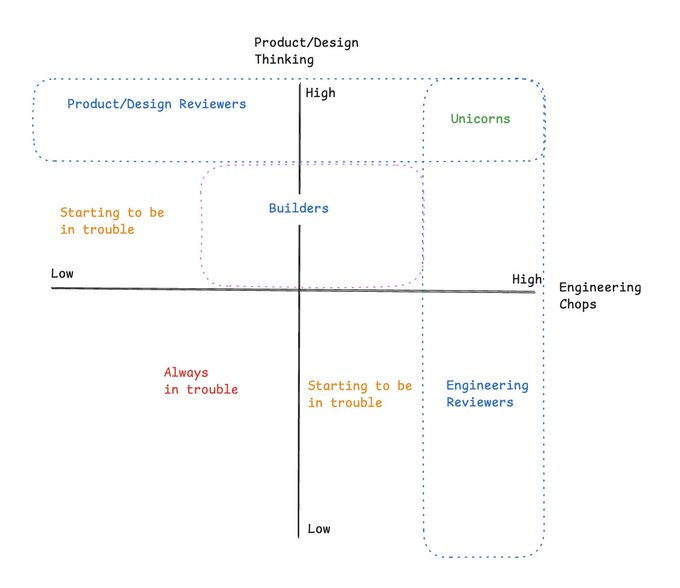
As code has become cheap to write, two product archetypes are emerging
Builders (product sense + coding agents + design intuition)
Reviewers (deep domain expertise, fast, high-throughput)
https://t.co/cUDSCsruXg
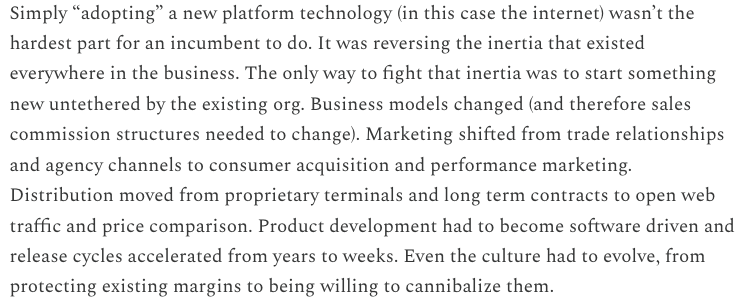
When everyone is debating whether Block's 40% layoffs are about AI or COVID bloat, it could actually be a war on inertia.
Platform shifts don't kill companies. The inability to rewrite internal playbooks does.
https://t.co/JicmzTWV0D
Really like the mental model of "transformative AI" over "AGI".
Focuses on AI's societal and economic impact rather than its ability to match human capabilities.
Economic Turing Test: an AI can perform a job for a month or three and be hired without the employer realizing it's a machine.
Transformative AI is achieved when AI can pass this test for 50% of money-weighted jobs, marking major societal changes.
Tactical tips form @yuhkiyam (CPO Figma) on how PMs can work effectively with designers.
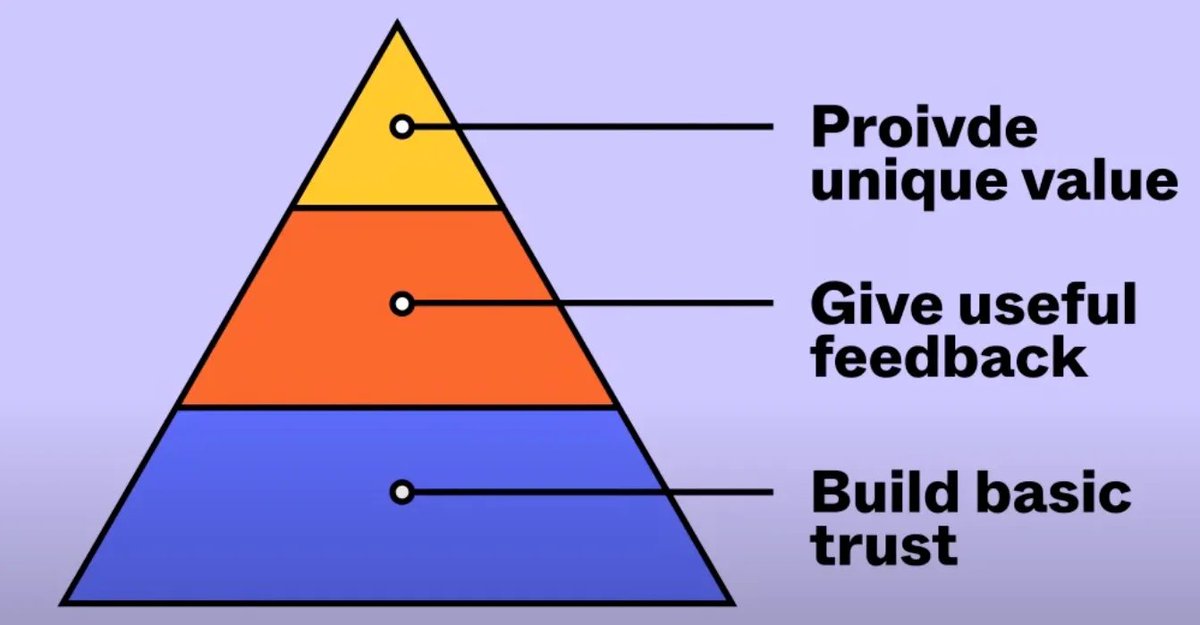
For building trust, the way we communicate matters greatly. PMs, designers, and engineers usually operate from different perspectives, and being able to communicate across these perspectives is crucial. For example, while a PM may push to release something as long as the metrics are good, a designer typically wants to understand why the metric is good in the first place, and making room for and highlighting these nuances helps build trust.
For giving useful feedback, this often relates to providing feedback on a design, and here I like the tip to zoom out instead of zooming in. It is easy to jump straight to minor details or edge cases without considering the main considerations for the design. The picture illustrates these points, from low-level details to a higher level.
For the last part, while a design is a solution, often the most value is achieved by better defining and understanding the problem and aligning on it. Doing this properly makes it easier for the designer to take a more articulated approach to exploring the solution space, where different approaches and tests can be more deliberate from the start, as visualized in the picture below.
https://t.co/mqiCTDbZ72
European geopolitics through Jeffrey Sachs’s lens
The interview with Jeffrey Sachs at the EU Parliament is one of the most interesting I’ve heard in a long time, and I highly recommend it. I found it refreshing to hear his view on how many wars could and should be avoided, especially given the ongoing conflict in Ukraine. He delivers a direct review of current and historical affairs and Europe’s position in all of this. At a high level, his argument is that the United States has been dictating global foreign policy, often with negative consequences for everyone else. He ties this overreach to the Ukraine war, which he sees as triggered by U.S. expansion through NATO. A consequence of this U.S.-dominated global policy is that Europe lacks its own foreign policy, as it obviously should have.
Quick Background: Jeffrey Sachs is an American economist and public policy analyst, currently a professor at Columbia University. I’ve previously listened to him alongside John Mearsheimer on the All-In Podcast. Both are rooted in realpolitik, offering aligned descriptions of how the world operates, yet they diverge in their conclusions. Mearsheimer represents an offensive strain of realpolitik, arguing that to prevent a global nuclear war, the U.S. must dominate and consolidate total power. In contrast, Sachs embodies a defensive perspective, contending that this very pursuit of dominance will inevitably provoke a nuclear war.
Expanding further on some of the main points in the interview:
US hegemony and NATO’s push eastwards
Sachs argues that since the Soviet Union’s collapse in 1991, the United States has relentlessly pursued a unipolar world order, with NATO’s eastward expansion as a cornerstone of this strategy. He frames it as a deliberate effort to contain Russia, rooted in the misguided belief that Russia would remain isolated and incapable of forming alliances with powers like China or Iran. The current geopolitical situation demonstrates the miscalculation of this approach.
Absence of foreign policy in Europe
Further, he contends that for nearly three decades, Europe has lacked a distinct foreign policy, instead aligning itself with U.S. directives through NATO. He sharply distinguishes NATO from Europe’s own interests, portraying it not as a defensive alliance rooted in European needs, but as an instrument of American imperialism serving U.S. goals. This subordination, he argues, has stripped Europe of sovereignty over its security, preventing it from crafting an independent foreign policy. As a Norwegian, I found this remark particularly striking: “I did not think it could get any worse than Stoltenberg,” which underscores his frustration with Europe’s deference to NATO’s, and by extension, America’s, leadership.
Diplomacy in the Ukraine war
Two key points stand out. First, Europe, not the U.S., should have led diplomatic efforts to resolve the Ukraine war. Effective diplomacy, however, requires engaging the other side, which Europe has failed to do. Second, this effort is further complicated by Ukrainian President Zelensky’s decision to prohibit dialogue with Russia. Sachs emphasizes that peace negotiations hinge on talking to the opposing party, and with Europe sidelined, the U.S. has stepped in. Yet, Europe should be driving this process. As the continent that will share a border and coexist with Russia for the coming centuries, it has the most at stake and the greatest need for a proactive, independent role in securing peace.
What should Europe do?
First, we need to guarantee our own security, reducing reliance on external powers like the U.S. Second, we must forge a unified European foreign policy(not NATO), one that allows individual nations to retain control over most domestic matters while presenting a cohesive global stance. Finally, Europe should lead peace talks with Russia. This means actively engaging in dialogue, abandoning warmongering rhetoric, and prioritizing diplomacy to de-escalate tensions.
Can you call JD Vance a fascist and Alice Weidel a Nazi?
Lately, I have noticed how lightly people slap “fascist” or “Nazi” on anyone they dislike, exemplified by JD Vance and Alice Weidel (Afd) lately. Sure, free speech means you can say it—but should you? And what is the potential harm in doing so?
My frustration boils down to two issues. First, these labels kill real discussion. These terms are so emotionally charged that they shift focus from a person’s ideas or actions to a simplistic stereotype. Call Vance a fascist or Weidel a Nazi and you can skip right past their immigration and economic ideas. When instead we should ask: 1) what are the underlying problems that make these ideas become increasingly popular and 2) given this proper understanding, are these ideas going to address them in a good way. That requires a lot of nuance, not name-calling.
Second, overusing them dilutes their historical significance. Fascism and Nazism aren’t just buzzwords—fascism locked down Mussolini’s Italy, banning parties and ruling everything from 1922 to 1943 (Britannica). Nazism, Hitler’s twist, ran on Aryan supremacy and the Holocaust, crushing democracy with violence from 1933 to 1945 (Britannica). If every nationalist is a “fascist” or “Nazi,” what’s left for actual tyrants who jailed dissenters or gassed millions? It also clouds current discourse, making it harder to spot real dangers when critique becomes hyperbole.
These terms carry heavy baggage, so if you’re throwing them at Vance, Weidel, or anyone, you should be able to prove it—full-on, not just cherry-picked quotes. Fascism and Nazism mean crushing dissent, racial purges, or torching democracy. Match that bar, and the case should be obvious.
Can’t explain what they mean? Don’t use them. For a short time they can work to silence the opposing view. But when “fascist“ or “Nazi“ becomes “person I do not like”, that vagueness will eventually destroy any attempt at valid critique. Because at some point the pendulum will swing the other way, where the “accused” can play victim, rally their crowd, and flip the script while you’re stuck with an empty word. Knowing the terms—centralized control, genocide, total power—keeps you honest and forces the argument to stay sharp.
Nothing is black or white. This demands open-mindedness and humility, plus an open marketplace of ideas where critique and nuance is the norm.
At the same time, the real bottleneck for shipping faster is internal product complexity and to shipping more value is product distribution
So, being able to prototype fast is great to improve coordination and testing in the first step:
1. Idea to prototype (✅)
2. Internal product complexity
3. Product distribution
@Alex_Danco
2 AI tools I’m loving as a PM this week for saving time:
1. Idea → Prototype: Jot bullets, draft a loose spec. Now, I use ChatGPT or Perplexity to make a functional spec, feed it to @boltdotnew, it spins up a working prototype to deploy & test fast.
Broad vs narrow feedback leads to general vs unique traits!
“narrow pressure from specific people that forges distinct style”
vs
“broad pressure to satisfy a perception of authenticity that ultimately minimizes surprise”
@Alex_Danco
How to communicate trade-offs / fend off requests:
- Explicitly state the current situation (what you are working on), compare it to a steel-man of the request, and then answer in a frame for what is best for the company
@tarstarr
Playing around with @lovable and have created my first game!
Still some limitations and stuff I want to fix:
- Have scoreboard (need to connect to database)
- Make the figures more fun
- Adjust navigation speed of ship
Deployed here: https://t.co/UumVOBgb9C
2. Research: Use a chatbot to craft a detailed research prompt, which I can feed into Deep Research to create a report on exactly what I am looking for. This gives a quick overview and provides easy access to the links I would have had to find myself.
Here’s a take on how the rise of American tech companies is at the core of a new Western Empire:
I have a deep fascination with the big picture—history and the rise and fall of great empires. Two books, in particular, have profoundly influenced my thinking on this topic. The first is Tragedy and Hope, a dense and ambitious history book by Carroll Quigley, and the second is Ray Dalio’s Principles for Dealing with the Changing World Order.
Dalio's book explores the recurring patterns in the rise and fall of empires throughout history. He identifies key drivers that create an empire—such as innovation, strong leadership, and economic productivity—and how those same drivers gradually give way to complacency and decline. Using this historical framework, he argues that the United States exhibits many signs of an empire transitioning into decline and that China appears to be ascending as the next global superpower.
From the perspective of Western civilization, this feels like a grim conclusion. However, this is where I find myself returning to Quigley's Tragedy and Hope and a key observation he makes about the uniqueness of Western empires. Quigley notes that while empires inevitably decline, Western empires are distinct in that their fall has consistently been accompanied by the rise of a new Western power that inherits and adapts the values and systems of its predecessor. The Dutch empire gave rise to the British, and the British to the United States.
The reason for this continuity lies in the parallel emergence of a new and more dynamic power structure as the old one stagnate and decay. Over time, this new structure becomes more productive and innovative, eventually reaching a tipping point where it overtakes the established order.
Applying this lens to the United States today, one could argue that we are witnessing not merely a normal political shift but a tipping point where a new power structure—driven by American technology companies—has surpassed the old framework of industrial and financial capitalism.
The emergence of this new power structure will necessitate a reordering of the internal structure and, externally, mark the beginning of a new age of expansion. Historically, such expansion is characterized by growth in four key areas: 1) population, 2) geographic area, 3) production, and 4) knowledge, where production and knowledge give rise to population which gives rise to geographic expansion. Just another way of saying robotics, AI and Mars.