THINGS CARATS ARE NOT AFRAID OF AS FANS:
1. LIVE BANDS
2. SEVENTEEN'S LIVE VOCALS
3. DANCING
4.SEVENTEEN LIVE VOCALS+DANCING
THINGS CARATS AFRAID OF:
1. SCOUPS 😭
people are badmouthing dokyeom without even knowing WHO HE REALLY IS, and that’s what makes me so angry. dokyeom is one of the most sensitive members of seventeen and one of the members who expresses his feelings the most. he has always been open about his emotions, so y’all mocking him because he cried???
he didn’t cry simply because he was “scared of enlistment”. everything suddenly felt real for him. he’s going to be away from the members, his family, and carats. his sister is pregnant and was due to give birth around the same time as his enlistment, and he had been looking forward to meeting his niece.
dokyeom is such a kind and precious person. he’s someone who can make everyone smile, which is why he isn’t called our HAPPY VIRUS for nothing. it hurts to see one of the happiest people, someone who is always making everyone laugh, be the one crying and then seeing people use that vulnerable moment against him is disgusting.
calling him a “manchild” is something i will NEVER shut up about 🤬 and the “my faves didn’t cry” comments??? OH JUST SHUT UP!!! this isn’t a competition. men are allowed to cry. everyone processes difficult situations differently, and crying doesn’t make him weak, immature, or less of a man.
and all of this has NOTHING to do with that group. if you have an issue with the fans, then attack the fans not the idols. stop dragging dokyeom into something that has nothing to do with him.
forced conscription is NOT a fucking joke. you can criticize a system that forces people to leave their families and loved ones and put their lives on hold without mocking the people who are subjected to it. there is nothing wrong with acknowledging how harsh and dehumanizing forced military service can feel while still respecting the people who have to go through it.
and one thing i genuinely don’t understand is their so-called “proof”. some of the screenshot that are being used weren’t even carats. yet y’all are getting rage-baited so easily by newly made accounts or accounts that aren’t even k-pop-related. instead of reporting those tweets and moving on, y’all keep engaging with them, giving them exactly the attention they want. that only makes everything worse.
having this much hatred in your heart and head while he is surrounded by love in the real world is honestly so bizarre. we don’t need your sympathy. this is our business, and somehow y’all love minding other people’s business so well. it must’ve been so boring over there, awww.
SO JUST SHUT THE FUCK UP AND FOCUS ON YOUR FAVES!!! 🤬 leave him alone. let him feel. let him cry. let him be human.
aku selalu pengen jadi kaya. tapi bukan kaya yg punya koleksi mobil sport sama tas birkin.
cukup kaya yg bisa bikin aku bisa bantu orang tanpa mikir panjang, bisa beli apapun tanpa liat harga, sama nurutin kemauan ibu, adek, dan keponakan ku yang bejibun itu
lagi rame yang muji kinerja Pram, and i think he’s finally getting the recognition he deserves.
sebagai wartawan, gue udah sering banget lihat langsung tabiat dan sifat berbagai pejabat. keliatan kok mana pejabat yang suka caper ke wartawan biar dapet exposure bagus, dan Pram tuh bukan tipe yang begitu.
terus kalau liput pejabat lain bisa ngaret 1–2 jam, tapi kalau Pram udah ngundang media, dia gak pernah telat. malah kita yang sering ditinggal karena dia selalu buru-buru lanjut ke agenda lain wkwkw 😭
gue pernah liput kebakaran di Muara Angke, yang kebakarannya itu terjadi di tanah sengketa milik suatu perusahaan. banyak orang yang malah ngehujat para penghuni, tapi Pemprov DKI tetep kasih bantuan full buat para korban.
pas live report gue bilang warga butuh toilet portable, pakaian layak pakai, air bersih, makanan bayi, dll. besoknya TRINGGG, semuanya ada 😭
karena besoknya gue beneran balik lagi ke sana buat live update. tanpa ngundang-ngundang media, tanpa pidato-pidato di dalam tenda, Pemprov DKI udah nyediain semuanya.
jadi selain karena kinerjanya bagus, gue juga respect sama Pram karena personality-nya beneran gak neko-neko sih.
memang bare minimum pejabat tuh harusnya kayak dia wkwkw. dan untungnya makin ke sini kinerjanya makin bagus sampai akhirnya mulai banyak yang notice.
harapan gue, semoga kinerja Pram setidaknya terus bagus kayak gini. dulu pas sesi doorstop dia pernah bilang kalau udah selesai jadi Gubernur DKI, dia mau pensiun.
gatau deh, bakal ada angin-angin yang beneran ngusung doi ke bangku RI 1 atau nggak 👀
aku bener-bener merinding bacanyaa..
maksudku, peristiwa gunung meletus & erupsi ini berbarengan semua loh timelinenya.. terus bencana lain kayak banjir.. dan kebakaran hutan karena ulah manusia itu sendiri. . :(
aku keinget sama surat ini di alquran,
"𝘁𝗲𝗹𝗮𝗵 𝘁𝗮𝗺𝗽𝗮𝗸 𝗸𝗲𝗿𝘂𝘀𝗮𝗸𝗮𝗻 𝗱𝗶 𝗱𝗮𝗿𝗮𝘁 𝗱𝗮𝗻 𝗱𝗶 𝗹𝗮𝘂𝘁 𝗱𝗶𝘀𝗲𝗯𝗮𝗯𝗸𝗮𝗻 𝗽𝗲𝗿𝗯𝘂𝗮𝘁𝗮𝗻 𝘁𝗮𝗻𝗴𝗮𝗻 𝗺𝗮𝗻𝘂𝘀𝗶𝗮; 𝗔𝗹𝗹𝗮𝗵 𝗺𝗲𝗻𝗴𝗵𝗲𝗻𝗱𝗮𝗸𝗶 𝗮𝗴𝗮𝗿 𝗺𝗲𝗿𝗲𝗸𝗮 𝗺𝗲𝗿𝗮𝘀𝗮𝗸𝗮𝗻 𝘀𝗲𝗯𝗮𝗴𝗶𝗮𝗻 𝗱𝗮𝗿𝗶 (𝗮𝗸𝗶𝗯𝗮𝘁) 𝗽𝗲𝗿𝗯𝘂𝗮𝘁𝗮𝗻 𝗺𝗲𝗿𝗲𝗸𝗮, 𝗮𝗴𝗮𝗿 𝗺𝗲𝗿𝗲𝗸𝗮 𝗸𝗲𝗺𝗯𝗮𝗹𝗶 (𝗸𝗲 𝗷𝗮𝗹𝗮𝗻 𝘆𝗮𝗻𝗴 𝗯𝗲𝗻𝗮𝗿)."
(QS. Ar-Rum 30: Ayat 41)
semoga kita semua selalu berada dalam perlindungan-Nya yaa huhu, stay safe, jaga diri, jaga keluarga, saling jaga sekitar!!
terus berdoa agar keadaan bisa segera membaik tanpa ada korban lagi yaa 🥺💗
do you??? ever get??? second hand happiness??? like minghao is happy??? so you're happy??? because he’s happy???
THE ANSWER IS ALWAYS YESSSS!!! AN ABSOLUTE YES WHENEVER I SEE MINGHAO IN HIS HAPPY CAREFREE STATE 😭😭🥹
🚨 UPDATE
Per jam 16.37 menjelang sore hari ini sekitaran Jakarta, Jawa Barat, Jawa Tengah. Masih merah pekat kondisi kandungan SO² di udara nya, dampak dari erupsi gunung anak krakatau.
Ya Allah. Stay safe. Jangan lupa pakai masker kalau ke luar rumah!
Ini anak perempuan, abangnya meninggal karena nolong dia. Bapaknya digosipkan selingkuh. Ibunya menceraikan ayahnya.
Engga gila aja udah bagus banget jir.
Islam tidak mengajarkan kita menghakimi trauma orang lain.
Let her find her own peace 🙏🏻
Anak Krakatau, Sunda Strait, Indonesia
When I walked across Anak Krakatau some years ago, I stood on ground built in living memory over a magma system very much older than that. Rakata rose across the water, the surviving fragment of a mountain that collapsed in 1883, and beneath my own feet lay the child that grew up afterward in the same place, itself already broken and partly rebuilt by the time I arrived. The mechanism has not repeated. What keeps repeating is the outcome. A single magma supply, drawn from the subduction zone beneath the Sunda Strait, has driven every phase of construction here for as long as anyone has kept a record of it, but the ways the surface structure has failed have been genuinely different each time: a magma chamber emptying beneath a caldera roof in 1883, a young and overloaded flank sliding into the sea in 2018.
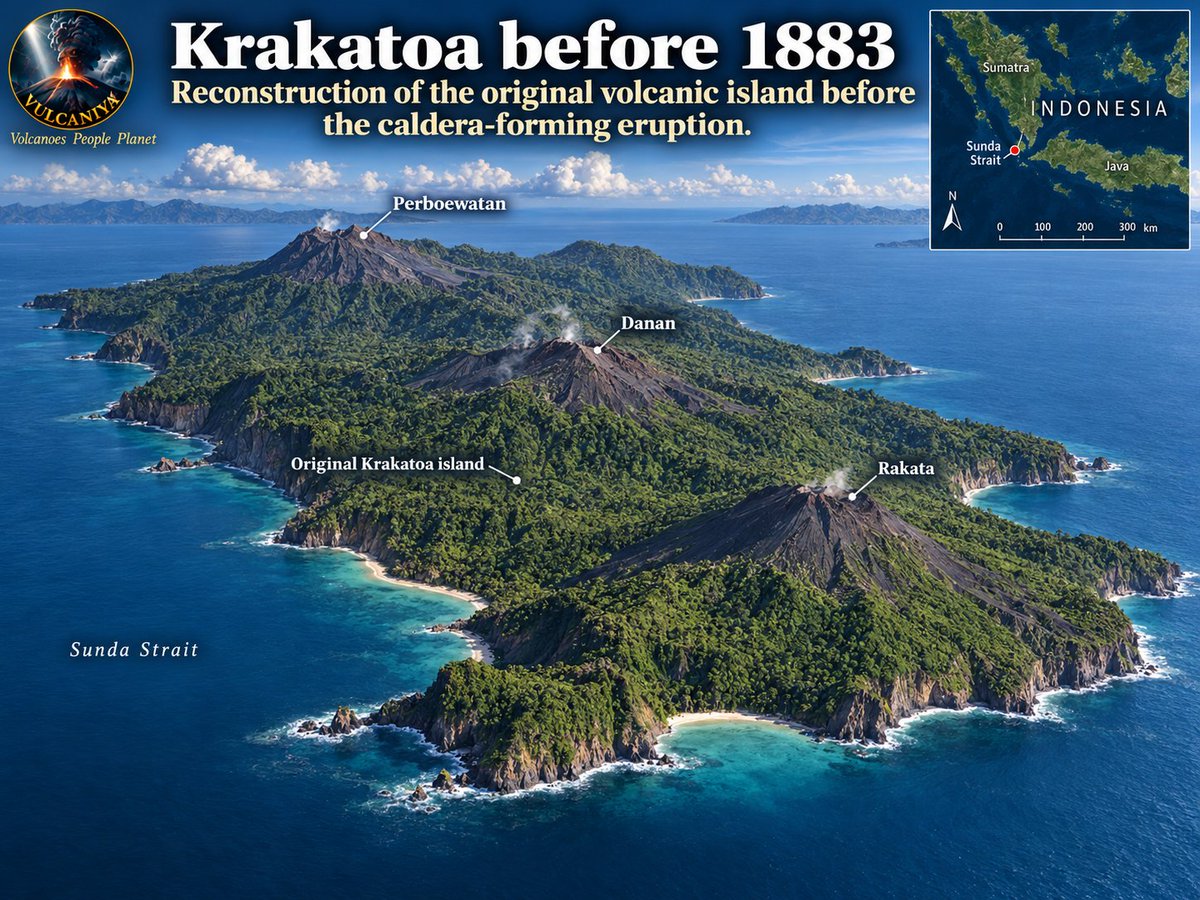
The first known collapse in this system happened long before anyone was counting years accurately. Sometime in the first millennium, by tradition around 416 or 535 CE, though neither date rests on solid evidence, an older volcanic edifice collapsed and left behind a caldera some seven kilometres across. Little more than that can be said with confidence about the event itself. Its rim survives today as Sertung and Panjang, once Verlaten and Lang Island to Dutch surveyors. New cones, Rakata, Danan and Perbuwatan, grew up afterward inside that caldera and merged, over time, into the single island that stood here through most of the nineteenth century.
That island did not last. Eruptive activity began at Perbuwatan on 20 May 1883 and reached Danan through June and July, progressively tapping a shallow, silica-rich magma system beneath both cones. Activity intensified sharply on 26 August, and in the most violent hours of the eruption early the next morning, the ground above that emptying chamber lost the support it needed and gave way. That is how a caldera forms, not an explosion carving out a hole, but ground dropping into a space an eruption has just emptied beneath it. The collapse destroyed Danan and Perbuwatan, and left only the southern part of Rakata, the cliff I could see across the strait, standing above the water. More than 36,000 people died, most of them in tsunamis generated during the eruption's final, most violent hours, whose precise combination of causes, collapse, explosions and pyroclastic flows entering the sea, is still debated among specialists. Some of those pyroclastic flows crossed roughly 40 kilometres of open water to reach the coast of Sumatra.
None of that stopped magma arriving from depth. The Indo-Australian plate slides beneath Sumatra and Java along the Sunda Arc, and the melt it generates answers to plate motion rather than to whatever has just happened at the surface above it. Steam and explosions were reported rising from the drowned caldera in the closing days of 1927, from a point between the old positions of Danan and Perbuwatan. A small island rose there and the sea washed it away again more than once before further eruptions finally built a cone that held, becoming a permanent island by 1930. Local observers named it Anak Krakatau, child of Krakatau, and it grew quickly after that, through explosions, ash falls and lava flows recorded well over forty times, reaching about 338 metres above sea level by 2018 at an average rate of some four metres a year.
That growth also set the conditions for a very different kind of failure from the one that broke Krakatau in 1883. Anak Krakatau had grown on the steep, submerged margin of the older 1883 caldera, water two to three hundred metres deep dropping away close to its base, with little solid ground supporting that side of the young cone the way rock supports a volcano built on a plain. Researchers modelling the island years before 2018 had already flagged that unsupported southwestern slope as the one most likely to fail. This time it was not a magma chamber emptying beneath a roof. It was a steep pile of loose ash and lava, built at that rate of roughly four metres a year for ninety years, finally too heavy for the ground beneath it to carry, and seafloor mapping done after the event found that the same southwestern slope had failed once before, in 1949, along an almost identical alignment.
Satellite radar had already picked up part of the warning, without anyone yet reading it as one: the southwestern flank was creeping slowly seaward along a detachment surface researchers later modelled beneath it, while thermal cameras recorded the cone running unusually hot through 2018. On the evening of 22 December, during an eruption that had been building all that year, a small earthquake shook the volcano roughly two minutes before the flank gave way, though scientists studying the seismic record stop short of calling that earthquake the trigger. The whole southwest side of the cone slid into the sea in about a minute, a landslide that removed at least 150 million cubic metres of rock and, submarine mapping done years later confirmed, closer to half the island's total mass once the material lost underwater is counted, cutting the island's height from 338 metres to about 110. A landslide of that kind does not produce the strong, short-period shaking that an earthquake-based tsunami warning network is built to detect, so no alert went out, and the displaced water reached the coasts of Java and Sumatra within roughly half an hour. It killed 437 people who had no warning at all.
The collapse did more than remove rock. It opened the vent directly to the sea, reconfiguring the volcano's plumbing so that rising magma met seawater on its way up rather than open air, and the eruptions that followed turned Surtseyan, magma flashing seawater into steam in dark, ash-heavy bursts rather than the drier explosions of before. Eruptions in the following months added roughly 0.3 cubic kilometres of fresh tephra on top of the scar, burying the evidence of how the collapse had actually happened almost as fast as scientists could map it.
Both forces are still active in 2026. PVMBG raised Anak Krakatau to Level III, Siaga, on 2 July, and has held it there since, with a three-kilometre exclusion zone around the crater. The volcano entered a sustained phase of continuous eruption at 23:07 WIB on 4 September, observers describing red incandescent jets consistent with lava fountaining through the night, and satellites tracked the resulting ash to around 15 kilometres, with a second, lower ash layer drifting separately. PVMBG said on 5 September that the rebuilt cone remains too small, for now, to collapse on a scale capable of generating a tsunami like the one in 2018. Put another way, watching Anak Krakatau now means watching the same contest that the 1949 and 2018 failures both eventually resolved on their own: how much unsupported weight that slope can carry before gravity settles it. For the moment the agency's answer is that the new cone has not yet built up enough of it, and the exclusion zone stays fixed on the crater rather than the coastline.
Rakata still stands across the strait as the one piece of Krakatau old enough to have survived the 1883 collapse. Everything nearer the crater, the flooded caldera, the flank that gave way in 1949 and again in 2018, the fountains of lava that rose there overnight on 4 September, is the same magma supply finding, breaking and rebuilding its own way to the surface, in the same stretch of water, for as long as anyone has kept a record of it.