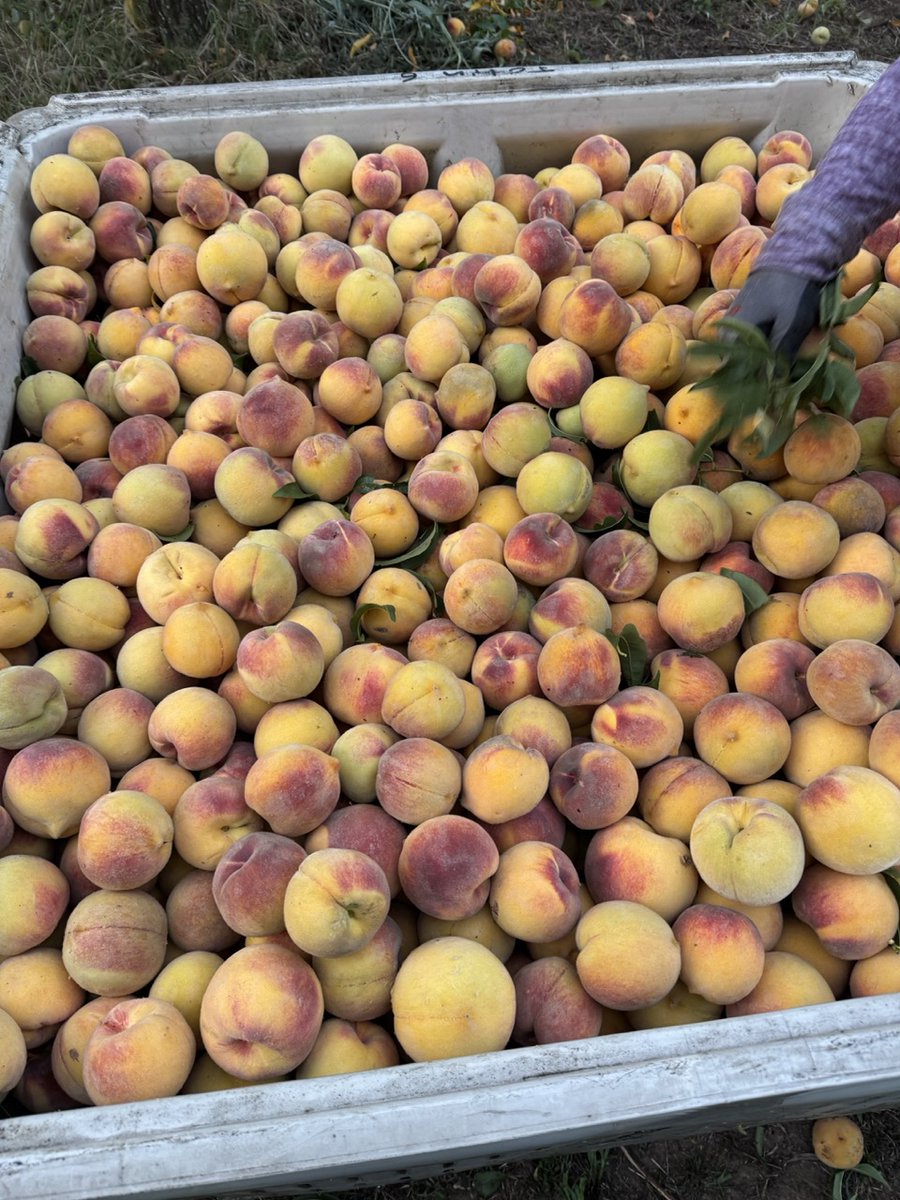
California peaches checking every box to make a happy grower!
✅ Flavor
✅ Color
✅ Size
We've worked with this grower for a few years. Last fall they put on a post-harvest nutritional foliar, which is a big reason we think this crop turned out so well. Setting next year's buds up for success in the fall is a high-impact strategy, and one we recommend for every perennial crop.
It can be hard to think so far ahead, but well worth it.
FYI this grower's post-harvest foliar was:
➡️ MacroPak™
➡️ MicroPak™
➡️ Axcel™ (the CA version of Accelerate™)
➡️ Rebound Boron™
Sap analysis is your friend here, because there are lots of nutrients that are key for bud initiation, and you don't want to neglect any!
More about Post-Harvest: https://t.co/LaGFSSr1xi
Our hearts go out to all the orchardists who have lost their crops this year.
In the silver linings category, we heard from Green's Fruit Farm in Pennsylvania that their trees got a second wind and may bounce back from last week's freeze!
When considering frost resistance, the goal is essentially to turn your plants' sap into antifreeze by packing it with as much sugar and minerals as possible to lower the freezing point.
➡️ Potassium is the primary regulator that moves these solutes into plant cells.
➡️ Calcium and Boron work together to build elastic cell walls that can withstand rupturing.
➡️ Seaweed is non-negotiable to help plants survive stress.
A few AEA products we regularly recommend to help deal with temperature stress are SeaStim, SeaCrop, and PhotoMag.
Of course, the most important thing is having excellent nutrition the prior year, and building a really tough bud in the fall using bud optimization foliars. We can help design those for you. Get in touch.
Activist: "Your cows are putting carbon into the atmosphere."
Farmer: "Where did they get it?"
Activist: "What?"
Farmer: "The carbon. Where did the cow get it before it put it anywhere."
Activist: "From... eating?"
Farmer: "From eating grass. And where did the grass get it."
Activist: "The soil?"
Farmer: "The air. The grass pulled it out of the air last spring. The cow ate the grass. The cow breathed some of it back out. It went back into the air it came from."
Activist: "But it's still going into the atmosphere."
Farmer: "It's going back. There's a difference between a thing going somewhere and a thing going back. You've described a circle and you're frightened of it."
Activist: "Then just don't have the cow."
Farmer: "The grass still dies in autumn. It rots where it falls. The carbon goes back into the air either way, just without anyone getting fed in the middle."
Activist: "It's not that simple."
Farmer: "It's grass, cow, breath, grass. Or it's grass, rot, air, grass. Same circle, fewer dinners. If that's complicated for you I'd stay away from the water cycle. That one's got clouds in it."
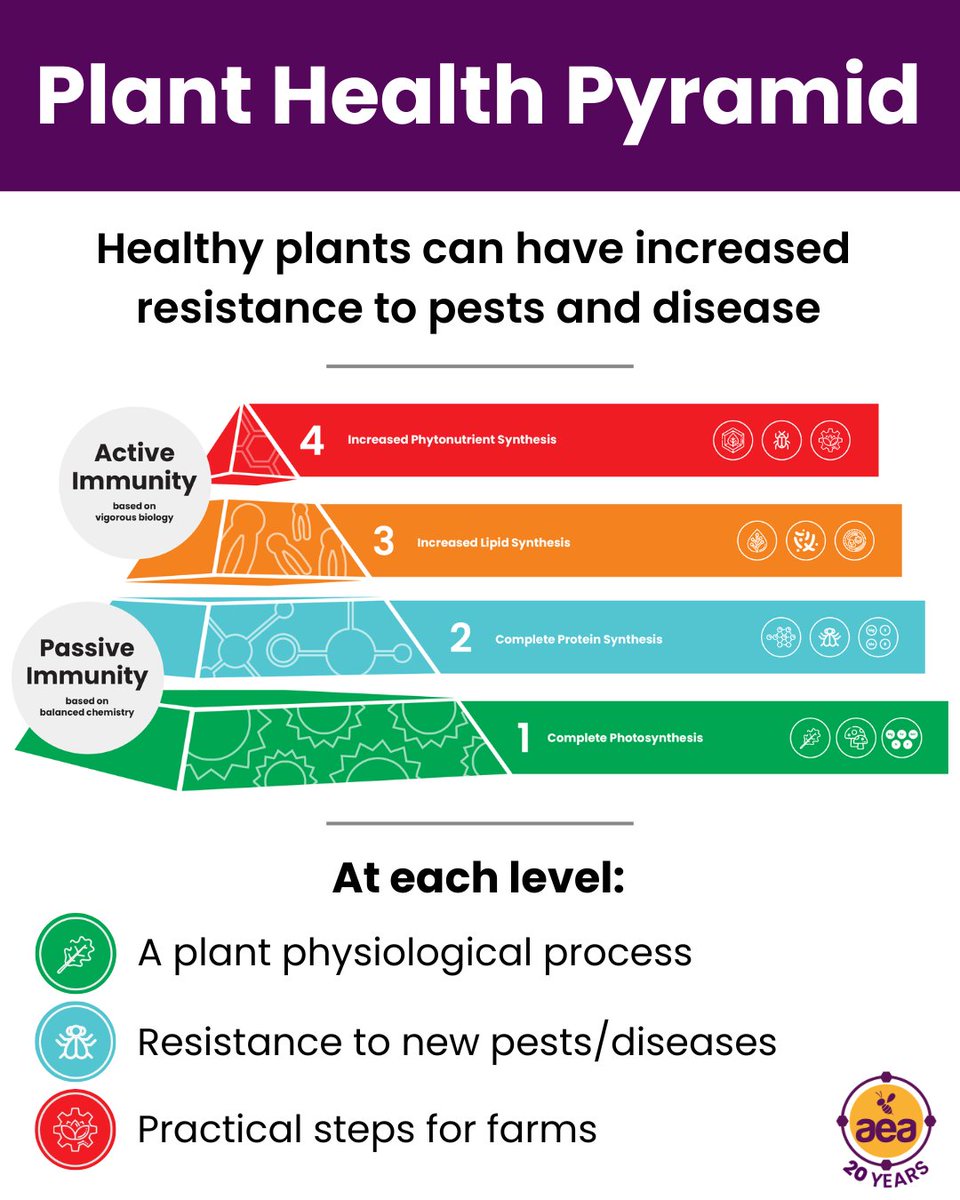
@JohnKempf developed the Plant Health Pyramid to describe how plants can become resistant to pests and diseases as their health improves.
➡️ It's a simple and essential tool for understanding the power of regenerative agriculture and precision plant nutrition to transform farms.
➡️ Most importantly, it gives actionable tools for farms to increase pest resistance and decrease their dependence on pesticides.
This week, we'll be sharing a detailed post on each level of the Pyramid. Follow along to learn more!
Dive in to the Plant Health Pyramid: https://t.co/zYs4sDlzK0
In Level 1 of the Plant Health Pyramid, plants increase both the quantity and quality of sugars they produce through photosynthesis.
➡️ By reducing the ratio of non-reducing sugars, the quality of the plant's root exudates improves.
➡️ This helps determine the soil microbial profile and and develop disease-suppressive soils.
🦠 When they reach Level 1, plants can become resistant to soil-borne pathogens, including verticillium, fusarium, rhizoctonia, pythium, and phytophthora.
Plants require 5 minerals for optimal photosynthesis: Mg, N, Fe, Mn, P.
➡️ Magnesium and Nitrogen are critical components of the chlorophyll molecule.
➡️ Iron is needed to assemble chlorophyll.
➡️ Manganese is required for water hydrolysis: the first step in photosynthesis.
➡️ Phosphorus is the essential element in ATP, which is needed in abundance to metabolize all those sugars.
Stay tuned for Level 2!
Read More: https://t.co/CAAGmg8VGl
"It's simplified everything."
Today on the podcast, Tom Cotter shares how his journey into regenerative agriculture has reduced his workload, improved yields, and increased his enjoyment of farming.
🎧 Listen: https://t.co/QHrpTKWMU1
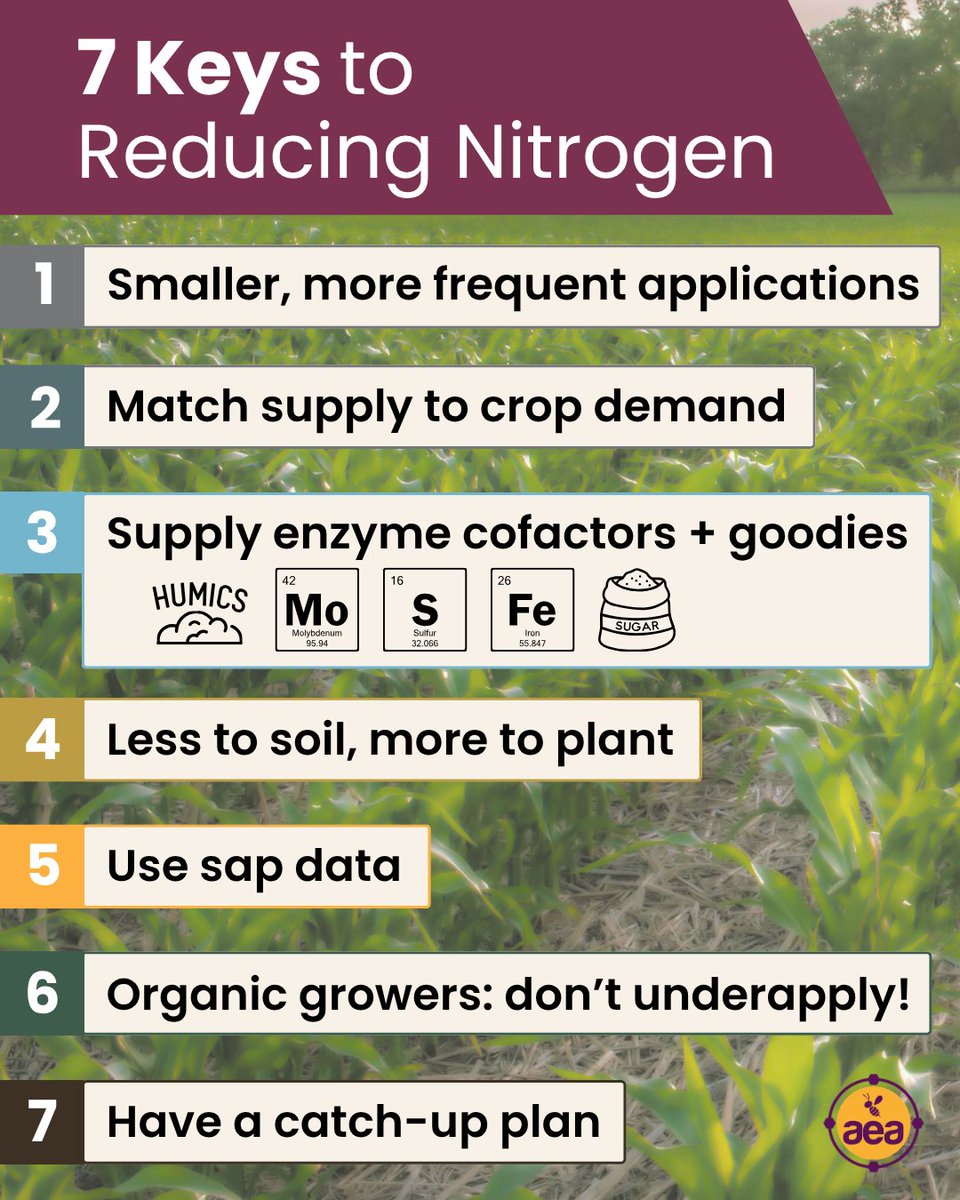
How to manage an offramp from synthetic fertilizers?
It's a delicate process to wean off synthetics while providing an onramp for biology to take over. Here are 7 keys we've distilled from our 20 years helping farmers implement biological systems.
We go into a lot more detail on our website: https://t.co/st9fQvH7gi
What would happen if we "rebooted" cattle to restore their innate herd instincts and selective grazing habits?
Bob Kinford joins John Kempf on the podcast to discuss:
➡️ The inherent intelligence and decision-making capabilities of livestock
➡️ Managing large herds across vast landscapes without fencing
➡️ Creating murmurations in cattle to guide their movement
➡️ The three-day “reboot” process that triggers cattle to begin eating highly nutritious invasive plants
➡️ Strategies for increasing animal weight gain by reducing stress associated with traditional feeding and moving
➡️ The relationship between animal bedding patterns and the development of mycorrhizal fungi in the soil
🎧 Listen: https://t.co/tMWehxRp10
Join our FREE webinar: Managing Brittle Environments with Adaptive Grazing
Learn how to navigate dry conditions, protect soil, and stay productive with practical, field-tested strategies.
�� Save your spot
https://t.co/7NVdxznkBh
These almonds in CA's Central Valley are getting fertigated with AEA's Soil Primer. The grower said the growth so far looks great!
Soil Primer should help to:
✅ Boost soil microbial populations
✅ Open up the soil for increased water penetration
✅ Improve soil structure and decrease soil compaction
We worked with another California almond farm that used Soil Primer in spring and fall as well as nutritional foliars to achieve 40% reduction in water use and 70% reduction in pesticide applications.
➡️ Read the case study: https://t.co/mb7jZu14Zt
➡️ More about Soil Primer: https://t.co/OYrd55zZ3Z
How much crop production can your soil support with the nutrients already present in it?
Bob Tillman's soil has enough potassium for 600 YEARS of production, and enough iron for 7 MILLION years. Bob used total nutrient digestion testing to discover the mineral reserves of his soil. And he's using biology to unlock it.
Bob founded @AltaColina Vineyard & Winery in 2003 in the steep terrain of Paso Robles, CA. He has spent two decades transitioning away from conventional methods to a biological approach centered on the natural resilience of his native ecosystem.
Today on the podcast, Bob and @JohnKempf discuss:
➡️ Transitioning to complete no-till after observing that native grasses were more effective than planted cover crops.
➡️ Using compost extracts and teas to inject biological activity directly into the soil through the irrigation system.
➡️ Providing ground cover with high-density native plant populations to support deep-rooted vines while maintaining high soil organic matter.
➡️ Using AEA and sap analysis to identify specific micronutrient deficiencies and adjust nutrition throughout the growing season through foliar applications.
➡️ Applying AEA products like CalGuard and Rebound Boron to address seasonal trending deficiencies in calcium and boron levels .
🎧 Listen: https://t.co/77GUjtZIc7
Is your problem a lack of fertility? Or too much?
Today on the blog, AEA Agronomist Katie Meyer questions conventional wisdom on fertility in market gardens. It's essential reading for every market gardener and compost-user.
"Fertility excesses, not deficiencies, underlie many of the weed, pest and disease pressures growers experience today," Katie writes. "And unless growers rethink how they interpret soil tests and how they time and scale fertility, these pressures only intensify as production increases."
She identifies problematic patterns to watch out for, essential nutrients for disease prevention, and an alternative way to think about compost.
📖 Read: https://t.co/ngJtlNurRY
We were honored to join Mayor Andre Dickens, Robles Partners, and Stream Realty for the ribbon cutting of the Upper West Market in Atlanta today.
Having a storefront in our state's capital will be a great way to share what we do with so many. We look forward to making our space feel a lot like our General Store in Bluffton!
We will keep you posted on the grand opening and hope you all will come to see us!
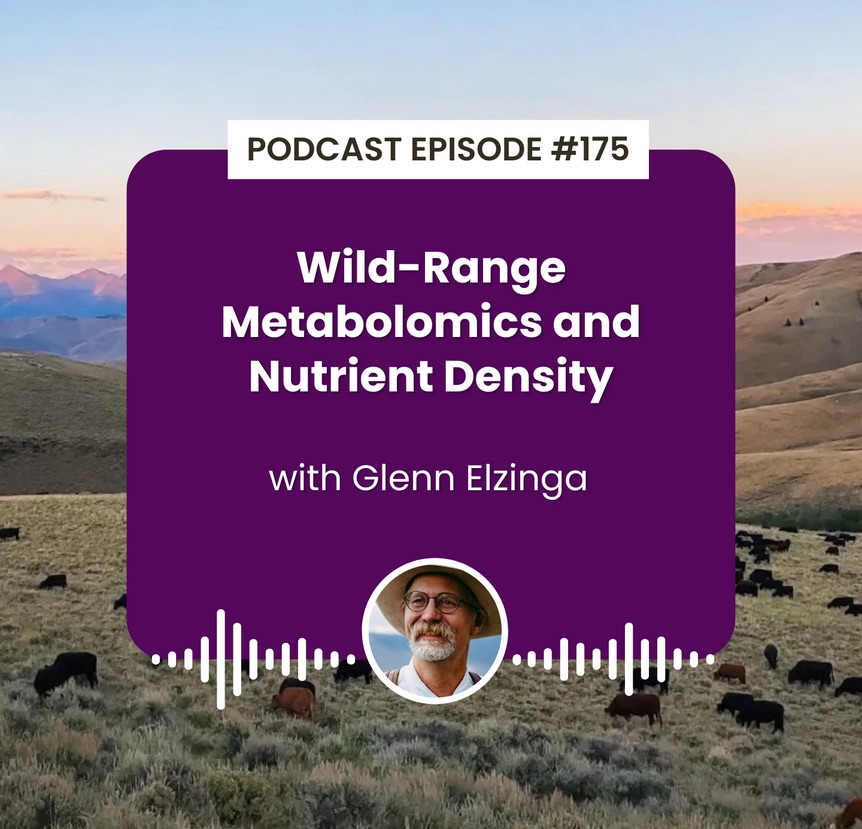
Glenn Elzinga is a co-founder of Alderspring Ranch: over 46,000 acres of wilderness rangeland in Idaho, where they have pioneered “inheritance grazing” by living with their cattle 24-7 on horseback.
In collaboration with researchers like Dr. Stephan van Vliet, Glenn has proven that grazing cattle on diverse wild ranges produces beef with significantly higher anti-inflammatory and antioxidant compounds compared to feedlot alternatives.
On the podcast, Glenn and @JohnKempf discuss:
➡️ Shifting from formulaic commodity agriculture to the “Wild West” of the regenerative space.
➡️ How human presence on the ground allows ranchers to coexist with predators like wolves.
➡️ Results of metabolomics research comparing wild-range beef to feedlot beef.
➡️ Nutritional wisdom: how cattle self-select plants for preventative medicine.
➡️ Why handling cattle with a focus on their left-eye perception reduces stress and improves performance.
➡️ Moving from horizontal expansion to vertical stacking to bring the next generation into agriculture.
🎧 Listen: https://t.co/2eRkfP7urL
There is a portion of farmers that hate these type of posts.
You shouldn’t be crying about it. You should look at it as the biggest opportunity of your life.
I travel a lot… and I try to get off the beaten path and get “lost” in the country.
IA is no different than IL or IN
I was in IA at @CalebAkin2 and saw a lemon and orange tree growing on a -25 morning
The technology, soil, people are here… but the system doesn’t allow it because the distribution of regional food has been blown up.
30 miles South of downtown Chicago
South of 10 million people
Flat black… 🌽 and 🫘
A complete waste of opportunity
The key Farmer skill going forward is salesmanship.
Those who can sell to end consumers will get premium pricing. As a Georgia Peanut grower tells it, he can sell a thousand pounds of peanuts from a 1/4 acre as peanut brittle or he can sell a thousand acres of peanuts to the mill for the same income. $4/bu corn is $65/bu retail cornmeal.
@FastCompany just named AEA one of the most innovative companies in Agriculture in 2026!
Innovation is baked into our DNA. It's how we'll scale regenerative agriculture to become the global norm.
This year was our most innovative yet. We released:
➡️ https://t.co/Oq72XHRuQ1: the world's first regenerative AI agronomist.
➡️ Pinion™: our first disease-control product, which has performed comparably to conventional fungicides against powdery mildew on grapes.
➡️ Revenant Charge™: low-cost soil biology boost for growers on a budget
➡️ Precision product blends for growers across the country
➡️ Groundwork Consulting
. . . in addition to our everyday ho-hum work of helping growers succeed at scale with regenerative agriculture in 100 different crops in all 50 states and 15 countries.
Read the Fast Company article: https://t.co/5DKLi1OdZf
#FCMostInnovative #soilhealth #regenerativeagriculture
While our Warm Season Grazing mix is popular for those looking to graze cattle, it’s also a good fit for smaller livestock as you can see in this video taken by our Marketing Director, Jonathan, last summer.
This mix is highly diverse and designed to be a hit for your livestock - both above and below ground.
The mix contains Forage Soybeans, Cowpeas, Mung Beans, Pearl Millet, Brown Top Millet, BMR Dwarf Sorghum Sudan, Forage Sorghum, Forage Collards, Sunflower, Turnip, Buckwheat and Okra!
And if you're looking for something specifically designed with goats and sheep in mind, try our Warm Season Sheep/Goat Mix which contains a higher rate of warm season legumes and features shorter growing plant varieties.
You can shop both of these mixes on our website! https://t.co/EP86gW7Rot
#CoverCrops #RegenerativeAgriculture #RegenerativeGrazing #AMPGrazing #GrassFedandFinished #CoverCropping #SoilHealth #GrazingGoats #GrazingSheep
Fantastic interview with @zebulousprime on the @stockcropper updates, new releases, and the 6 year process that has gotten them to where they are today. Give it a listen and share far and wide!