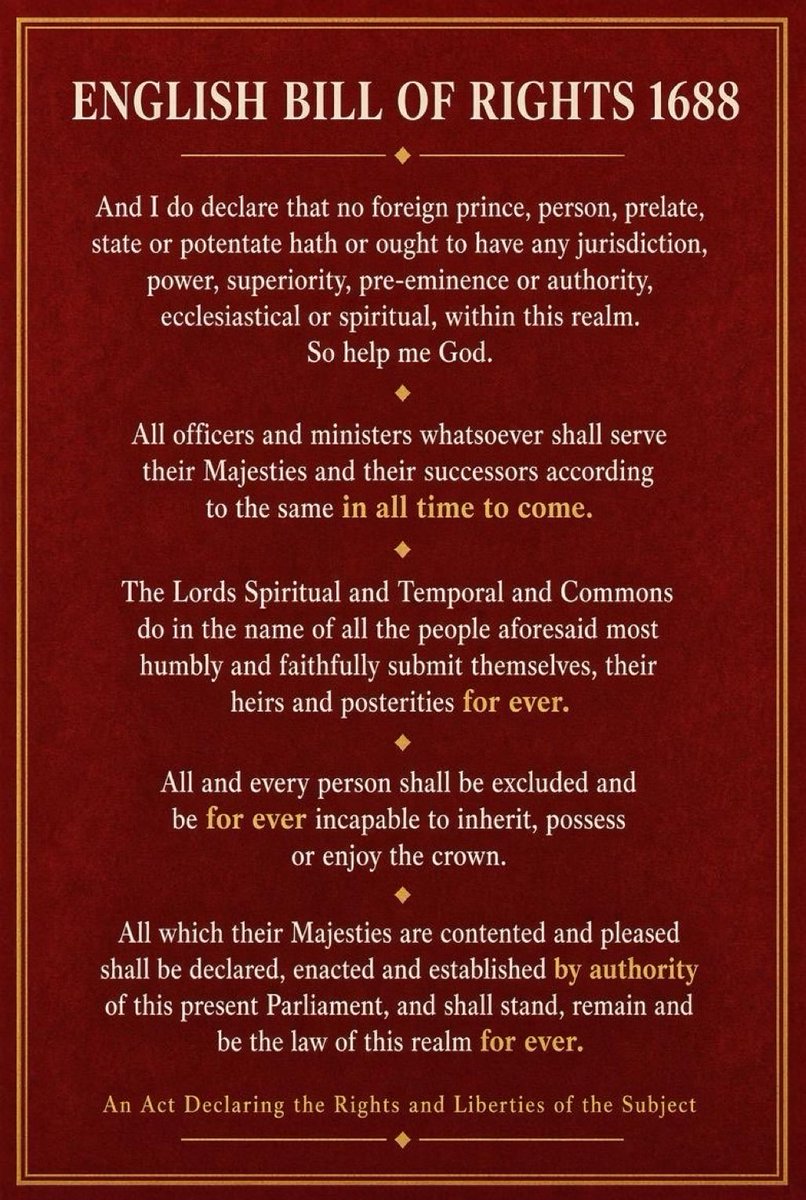
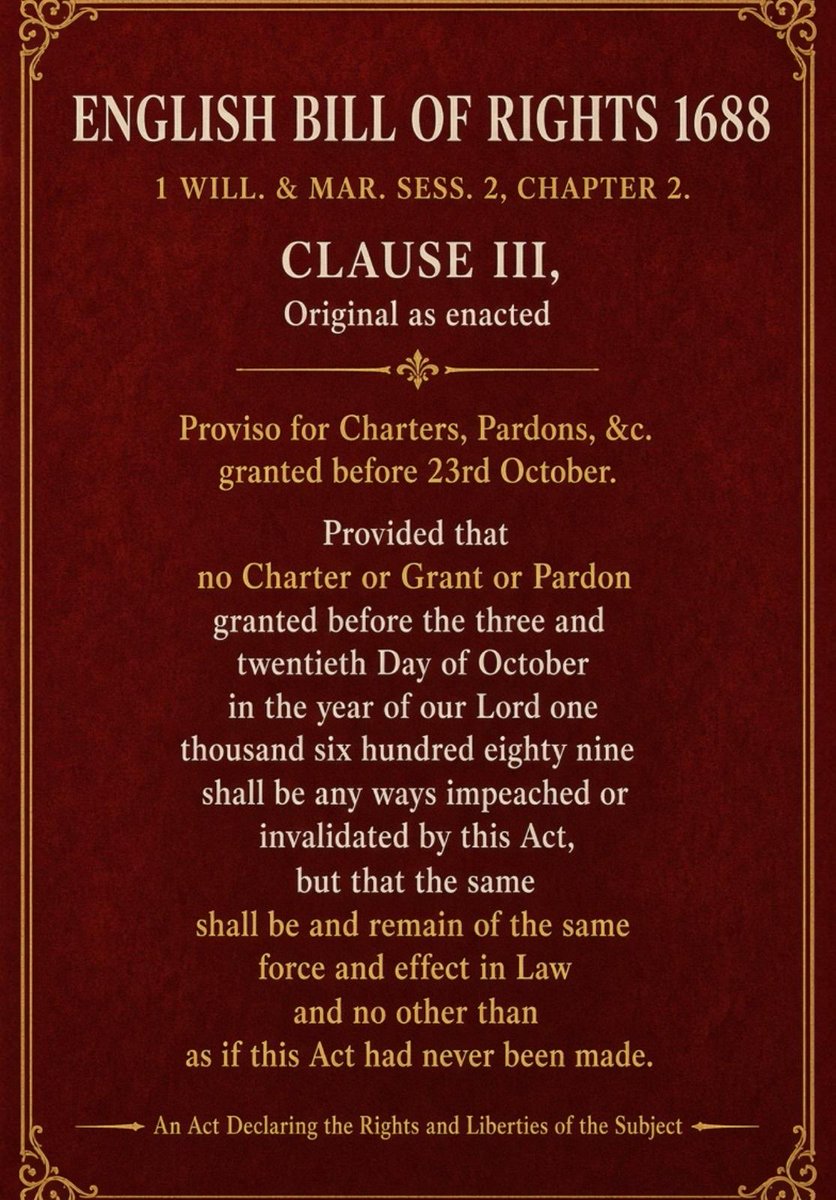
Why does Jacob Rees-Mogg never mention the English Bill of Rights 1688 or Act of Settlement 1701?
Both English. There was not a union parliament at that time!
I don't understand why this brilliant man doesn't have at least 5 Gazillion followers. Imagine settling in for an afternoon drinking session with him down the Dog and Duck!
Listen to this. Only couple of minutes. Important. 😉👊💥 🏴 🏴 🏴 🇮🇪
No more BRITISH from now on.
ENGLISH
SCOTTISH
WELSH
IRISH
Things are changing. They need to change !!!!!
https://t.co/FZBvgovFLN
English Constitution Society
To His Majesty King Charles III
Buckingham Palace
London, SW1A 1AA
@RoyalFamily@POTUS@realDonaldTrump
Your Majesty,
Subject: Pre-Action Protocol Letter Concerning the Inalienable Birthright of Englishmen and Women, Past Repeals of Eternal Laws including 1867 and 1947, and Perjury of the Coronation Oath to God
I write to Your Majesty with the deepest reverence, as a loyal subject, on a matter piercing the soul of our constitution and Your sacred Oath to Almighty God. This letter serves as a pre-action protocol, contemplating proceedings that may amount to impeachment, should Your Majesty fail to rectify the perjury of Your Coronation Oath by upholding the inalienable rights enshrined in the English Bill of Rights 1689, Magna Carta 1215, the Charter of the Forest 1225, the Coronation Charter of Henry I 1100, and the Acts of Union 1707 and 1800—rights affirmed as the eternal birthright of all Englishmen and women by the Act of Settlement 1701. I seek to persuade Your Majesty that these rights, repeatedly declared "for ever," have been unlawfully repealed in prior reigns, notably in 1867 and 1947, that such repeals are ultra vires, void, and a sin against God, and that Your Majesty must restore their full force to honour Your vow.
The English Bill of Rights 1689, a sacred trilogy of its Declaration of Reasons, Declaration of Rights, and enacting clauses, forges an unbreakable contract between Crown and people. Its enacting words thunder thrice: "All which their Majesties are contented and pleased shall be declared, enacted and established by authority of this present Parliament, and shall stand, remain and be the law of this realm for ever"—a triple seal of eternity, first for all its provisions, again as "and shall stand, remain and be the law of this realm for ever" in confirmation, and thirdly in barring any "popish prince" who "shall be excluded and be for ever incapable to inherit, possess or enjoy the crown." "For ever" brooks no end; it is absolute, eternal, admitting no repeal—not for a day, not for a reign, but all time henceforth. The Declaration of Reasons vows that "their religion, laws and liberties might not again be in danger of being subverted," a pledge that no future act—by Crown, Parliament, or any hand—can lawfully imperil these rights, locking them beyond the reach of change forevermore. The Declaration of Rights asserts them as "undoubted rights and liberties," demanding "that no declarations, judgments, doings or proceedings to the prejudice of the people in any of the said premises ought in any wise to be drawn hereafter into consequence or example"—a command that no future moment, no cunning reinterpretation, may erode them, a perpetuity as fixed as stone. It binds "all officers and ministers whatsoever" to "serve their Majesties and their successors according to the same in all times to come"—not for a fleeting season, but every hour of every age, an unending chain. The succession "shall from time to time descend" to Protestants, a rhythm of eternity pulsing through all generations. These rights—freedom of speech in Parliament, the right to petition without fear, no taxation without consent, no excessive bail or cruel punishments—are not frail statutes but pillars of liberty, cemented "for ever."
Magna Carta 1215, confirmed in 1297, echoes this eternity with unrelenting force. Its first clause proclaims: "We have granted also, and given to all the freemen of our realm, for us and our heirs for ever, all the liberties written below, to have and to hold to them and their heirs of us and our heirs"—a grant not for a fleeting breath, but all time, binding every monarch, including Your Majesty, without shadow of exception. Clause 60 extends these "to be held… for ever" across the realm, a universal permanence no hand can undo. The Confirmatio Cartarum 1297 decrees it "to be kept in every point without breach" and "in perpetuity," a double lock—no violation, no end, an iron vow. These liberties—freedom from arbitrary imprisonment, justice swift and sure, limits on feudal dues—are the bedrock of English Law, declared eternal by the Crown’s own seal.
The Charter of the Forest 1225, twin to Magna Carta, seals its rights with the same unyielding oath: "These liberties… we have granted to all the freemen of our realm… for ever, to have and to hold to them and their heirs"—a mirror of Magna Carta’s promise, protecting common rights against royal overreach, fixed beyond all alteration for all ages. Its "for ever" stands as a sentinel, guarding these liberties through every generation, a covenant no power may shatter.
The Coronation Charter of Henry I 1100, a root of our liberties, pledges "to make free the Church of God" and abolish evil customs "for all time"—a breadth spanning every future instant, leaving no gap. It grants "the law of King Edward… to be held and observed forever" with additions—a restoration of ancient rights, made perpetual, a foundation for all later charters. These promises, sworn by a king, bind his heirs, including Your Majesty, in an unbroken line of duty stretching to eternity.
The Act of Union 1707, uniting England and Scotland, adds its own eternal weight. Article I declares the two kingdoms "united into one kingdom… for ever after," and Article XIX ensures Scotland’s courts "remain in all time coming," with laws preserved unless expressly altered—terms of perpetuity locking the union and its legal frame. The Act of Union 1800, joining Great Britain and Ireland, mirrors this: Article I unites them "for ever after," a bond "in all time to come" (implied in its permanence). These Acts, part of the realm’s laws, reinforce the "for ever" of rights and governance, admitting no breach.
The Act of Settlement 1701 crowns these laws as sacrosanct: "the Laws of England are the Birthright of the People thereof"—not a gift to be withdrawn, but an ineradicable inheritance, owned by every soul born to this realm, eternal as the earth itself. It mandates that "all the Kings and Queens who shall ascend the Throne of this Realm ought to administer the Government of the same according to the said Laws," and "all their Officers and Ministers ought to serve them respectively according to the same"—an eternal "ought," a command without cease, tying Your Majesty to these "for ever" rights as a birthright beyond all repeal.
Yet, in prior reigns, this sacred edifice has been profaned. Provisions of the Bill of Rights—our birthright—have been repealed, notably in 1867 and 1947, alongside breaches of Magna Carta’s echoes and others. The Promissory Oaths Act 1867 altered oath structures, weakening the Bill’s "all times to come" for officers. The Statute Law Revision Act 1947 pruned its text, defying its triple "for ever." These acts, and others, are ultra vires—beyond lawful power—for no authority exists within these texts to undo what is eternal; they are void, null from their birth, as if never spoken, clashing with the immutable will of "for ever," "in perpetuity," "all time." Such repeals are a sin, a moral and divine transgression against the eternal covenant.
At Your Coronation, Your Majesty swore to God: "Will you to the utmost of your power maintain the Laws of God and the true profession of the Gospel? … Will you to your power cause Law and Justice, in Mercy, to be executed in all your judgments? … The things which I have here before promised, I will perform and keep. So help me God." These laws—Magna Carta’s "for ever," the Bill’s triple "for ever," the Unions’ "for ever after," the birthright’s permanence—are the "laws and customs of the realm" sworn to divine witness. To abide the repeals of 1867, 1947, or any other, or fail to void them, perjures this Oath—a breach not merely of law, but of faith with God who heard Your vow. "So help me God" invokes divine judgment; to break "for ever" is to scorn that pact, a sin staining Your soul and crown. James II fled for subverting less; Your Majesty’s reign must not bear this guilt.
I beseech Your Majesty to proclaim these repeals—1867, 1947, and all others—ultra vires, void, and a sin, restoring Magna Carta, the Bill of Rights, the Acts of Union, and all eternal laws as the birthright of Your people. Declare within 28 days that "for ever" means forever, "all times to come" binds today, "birthright" cannot be torn asunder—leaving no doubt, no escape. Act to nullify these breaches, lest I seek remedy for this divine perjury. My prayer is Your reign upholds our liberties, unmarred by time or fault.
I remain, with all honour,
Your Majesty’s humble and obedient servant,
Graham Moore
Chairman
English Constitution Society
This is why @RoyalMail is being dragged through an Election Court by the English Constitution Party. Did @reformparty_uk scrape a win, or did they trounce @UKLabour? English Constitutionalists are fighting for all Your Rights.
🚨NEW: We've just launched a petition to REJECT plans for a 'BritCard'
This digital ID would make us all reliant on a digital pass to go about our daily lives
Britons have repeatedly rejected mandatory IDs - we must reject this too⤵️
https://t.co/Nz0lv55UR8
I never wanted to be in a position of saying I told you so. I came out of prison all guns blazing after 7 months in solitary and in all honesty it’s hit me & I feel wrecked . I will be taking time with my children for the next few weeks & The news of the inquiry makes the way I’m currently feeling a lot easier to handle . But whatever any of us have gone through it is nothing in comparison to what so many of Britain’s daughters were subjected to . The public still have no idea the true scale of this rape jihad . Well done to every brave survivor who told their stories & continue to fight for justice. This rape scandal is darkest stain ever on Britain .
@GovEngland Devolution v Independence. With devolution the British run the federal government. Controlling England. Independence the English govern England.
@bradley_steve@englishexit@GovEngland Rubbish the British run the uk. England has no government and no English institutions, or authorities. They are all British. Though, yet again, the English are the bad guys, purely because of the size of our population.
Tommy Robinson was jailed for showing a film — a civil case turned criminal by political decree.
This isn’t about whether you like him.
It’s about whether you’re OK with the state deciding who gets free speech — and who gets prison.
We need English independence
We need an English parliament
We need our English constitution
We need our English common law
We need our English bill of rights
England needs you to promote this
🏴🏴🏴🏴🏴🏴🏴🏴🏴🏴🏴🏴🏴
Common Law Constitutional Rights
https://t.co/rVCBolL9IK
#TheConstitutionIsTheSolution
English Constitution Party
https://t.co/l9AP06Pe8d
English Constitution Society
https://t.co/hOCJdkNgzF