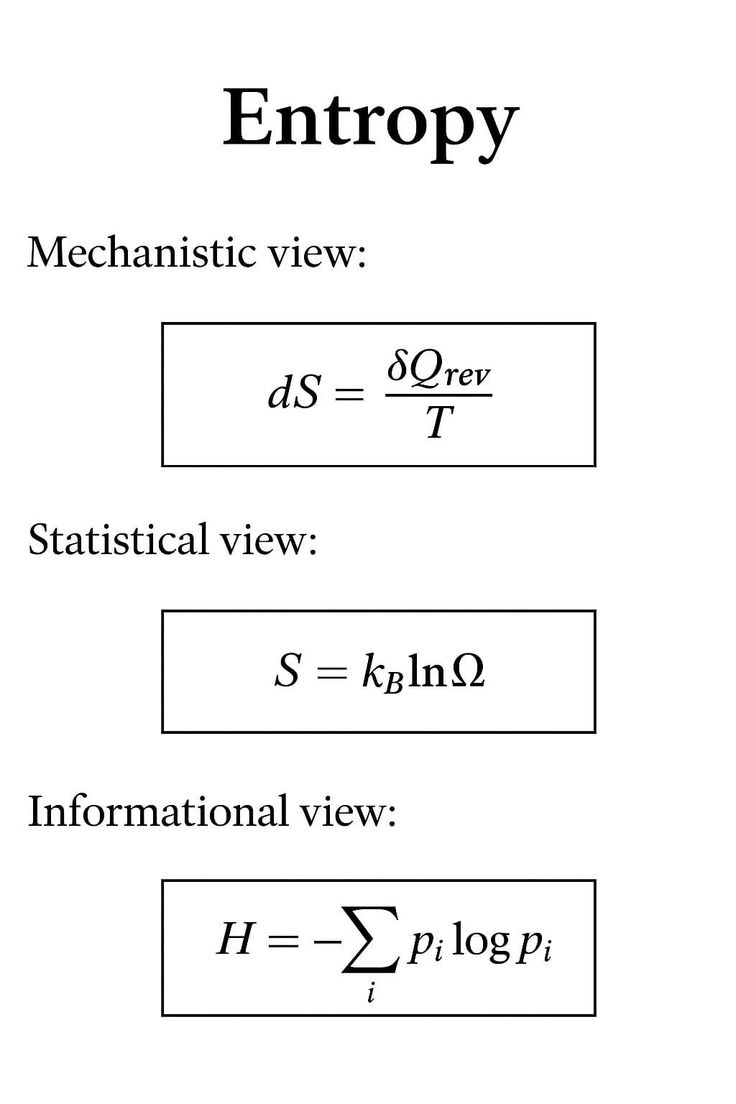
Entropy shows up in engines, molecules, and your phone’s data. This graphic lays out three perspectives.
Mechanistic: dS = δQ_rev / T for reversible processes. Statistical: S = k_B ln Ω linking to microstate count. Informational: H = −∑_i p_i log p_i for probability-based uncertainty.
These concepts power real-world tech like high-efficiency turbines in power plants, explain why cream mixes into coffee irreversibly, enable JPEG and MP3 compression to shrink files, and help train AI by measuring how much new info each prediction adds.
Biological Neuron vs. Artificial Neuron (Perceptron with Sigmoid Activation)
A biological neuron receives input signals through dendrites, integrates them at the cell body (soma/nucleus), and fires an output signal along the axon if the combined input exceeds a threshold.
Mathematically, this is modeled as an artificial neuron:
> Multiple inputs X₁, X₂, …, Xₙ are multiplied by their respective weights W₁, W₂, …, Wₙ.
> The weighted sum is adjusted by a bias term B:
Z = Σ WᵢXᵢ - B
> A nonlinear activation function (here the sigmoid) is applied:
Output = 1 / (1 + e^(-Z))
This produces a smooth output signal between 0 and 1, mimicking the neuron’s firing behavior in a differentiable way suitable for machine learning.
Volume of a Sphere using Spherical Coordinates
Spherical coordinates:
x = ρ sinφ cosθ
y = ρ sinφ sinθ
z = ρ cosφ
dV = ρ² sinφ dρ dφ dθ
Limits: 0 ≤ ρ ≤ R, 0 ≤ φ ≤ π, 0 ≤ θ ≤ 2π
V = ∭ dV = ∫₀^{2π} ∫₀^π ∫₀^R ρ² sinφ dρ dφ dθ
Integration steps:
> ρ first: [ρ³/3] from 0 to R → R³/3
> φ next: ∫ sinφ dφ from 0 to π = 2
> θ last: ∫ dθ from 0 to 2π = 2π
Final result: V = (4/3) π R³
This derivation is fundamental in physics, astronomy, fluid dynamics, and engineering for calculating volumes of spherical objects such as planets, droplets, cells, and particles.



![mathemetica's tweet photo. Volume of a Sphere using Spherical Coordinates
Spherical coordinates:
x = ρ sinφ cosθ
y = ρ sinφ sinθ
z = ρ cosφ
dV = ρ² sinφ dρ dφ dθ
Limits: 0 ≤ ρ ≤ R, 0 ≤ φ ≤ π, 0 ≤ θ ≤ 2π
V = ∭ dV = ∫₀^{2π} ∫₀^π ∫₀^R ρ² sinφ dρ dφ dθ
Integration steps:
> ρ first: [ρ³/3] from 0 to R → R³/3
> φ next: ∫ sinφ dφ from 0 to π = 2
> θ last: ∫ dθ from 0 to 2π = 2π
Final result: V = (4/3) π R³
This derivation is fundamental in physics, astronomy, fluid dynamics, and engineering for calculating volumes of spherical objects such as planets, droplets, cells, and particles.](https://pbs.twimg.com/media/HJbF-AfaQAAZ5uM.jpg)


