You can migrate every mailbox and still fail Day 1.
216 Microsoft 365 tenant-to-tenant migrations. 1.83 million users moved.
The biggest lesson? The tool was never the hard part.
Identity, governance, ownership, and business decisions determine success.
My 6-route, 5-gate playbook 👇
#Microsoft365 #TenantMigration #Copilot
https://t.co/v90stliVX1
BYOAI (Bring Your Own AI - Think BYOD except way worse) is one of the most ignored risks in IT. I sincerely mean that.
Your employees’ personal AI can reach company data through phones, meeting tools and connectors.
Who approved that access?
My white paper + risk assessment:
https://t.co/AnYrQiCYu1
My Linkedin Article: https://t.co/p0owa9pmEk
Before an AI agent changes a customer record, who authorizes it?
Microsoft-Decision-1 can score the proposed action. Your company still owns the permissions, approval, and outcome.
I break down the controls in my latest article below.
#AIGovernance
https://t.co/bOTR7fmSXd
What You Need to Know: Microsoft's October 13, 2026 Deadline
A Windows 10 PC running Office LTSC 2021, talking to a Windows Server 2012 file server.
Without action, on October 14 that chain is unsupported at every link. October 13, 2026 is three Microsoft deadlines in one day.
Count before you buy.
#Windows10 #Microsoft365 #WindowsServer
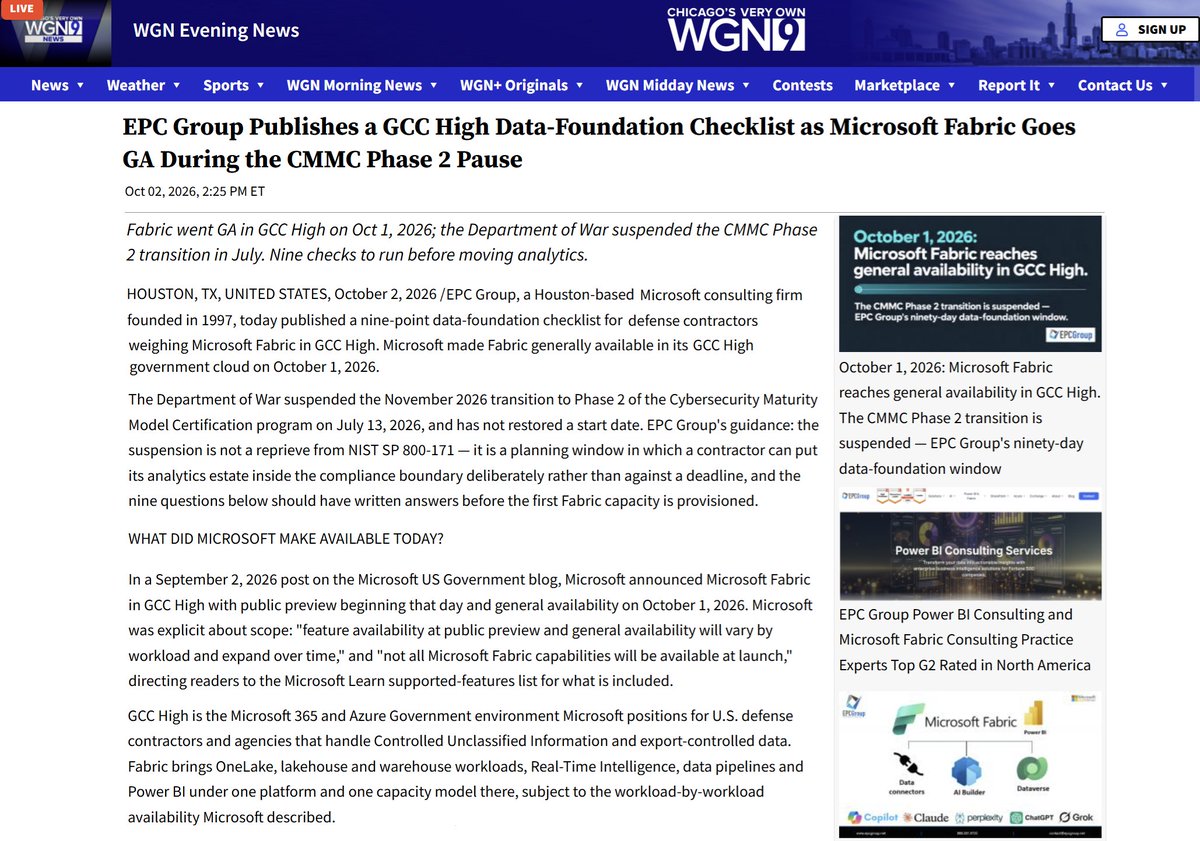
The CMMC Phase 2 pause is not a reprieve from NIST SP 800-171. It is a planning window.
Two dates matter for every defense contractor running analytics:
→ July 13, 2026: the Department of War suspended the November 2026 transition to CMMC Phase 2. No restored start date has been published.
→ October 1, 2026: Microsoft Fabric reached general availability in GCC High.
Put them together and the question changes. It is no longer "can we move Power BI and our program data into Fabric?" It is "have we written down what happens when Controlled Unclassified Information lands in OneLake?"
So we published a nine-point data-foundation checklist. Nine questions that should have written answers before the first Fabric capacity is provisioned:
1. Is the workload actually available in GCC High today?
2. Is the Fabric workspace inside the assessment scope?
3. Is identity mapped before data?
4. Are the items that will hold CUI labeled?
5. Where do Fabric and OneLake audit events land?
6. What is the capacity posture, in writing?
7. What is an agent allowed to do?
8. Which workload goes first?
9. What leaves the commercial cloud, and when?
The checklist incorporates TAR-8, our open 8-Surface Tenant AI Readiness Standard, and maps to the five question families an assessor asks about an analytics platform.
The nine-point checklist: https://t.co/4IxnOCCJKb
The TAR-8, the 8-Surface Tenant AI Readiness Standard: https://t.co/DMqDCuit46
Multiple models. One truth.
#MicrosoftFabric #GCCHigh #CMMC #Microsoft365 #GCCHigh #PowerBI
Your Copilot readiness report tells you who's licensed.
It can't tell you what an AI can find, change, retain, or transmit once it's inside your tenant.
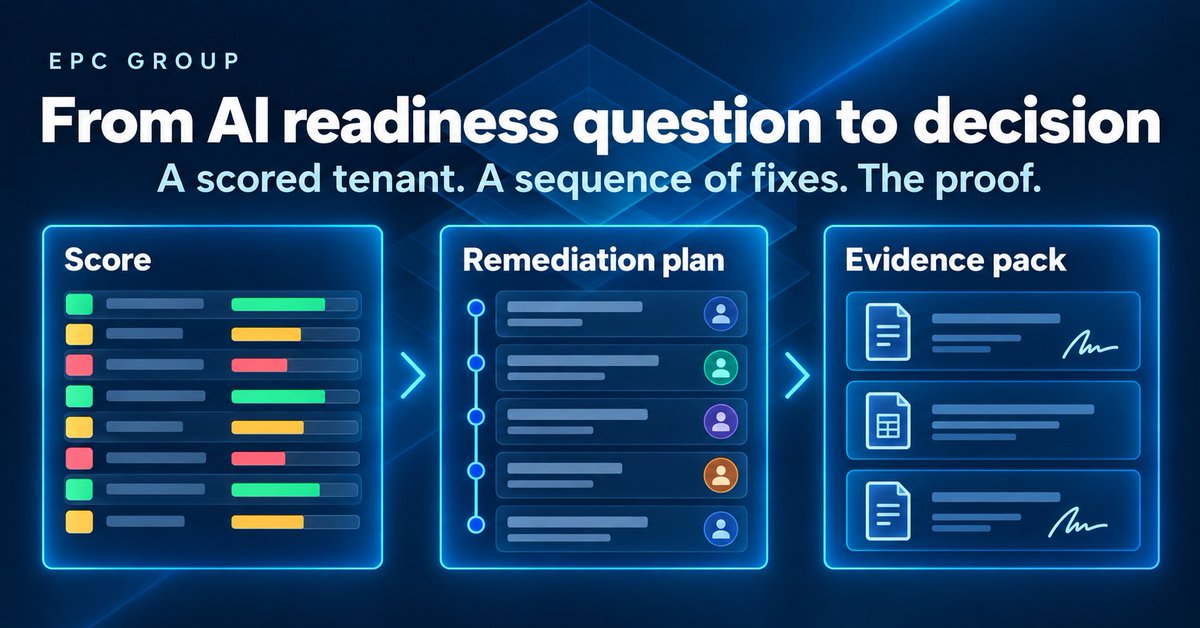
TAR-8 answers that. 8 surfaces. 24 points. Evidence for every score.
Free: https://t.co/DMqDCuit46
#Microsoft365 #Copilot
Seven consecutive quarters.
G2 named EPC Group a Leader in Business Intelligence Consulting for the 7th straight quarter, plus Momentum Leader for Fall 2026.
Verified client reviews. Not applied for. Not purchasable. Backed by our Evidence Center.
#PowerBI#MicrosoftFabric
Microsoft Fabric IQ Just Turned Every Power BI Semantic Model Into the Trust Layer for Enterprise AI
The article covers Fabric IQ, Copilot in Power BI, Fabric Data Agents, semantic-model governance, row-level security, sensitivity labels, Microsoft Purview, and the 90-day readiness plan.
For help with Microsoft Fabric, Power BI semantic-model governance, Copilot readiness, or enterprise AI governance:
[email protected] | 888-381-9725 |
https://t.co/frzXmQzOUw
#MicrosoftFabric #FabricIQ #PowerBI #MicrosoftCopilot #EnterpriseAI #DataGovernance #AIGovernance
Microsoft just changed the strategic value of every Power BI semantic model your organization owns.
With Microsoft Fabric IQ, semantic models are no longer only powering dashboards.
They are becoming the trusted grounding layer for answers produced by Microsoft 365 Copilot Chat, Copilot Cowork, Fabric Data Agents, and future AI-powered applications.
That means the measures, KPI definitions, row-level security, sensitivity labels, business terminology, and lineage your teams have built now determine whether enterprise AI answers are trustworthy—or merely convincing.
The central issue with enterprise AI is not whether it can produce an answer.
It is whether the answer is grounded in the right metric, the right definition, the right data, and the right security context.
https://t.co/zaX7OVMaTu
In this article, I explain:
• What Microsoft Fabric IQ actually is
• What is changing with Copilot in Power BI
• Why Power BI semantic models are becoming the enterprise AI trust layer
• Why many organizations are not yet ready
• How to certify semantic models for AI grounding
• A practical 90-day Fabric IQ readiness plan
The organizations that spent years governing their semantic layer just discovered that they were not only building business intelligence.
They were building the foundation for trusted enterprise AI.
Is your Power BI semantic layer ready to ground every AI answer your organization produces?
Nearly half of the CFOs we interviewed have never held the AI governance meeting that matters.
Yet their companies are buying Copilot, Claude, ChatGPT, Gemini, Perplexity, etc... funding agents and calling it transformation.
The CIO runs the platform. The CFO owns the exposure.
My new article: https://t.co/HRKfUFWLI0
#AIGovernance #CFO
Accenture called it an “isolated matter.”
Every CIO should ask a harder question:
Isolated from what?
- From Accenture’s operations?
- From client environments?
- From source-code repositories?
- From Azure credentials, storage keys, tokens, or configuration files?
https://t.co/veYN6EAbNr
Those are not the same thing.
This article explains the seven questions every board, CIO, CISO, CFO, and General Counsel should ask after a consulting-partner security incident.
It also examines a larger issue:
How much access should any global integrator possess—and who is independently verifying that access?
Read the article below as its a full technical analysis, vendor-risk framework, rate comparison, and 30/60/90-day response plan:
#Cybersecurity #VendorRisk #Accenture #AISecurity #CIO #AIGovernance #MicrosoftSecurity