فضيحة تاريخية يجب أن يشاهدها العالم أجمع
الوزير الإسرائيلي يُخاطب الجنود الإسرائيليين قبل دخولهم غزة قائلاً: "أمسكوا بالأطفال الرضع في غزة وحطموا رؤوسهم على الصخور"
An Israeli unit's "homecoming" party featured a display of their well-documented annihilation of southern Lebanon's villages, met with cheers and laughter from crowds of soldiers, their relatives, and family members.
It is a scene impossible to see anywhere but Israel.
Kau ingat kau ada 100 masalah dalam hidup ni.
Sampai satu hari kau dapat masalah kesihatan... baru kau sedar.
Sebenarnya kau cuma ada satu masalah je.
Jaga kesihatan.
Segala yang lain boleh diselesaikan, tapi kesihatan tak ada, semuanya jadi sia-sia.
Spanish actress Georgina Amoros shares on Instagram
“The craziest thing about this Timothy Chalamet drama with kyile jenner is that Israel bombed 97% of the schools in Gaza”
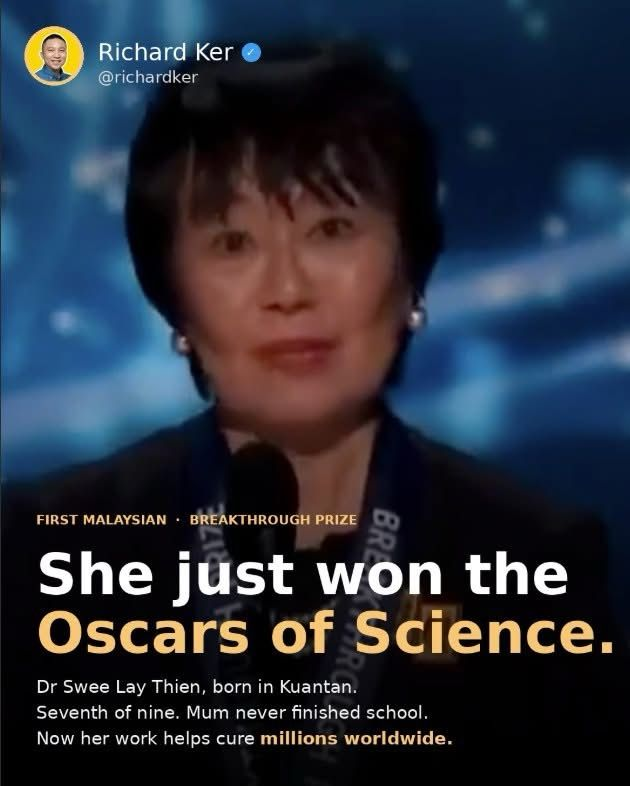
She was born the seventh of nine children in Kuantan.
Her father was a public servant who got transferred all over the country, so she grew up moving between small towns.
Her mother never finished school. But her mother worked harder than anyone she knew, and believed education was everything.
That belief sent Swee Lay Thein to medical school at Universiti Malaya. She graduated in 1975.
Then she moved to the UK and spent the next 20 years chasing one stubborn question. Why do some patients with blood disorders suffer terribly, needing transfusions their whole lives, while others barely feel sick?
The answer was hidden in a gene. Babies are born producing a special kind of hemoglobin that protects them. Then the body flips a switch and stops making it.
Swee Lay wanted to know what controlled that switch. If you could keep it on, you could save millions of lives.
It took her decades. She travelled across the UK collecting blood samples from families. She flew to Malawi to study a single family with 270 members across seven generations. She hit dead ends. She kept going.
In 2007, she and her team found the gene. They called it BCL11A.
That discovery led to Casgevy, the first FDA-approved CRISPR therapy for sickle cell disease and beta-thalassemia. A real cure. Already changing real lives around the world.
Last month, Dr Swee Lay Thein stood on a stage in Los Angeles and accepted the Breakthrough Prize, often called the Oscars of Science.
She is the first Malaysian-born scientist to ever win it.
In her speech she said, "As a child hanging out with my older brothers, playing on old railway tracks in Malaysia, I never imagined being here today."
She dedicated the moment to her mother. The woman who never finished school.
A girl from Kuantan. A mum who believed in education even though she never got one herself. A daughter whose work is now saving lives around the world.
That is a Malaysian story.
Tahniah, Dr Swee Lay Thein. We see you. We are proud. 🇲🇾
I still have nightmares about my SPM exams.
SPM is Malaysia’s national school leaving examination. The result that is supposed to determine your entire future.
I sit back in that hall, unprepared and the questions make no sense. I wake up unsettled. Even today.
The reason I wasn’t ready was simple. While everyone else was studying, I was on the computer building websites. For my school. For my hometown of Tawau, a small town on the east coast of Sabah, Malaysian Borneo.
All unpaid. Nobody asked me to do it. I just wanted to. Learning HTML. Figuring out how the internet worked. It felt like play. It wasn’t serious.
I almost failed my SPM.
In Malaysia, your SPM results decide whether public universities accept you or not. Mine were not good enough. Every single one rejected me.
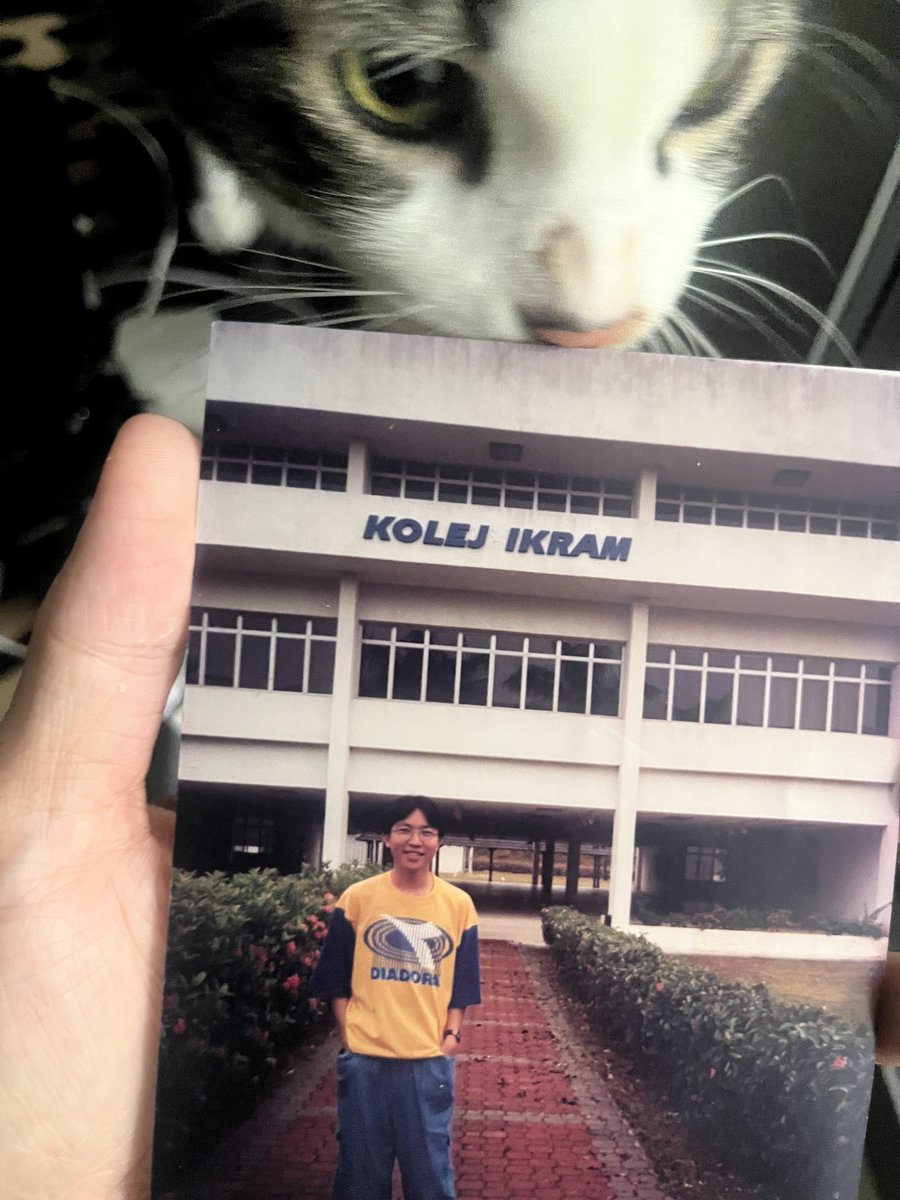
I ended up at Kolej Ikram, a small private college in Kajang, just outside Kuala Lumpur. Not what I planned. Not even close.
But at Kolej Ikram, I met Khairul Najmi. My English lecturer. Many Malaysians will know him as a coach on Akademi Fantasia, the country’s most watched talent competition at the time.
He helped me apply for a MARA study loan. MARA is a Malaysian government agency that funds education for students who need support.
That loan took me to the UK to study Electronics Engineering. And oh boy… that was 1000 times tougher than SPM. 😂
And yet here I am today running a digital agency built entirely on content and storytelling.
One person changed the direction of my life.
And those late nights building websites? The thing that nearly failed me? That became the foundation of everything I do today.
Most of it started from a teenager in Tawau who couldn’t stop tinkering on the internet. For free. Just because he loved it.
A few things I learned from all of this:
1. The thing distracting you today might be preparing you for tomorrow. You won’t know until later.
2. One bad result does not decide your future. It just feels that way at the time.
3. And the person who changes your life is not always who you expect. Sometimes it is someone well known but you meet them not on a stage, not on television, but quietly in a classroom.
4. Sometimes the wrong path is exactly where you needed to go.
5. Life will never be in a straight line. You can plan for the best but life has other plans for you.
Thank you for reading this story. Have a great day. And follow for more.
This is horrifying and barely getting media coverage.
Trump set April 30 as a deadline for the Zambian Govt. They must either accept Trump's new health funding agreement to have access to critical AIDS meds—and thus give the USA expanded access to its precious mineral resources like copper, lithium, and cobalt—or let its citizens die due to lack of vital AIDS medications.
Zambia is 98% Christian. Christians will die as a result of Trump's extortion. Notice how MAGA is wholly silent? Barbaric.
In case anyone isn’t aware, Trump is demanding Zambia to hand over its mineral rights by end of day tomorrow or the U.S. gov’t will cut off the country’s access to the AIDS medications that are literally keeping its citizens alive.
Just thought y’all should know.
Here is the complete architecture of how you keep a poor country poor while convincing its educated class that this is their own fault:
Step one: During colonialism, extract capital, destroy domestic industry, structure the economy around export of raw materials.
Step two: Grant formal independence while maintaining the economic structure, the debt obligations, the currency arrangements, and the trade relationships established under colonialism.
Step three: When the economy underperforms, as it must, being structurally designed for extraction, not development, offer loans conditional on policies that deepen the existing structure.
Step four: Train the country's economists in Western universities where the theories taught do not acknowledge steps one through three as economically relevant.
Step five: Staff international institutions and domestic finance ministries with these economists.
Step six: When the policies fail, attribute failure to cultural factors, corruption, and weak institutions.
Step seven: Publish a report with recommendations.
Step eight: Return to step three.
The machine runs on its own now.
The colonial administrator retired.
The indebted finance minister presenting his structural adjustment plan to the IMF board doesn't think of himself as administering colonialism.
He has a PhD from LSE.
He genuinely believes the model.
This is not a conspiracy.
It is an education system.