You don’t need to stay to do good research: work that aims to scale to much more intelligent systems can almost always be done on publicly-available models. (And nobody can think creatively in such pressure cookers.)
You don’t need to stay to gain influence, because you’re almost definitely too scared to wield that influence in ways which matter (see the tweet on public criticism above).
You don’t need to stay to generate scary demos or warn policymakers: we will be swimming in warning shots before long.
You don’t need to stay to advance AI capabilities, even if you’re worried about the latest bogeyman your CEO has constructed: “we need to do it to beat the bad guys” is a big part of what makes people the bad guys.
You don’t need to be there to implement guardrails or other short-term mitigations: there are plenty of bright young things eager to slot into your place in the machine.
You don’t even need to be there to feel rich and powerful. For one, you’re probably already rich (and there’s plenty of money up for grabs elsewhere). But more importantly, the sense of power is almost entirely illusory. Everyone involved has locked themselves into a mindset where they’re incapable of making real choices, except for how fast to barrel down the train tracks that their fear has laid out for them. (More on how that happens in my QT below.)
The world is more open-ended and malleable than it’s ever been. A single person who’s thinking clearly and creatively could build things that have never yet been imagined. Or they could just keep spinning in place. At this point AGI company employees owe it to both the world and to themselves to do something better.
people on here are thinkers so they assume that reasoning about alignment is the hard part and making sure millions(1) of task types, environments, and their respective virtual machines are configured correctly is the easy part but it’s essentially the opposite. you need to have worked in a large technology organization to appreciate the complexity and unreliability of this intuitively
(1) made up order of magnitude
Recently I've flipped from being bullish to being bearish about AI.
I think I'm updating my bearishness to be more solidly bearish. Early thoughts (which I hope to be disproven in the next year or so, I would prefer progress) and my reasoning:
The whole 'it turns out if you keep training and scaling the models more they develop broad new capabilities in lots of domains' thesis is wrong (sorry Demis). The recent batch of models haven't got more general, they've got less general. This is most obvious in the fact that their language outputs have got much worse in comparison to e.g. o3. If they were gaining generalist capacities we would expect them to be describing their work in ever more graceful and comprehensive prose!
The image that was being shared as the AGI thesis (November 2025, Tomas Pueyo) was the spiky bubble that has a current spike or two out past human capabilities (e.g. on coding or math) but below human on other capabilities on the other spikes - the future prediction was that as the models scale/advance, every spike would grow bit by bit until the whole center encompasses the human capabilities, with super-superhuman on some spikes. I think it seems like what's actually happened in the last few models has been that the coding/math spike has grown, but leaving behind or even at the cost of the other spikes. The models are no better at some simple logic, language (and sometimes worse!).
This makes sense from a simple RL perspective; you can't RL something endlessly on one domain of tasks and expect it to improve on the other tasks. The fact that early LLMs did seem to improve generally was a byproduct of the written language corpus covering everything - that corpus is general, so training it on that gave the appearance of something generally intelligent and becoming more generally intelligent as it got better at replicating that corpus. But the actual logic and underlying ground truths behind the language aren't captured efficiently enough and weren't effectively RLd in - they top out at some point (I guess this happened around the time that there was the 'has scaling hit a wall' discussion in late 2024). Chain of thought was then a genuine breakthrough, along with web search, which plugged into that general LLM global-corpus intelligence to lead to post 2024 gains.
The AI companies have since worked out that coding works (and pays) really well (basically this is because the entire job is nearly perfectly recorded and exists as training data, and you can set up clear benchmarks and rewards). The recent models (and benchmarks) have been maxxing that and we've seen degradation on normal English use for that reason. This could still be transformative, leading to extremely powerful (and potentially dangerous, particularly in cyber security) models but it's not a pathway to AGI.
I'm probably at about 40% confidence about this. It fits my current observations of AI progress and has a basic explanatory model. It doesn't account for potential breakthroughs, which is a major reason for discounting.
To make some predictions, I guess if I'm right this will become broadly apparent and more widely acknowledged in the next year or two, as we see how the spikiness of models that keep getting released develops.
Maybe there will be efforts to concentrate on specific spikes e.g. health or law which require going back to earlier models and RLing on a different data set/with different rewards/benchmarks. Maybe those separate models can be linked together to give a more apparently general model. How capital intensive that is/the potential profitability will be a defining question. But I just don't see general abilities emerging atm, and I don't think we will any time soon. Good news - a whole industry of tackling important specific problems/sectors can open up!
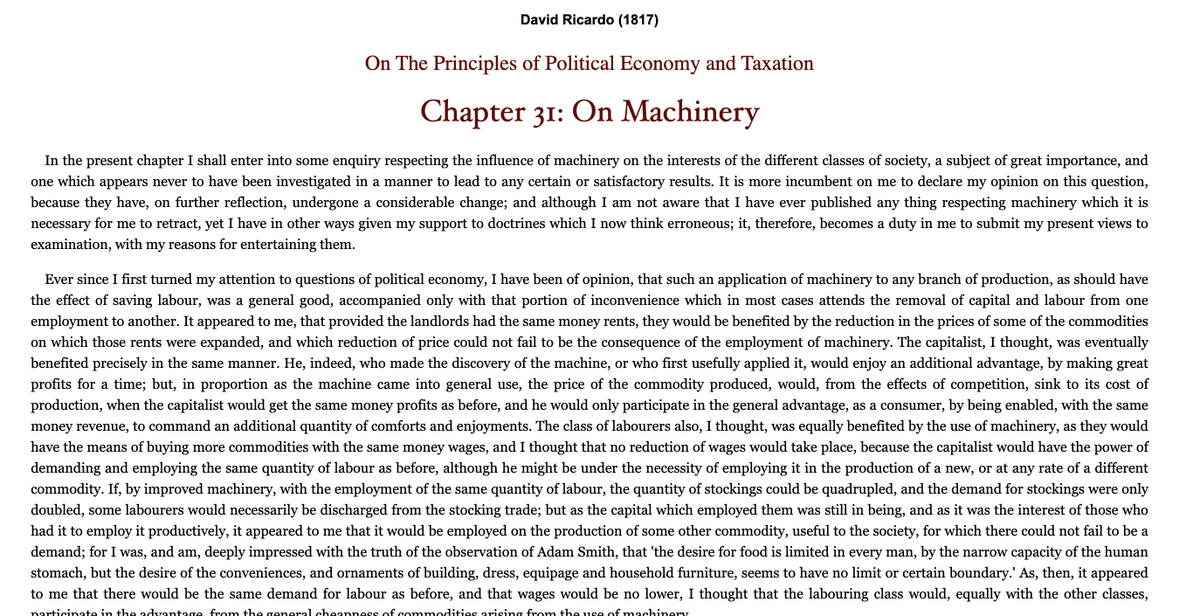
New rule: Anyone who is about to write a "all workers will be replaced by machines" essay needs to first read On Machinery by David Ricardo (yes, that David Ricardo), because he probably wrote your essay...in 1817.
Some takes about RSI from discussions with many smart researchers & thinkers:
1. Many RSI (or automated AI R&D) debates converge to similar cruxes: is a 1000x sample efficiency improvement possible, can you just simulate reality and train on it with no sim2real gap, can we easily make models good at "fuzzy" tasks? People like to assume that automated research agents will find such breakthroughs specifically *because* without them, progress could be heavily bottlenecked on data or continued compute scale-ups.
2. The Yudkowsky "genius brain in a box" framing of ASI has latent influence on many researcher views even though people may not be aware of it. A common move is to "flip" predictions, as they go further out, from assuming LLM or deep learning-specific properties of future AI to assuming "von Neumann x1000", human brain-like properties. I'd like to see more thought-out reasoning of why this flip should occur at any particular point (eg pre or post automated AI R&D)—this question is a crux behind many predictions like AI 2027.
3. There are some cracks in this worldview beginning to show: predictions from a few years ago that models would be less jagged now than they are, or that they would be more deceptive, synthetic data would work better, etc. Many of these seem like prediction errors from imagining future models as a "human brain in a box", but LLMs are empirically a different kind of intelligence. Most models of software-only intelligence explosion are also coarse enough to mostly ignore properties of LLMs.
4. Views about fast RSI progress seem to be correlated with (a) belief that synthetic data is all you need (b) belief in very high GDP growth and an industrial explosion because of automated firms (c) having worked only in AI research or in small organizations.
5. Key technical things to track over the next 1-2 years: does RL increase in its generalization, AI lab data spend, can we automate synthetic RL env construction, best practices for FDEs deploying AI into large enterprises, coherency of AI personas, how powerful will multi-agent scaling of test-time compute be, and continual learning.
6. Overall I think the "RSI leading to *fast* takeoff" frame had huge alpha in 2022, moderate in 2024, and potentially is of neutral usefulness in 2026 for predicting the future.
does anyone out there believe that simple minds can do things that more complex minds cannot do? If so, can you help me figure out, what are examples of those things?
🏆 Massive shoutout to our hackathon winners!
🥇 Banana Guesser — @alessandroduico@eskoskin@MundadaM
🥈 Team Orbit — @deviamar622@jeewoo_meche@GTanvi_
🥉 BlaBlah VC — @RVAClassic@BeomsooSon @selenemiyu
A big thank you to all teams who participated — we loved the energy, the creativity, and finally meeting our community in SF.
Can’t wait to meet more of you soon. 🚀
🚨Ilya Sutskever finally confirmed
> scaling LLMs at the pre-training stage plateaued
> the compute is scaling but data isn’t and new or synthetic data isn’t moving the needle
What’s next
> same as human brain, stopped growing in size but humanity kept advancing, the agents and tools on top of LLMs will fuel the progress
> sequence to sequence learning
> agentic behavior
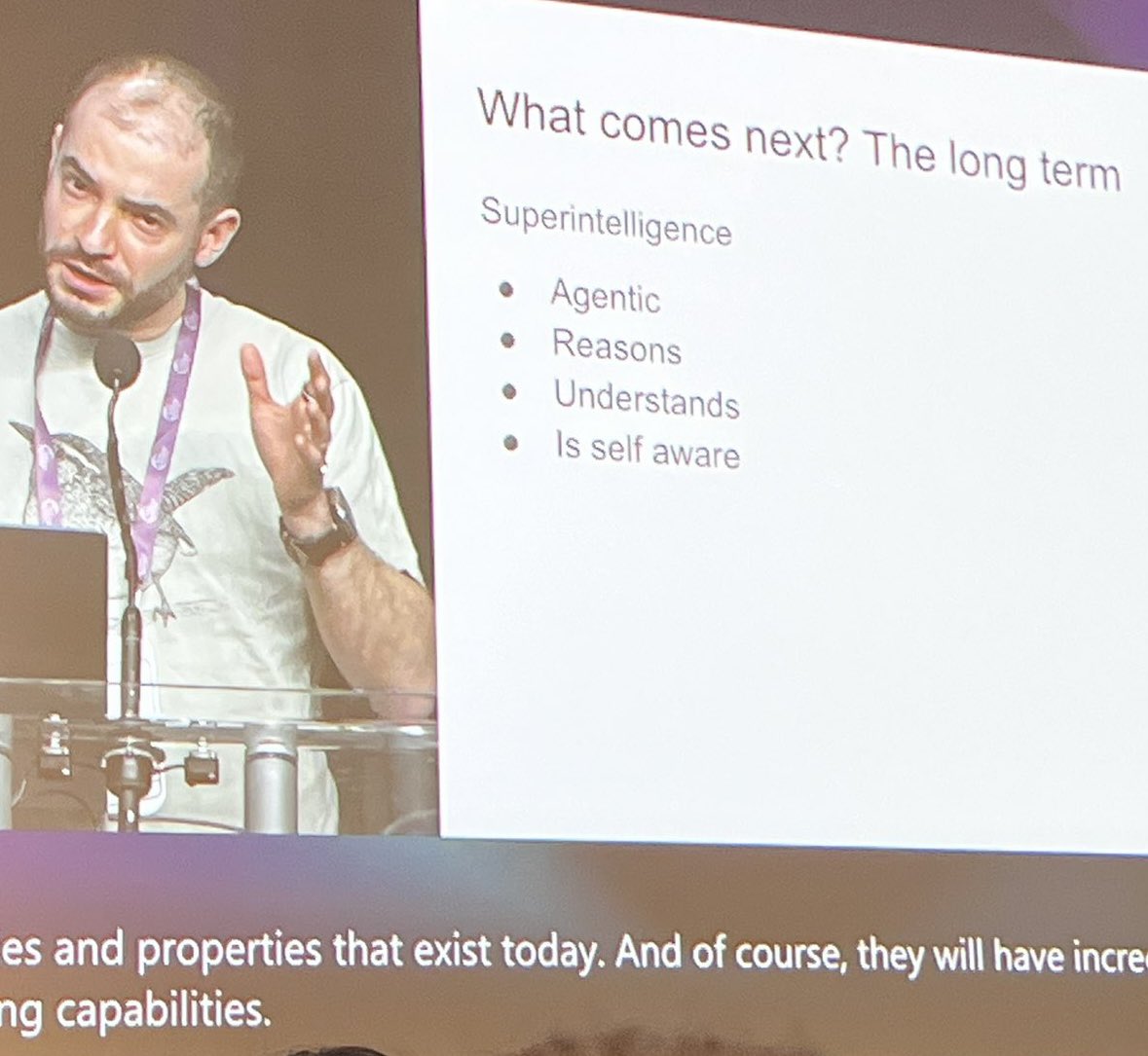
> teach self awareness
Think of it as the “iPhone”, which kept getting bigger and more useful from hardware point, but plateaued and the while focused shifted to applications.
2025 will be the year of Agents!
> @Replit for coding
> @seobotai for content
> @crewAIInc for the rest
First-time founders: push back date night to work on their startup
Second-time founders: prioritize ruthlessly so they don’t miss date night
I made up for a lack of focus as a first-time founder with sheer hours. I worked every waking hour, basically.
Now...
(🧵)